
AI Lab Innovation: Key Findings
- Nearly 50% of tech leaders say AI is central to their strategy.
- R&D leaders view AI not as a cost-saver, but a catalyst that boosts product–market fit by up to 50%
- Unico Connect’s on-prem AI Lab turns potential into performance, cutting prototyping from weeks to days while reducing costs and safeguarding data.
Nearly half of tech leaders say AI is fully embedded in their core strategy, and a third report it’s integral to their offerings, PwC’s October 2024 Pulse Survey found.
R&D chiefs insist AI isn’t a cost-cutter but a catalyst that boosts product–market fit by up to 50%, McKinsey reported.
To turn potential into performance, Unico Connect invested in an on‑premises AI Lab, slashing prototyping from weeks to days while keeping costs and data privacy in check.
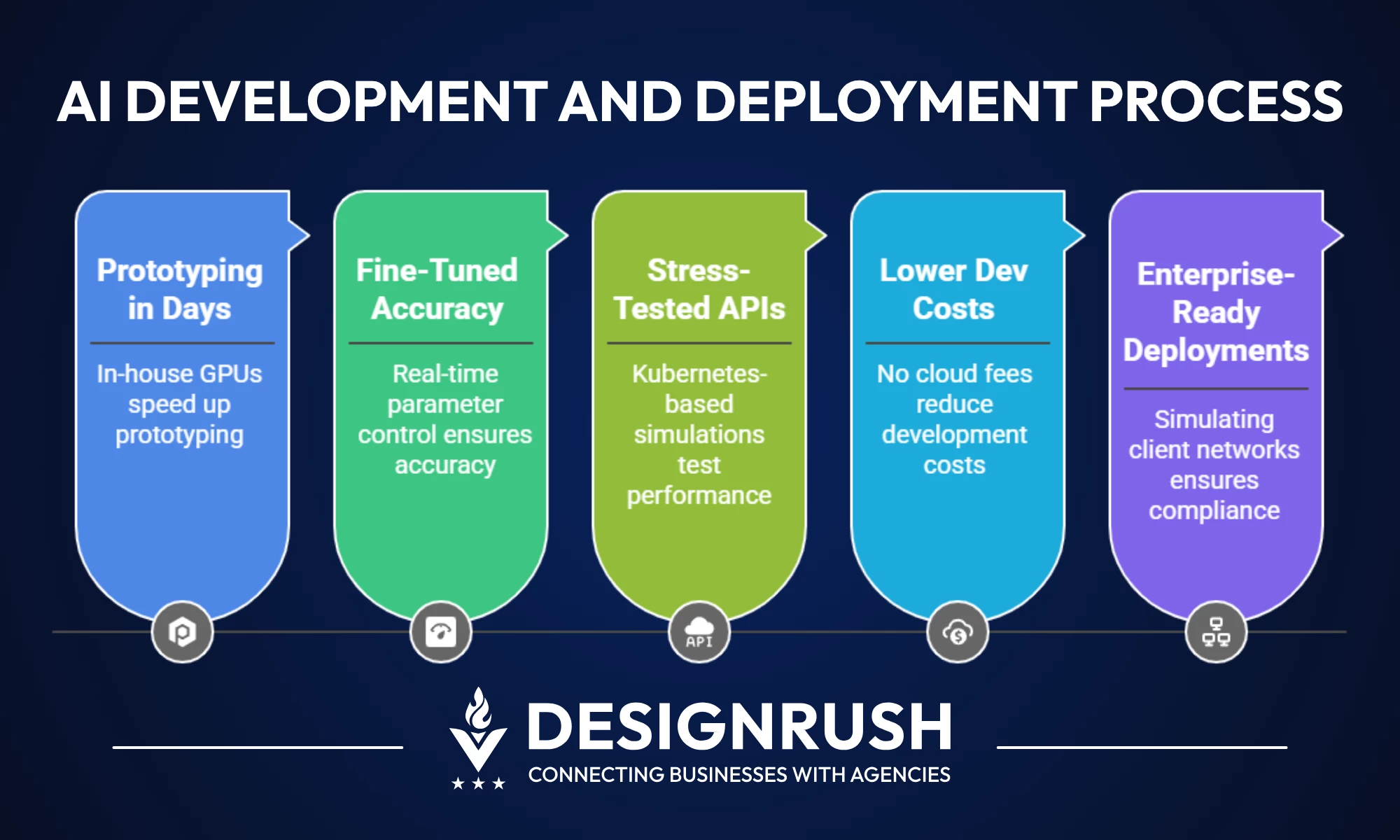
These five capabilities reduce timelines and costs, boost precision, and minimize risk to turn AI potential into real client value:
Editor's Note: This is a sponsored article created in partnership with Unico Connect.
1. Faster Prototyping & Time‑to‑Market
Unico Connect’s on-premises AI Lab, equipped with high-performance NVIDIA RTX 5090 GPUs and 96 GB of RAM, removes the delays common in cloud-based experimentation.
Teams can run tests as soon as ideas emerge, turning whiteboard concepts into working prototypes within days.
“AI experimentation requires agility, speed, and flexibility,” said Malay Parekh, CEO at Unico Connect.
Parekh explains that unlike traditional app development, AI doesn’t follow a set path. The Lab gives teams a powerful, controlled environment to test, fail, learn, and optimize—without cloud-related delays or cost constraints.
For business leaders, this speed translates into faster go-to-market cycles, early visibility into what’s working, and fewer costly missteps.
By keeping infrastructure in-house, the lab also eliminates cloud GPU metering fees during R&D.
That means more experimentation at a lower cost, making AI innovation not just faster, but financially viable.
2. Precision Through Experimentation
AI development is an exercise in iteration, and control makes the difference between generic output and business value.
With in-house access to models like Llama and Mistral, Unico Connect can fine-tune AI systems directly against client data, adjusting parameters in real time for better relevance and accuracy.
That level of control translates into outcomes that align with operational goals.
Keeping the lab environment on-prem also shortens the feedback loop.
Developers test and deploy updates within the same system, speeding up iteration and increasing the chances that AI systems meet performance benchmarks right out of the gate.
3. Scalable, Real‑Time API Testing
AI systems should be accurate and perform under pressure.
Exposing every model through REST APIs and testing them in a Kubernetes-powered environment simulates real-world traffic before anything goes live.
Developers can run load tests in parallel, monitoring latency, throughput, and error rates under realistic conditions.
4. Lower Experimentation Costs
Cloud GPU costs can spike quickly during AI development.
With direct access to on-premises hardware, teams can prototype freely by testing different models, refining pipelines, and iterating fast while avoiding metered cloud costs.
5. Simulating On‑Prem Deployments for Enterprise Clients
Data can’t always live in the cloud. While on-prem infrastructure is a requirement, it often comes with hidden friction.
Unico Connect’s AI Lab helps surface those issues early by replicating real-world network conditions, security layers, and firewalls.
That means no post-launch surprises, no backtracking to meet policy, and no delays in deploying AI.
It’s a risk-reduction strategy that keeps innovation on track while staying within regulatory boundaries.
Speed, precision, resilience, cost efficiency, and compliance are no longer nice-to-haves. They are the baseline for AI that performs.
“Our in-house AI Lab is fundamental to transforming AI from experimental technology into a reliable business asset,” said Parekh.
“By replicating deployment environments early, we reduce risk and accelerate compliance.”
According to Parekh, this isn’t just a safeguard — it’s a strategic advantage that helps teams deliver AI that’s faster, more predictable, and aligned with business goals.
An in-house AI Lab turns these into real business outcomes. Teams validate ideas quickly, fine-tune performance under real-world conditions, and stress test at scale before launch.
That means fewer surprises, tighter control over costs, and no compromise on data privacy.
This is not about experimentation for its own sake. It is about building AI that works on budget, on time, and under pressure.