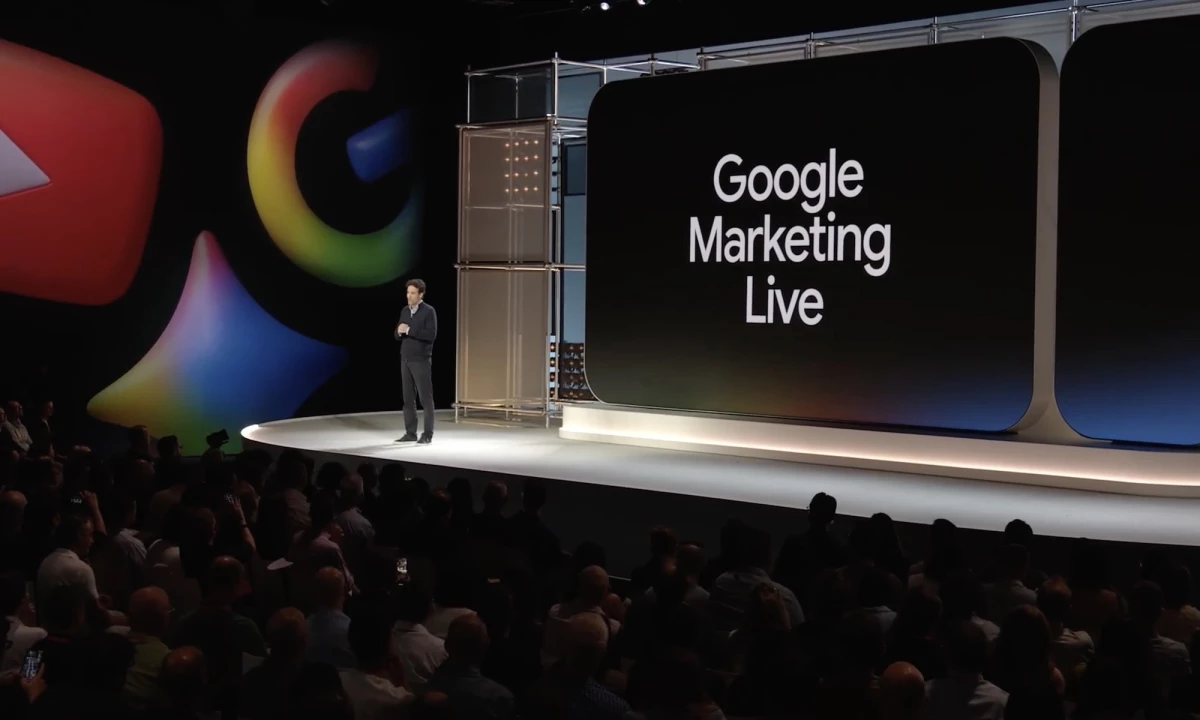

Google held its annual Marketing Live event on May 20, and the announcements confirmed something agencies have been anticipating for the better part of two years.
Gemini is no longer a feature running inside Google's ad products, but is now the operating layer underneath all of them.
This week's keynote made clear how far the integration has gone.
🚨 This is it! The 24-hour countdown to Google Marketing Live is ON! 🚀
— Google Ads (@GoogleAds) May 19, 2026
Don't miss your chance to learn why the Gemini advantage is YOUR ultimate competitive edge, straight from the industry visionaries and Google leaders making it happen. 🔥 Catch the latest tomorrow and enjoy… pic.twitter.com/hkkHehvoME
The keynote covered five interconnected areas.
Key updates included a unified AI agent called Ask Advisor, conversational ad formats built for AI Mode in Search, and major updates to Asset Studio's creative tools.
It also announced expanded agentic commerce infrastructure and a reimagined measurement suite built around Google Analytics 360 and Meridian.
Taken together, the announcements describe a platform where campaign execution is increasingly handled by AI.
👋Meet AI Brief, the control you’ve been asking for.
— Google Ads (@GoogleAds) May 20, 2026
Use your words to steer AI Max so it follows your brand, messaging, and matching guidelines. #GML2026pic.twitter.com/UvqhTKU1uI
It also highlighted how the agency's role is moving toward the quality of inputs it provides.
For any team that has not yet thought seriously about what this means for their operating model, the conversation is overdue.
The End of Platform-Hopping
The biggest announcement for agency workflows is Ask Advisor.
It is a unified Gemini-powered agent that connects Google Ads, Google Analytics, Merchant Center, and Google Marketing Platform into a single interface.
We’re moving from a family of agents to one Ask Advisor.
— Google Ads (@GoogleAds) May 20, 2026
INTRODUCING: Ask Advisor built with Gemini capabilities
Soon you can collaborate seamlessly across a range of Google marketing products. #GML2026pic.twitter.com/KKtJYX1kXZ
Until now, Google has maintained separate advisory tools across its products.
Ask Advisor consolidates them into one continuous agent that can move across platforms without the user switching tabs or rebuilding context.
Speaking at a virtual press briefing ahead of the event, Google VP of Global Ads Dan Taylor described how the AI agents communicate across platforms.
"On the back end, our agents talk to one another and carry each other's content, creating a continuous thread of intelligence," he explained.
In practical terms, a team could ask Ask Advisor to pull product details from Merchant Center, identify a new audience segment using Analytics data, and launch a Google Ads campaign from a single prompt.
Users can also compile a cross-platform performance report without manually pulling from each platform.
Ask Advisor is currently in beta for English-language accounts globally, and the implications for agency resourcing are direct.
What used to take a specialist an hour of platform-hopping now happens in a single prompt, leaving more room for the work that actually requires human judgment.
A Different Kind of Search
AI Mode has now surpassed 1 billion monthly users, with queries more than doubling every quarter since launch and averaging three times the length of traditional searches.
According to Google, 75% of people say they make faster, more confident decisions using the platform.
To meet this behavior, Google has announced three new ad formats built with Gemini:
- Conversational Discovery ads that answer a user's specific question with tailored creative
- Highlighted Answers that surface relevant ads within AI Mode recommendation lists
- AI-powered Shopping ads that generate a custom explainer for why a specific product suits a user's search
Direct Offers is also expanding, adding AI-generated product bundles, native checkout, and travel deals directly inside results.
AI Max for Search is also adding AI Brief, which lets agencies guide the system with brand tone and messaging requirements.
Meanwhile, Google is sunsetting Dynamic Search Ads in September and consolidating this functionality into AI Max.
This shift has direct creative implications.
Ad copy written for short keyword queries won't perform the same way when people are asking detailed, multi-sentence questions, and agencies need to brief for full questions.
A user asking which campaign management platform works best for a mid-size eCommerce brand, for instance, expects an ad that speaks to this situation directly.
Search strategy now has to account for AEO alongside SEO, optimizing for being the answer an AI platform actually serves up.
Creative at Scale
Asset Studio has been upgraded with multimodal Gemini-powered creative generation.
This allows advertisers to use natural language prompts to generate image and video assets directly from brand guidelines.
Gemini Omni also now supports video workflows and 1-Click Creative Testing, handling asset optimization.
Asset Studio now connects to external design tools, centralizing the workflow so teams do not need to move assets across platforms to get them into campaigns.
For agencies that sell on the strength of their creative, the more pressing question is what happens when clients can generate assets themselves with just a prompt.
The ones that survive will be the ones whose creative judgment, briefing, and brand understanding can't be replicated by a prompt.
The Commerce and Measurement Overhaul
Google expanded its Universal Commerce Protocol to new verticals alongside a Universal Cart that works across all of Google's shopping surfaces.
UCP also now extends into Demand Gen campaigns, YouTube Shopping ads, and AI Mode experiences.
AI Max for Shopping generates dynamic ads from Merchant Center feeds to capture conversational queries.
Demand Gen is also expanding into Google Maps for location-intent audiences, and Google is introducing AI-assisted creator discovery tools for YouTube partnerships.
On measurement, Meridian is being integrated directly into Google Analytics 360 alongside Meridian GeoX and Meridian Studio.
Meridian GeoX lets teams run geo-based experiments to test what media is driving results.
Meridian Studio makes these models accessible to non-technical teams, while Qualified Future Conversions ties early brand signals to predicted long-term revenue.
This gives agencies a way to make the case for upper-funnel investment with data that connects to downstream revenue.
For retail and eCommerce clients, product feed quality is becoming a visibility question that sits upstream of optimization entirely.
On top of this, a product not structured for AI interpretation may not surface in agentic shopping flows, regardless of bid levels.
For agencies working out where to focus first, a few priorities stand out across the announcements:
- Audit your clients' product feeds now: How a product is structured in a feed now directly affects whether it appears in AI-driven shopping results at all.
- Test Ask Advisor as soon as your account has access: The time saved on cross-platform reporting and audience research is where the immediate operational value is.
- Revisit your search creative briefs: AI Mode queries are running three times longer than traditional searches, and copy written for short keywords will underperform in this environment.
The window to get ahead of these changes is still open, but this week's announcements suggest it will not stay that way for long.
Our Take: What Does This Mean for the Agency Model?
We think GML 2026 is the biggest signal yet that the search giant is rebuilding its ad platform around a different assumption about what agencies are for.
Execution is increasingly automated, and the value agencies provide now lives in what they bring to the AI.
This includes first-party data, clean product feeds, strong creative briefs, and measurement frameworks that give the AI something real to optimize against.
Google has been pointing this way for several GML cycles, and this year's keynote confirms that it has arrived.
The agencies best placed for what comes next are those that have already built their practice around data quality, creative strategy, and measurement.
The advertising announcements at GML also arrived days after Google's I/O event, where the company also unveiled a major overhaul of Search itself.
Agencies moving into AI-powered campaign management need partners who understand how to build the data infrastructure these platforms now depend on.
Take a look at these top AI development companies in our directory.