
Google AI Mode Personalization: Key Findings
- AI Mode now reaches 75 million daily users, proving it’s a permanent feature of search and urging brands to treat it as core infrastructure, not a test.
- Personalization features are in internal testing, giving marketers a limited window to align content with the behavioral signals AI will soon prioritize.
- AI is shifting from retrieval to assembly, meaning brands must build structured, trustworthy content that’s ready to be cited.
Google’s AI Mode is steadily reshaping what search looks like. The next era won’t resemble traditional SERPs with their familiar list of blue links.
Instead, it will feel more like a tool that already knows you, serving highly specific, personalized results you didn’t have to explain.
According to Irina Shvaya, Founder at full-service marketing firm, eSEOspace, users are already adjusting to their habits even before these features are fully rolled out.
“The question now is less about when personalization will launch and more about who will be ready when it does,” says Shvaya.
For brands, this is a strategic grace period and a rare chance to act before AI personalization becomes the norm and rewrites the rules of search.
Editor's Note: This is a sponsored article created in partnership with eSEOspace.
AI Mode: The Adoption Curve No Brand Can Afford to Ignore
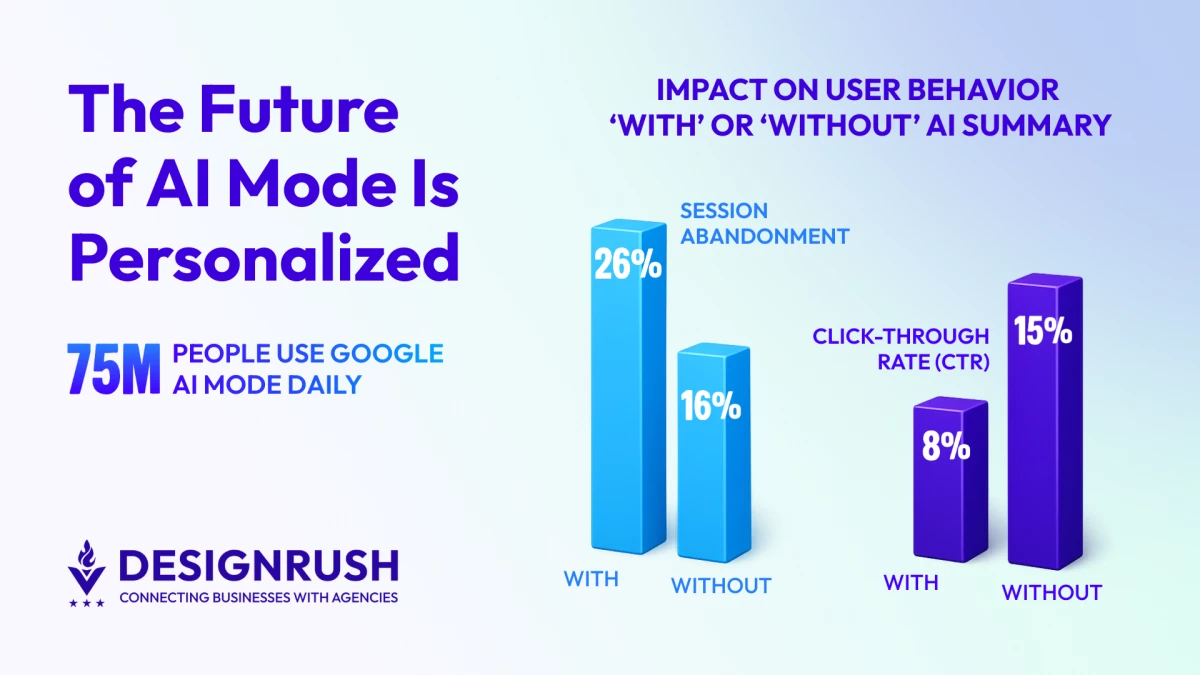
According to Google’s SVP of Knowledge, Nick Fox, the feature now supports roughly 75 million daily active users worldwide.
This level of scale signals permanence and a technology that’s no longer about experimentation.
In fact, it’s already becoming core to how people search. And recent data reported by Search Engine Land shows just how much behavior is changing:
- AI summaries now appear in about 18% of all Google searches, showing how integrated they’ve become
- Click-through rates on traditional results drop from 15% to around 8% when summaries appear, as users rely more on AI-generated answers
- Session abandonment rises to 26% after users see an AI summary, compared to 16% without one, suggesting many get what they need without further exploration (Source: PPC Land)
“What these numbers reveal is important,” adds Shvaya.
“Search journeys are evolving from quick retrievals to immediate answers, but with less direct engagement.
This means brands must rethink how they create content, focusing on trust and clarity to remain visible in a landscape where users may never click through.”
AI Mode is expanding the way users consume information, not just shrinking the path to websites.
Brand content now has to compete not just on ranking, but on credibility and AI-readiness.
Building on this trend, eSEOspace outlined exactly how brands can structure their websites to stay competitive in an AI-dominated search landscape:
What Google’s “Personal Context” Will Unlock Next
The personalization layer promised at Google I/O was never meant to be cosmetic.
It was pitched as a fundamental upgrade for AI Mode to draw from a user’s search history.
It may also incorporate data from connected Google products, like Gmail, to reduce friction and improve relevance.
While Google has confirmed that these personal context features are not live publicly yet and remain in internal testing, the official public rollout date is inevitably pending.
“The implications of this are massive,” says Shvaya.
“Once personal context is activated, AI will stop responding just to queries. It will start responding to people, informed by patterns, preferences, and intent layers that brands currently don’t structure content for.”
Rethinking Search Content for a Context-Aware Future
Right now, AI Mode works without the benefit of user-specific personalization. But that limitation is temporary.
What it’s already exceptionally good at is pulling insights from structured, comprehensive, and clearly segmented content.
“We’ve seen that the search environment is moving toward systems that assemble answers instead of simply retrieving them,” says Shvaya.
To this end, brands that give AI content it can confidently use will outperform those still creating content it has to interpret.
Here are four expert-led tips for making this happen:
1. Understanding Audiences the Way AI Eventually Will
Personal context won’t reward generic content. It will reward content that aligns cleanly to distinct audience intent layers.
That means brands need a clearer picture of the problems each segment is trying to solve.
Not just their demographics, but their motivations, anxieties, comparison habits, and decision triggers.
This is familiar territory for PR teams, audience strategists, and editors, but new territory for legacy SEO content systems.
2. Breaking Content Into Pieces, Not Pages
AI doesn’t read as humans do. It assembles.
Content that works best for intelligent search systems is modular, logical, self-contained, and context-rich.
That includes:
- Clear headings that reflect real questions, not keyword variations
- Definitions, summaries, and facts are placed early
- Supporting data structured for quick extraction
- Markup that confirms meaning, not just mentions terms
The goal is simple.
Make your content easy for AI to borrow from, not easy for users to bounce from.
3. Trading Keyword Targeting for Intent Mapping
The future of search will categorize content by purpose, not just phrasing.
Brands should be creating content ecosystems that cover multiple intent clusters, such as:
- “Help me understand this.”
- “Help me compare this.”
- “Help me decide this.”
- “Help me trust this.”
A strategy like this future-proofs content without over-optimizing it.
4. Making Trust the Anchor of Your Search Strategy
If users don’t rely on AI summaries alone, it’s because they don’t fully trust them yet.
When personal context launches, the AI will lean toward sources that already demonstrate credibility.
Right now, reviews, authoritative references, and clear sourcing are already central to user decision-making, especially in transactional searches.
That behavior will eventually shape AI trust models, too.
Early movers are adjusting their strategies accordingly.
At eSEOspace, that’s meant moving away from keyword-first strategies and focusing instead on what AI is starting to reward.
“It’s not just about what you say, but how confidently AI can pull from it,” says Shvaya.
“In other words, structure, clarity, and external credibility are becoming non-negotiable.”
That shift, for example, is even more visible with the rollout of Gemini 3 in Google Search.
With dynamic layouts, simulations, and interactive tools now integrated, Gemini brings a generative, reasoning-driven experience that relies on well-structured, clearly categorized content AI can confidently use:
Act Now Before AI Sets the Terms of Engagement
Brands that still think search content is built for algorithms alone are optimizing for a world that’s already fading.
“The delay in personal context isn’t slowing AI search; it’s accelerating the need for better content foundations,” explains Shvaya.
“It’s giving brands time to rethink structure, intent, credibility, and audience alignment before personalization adds rocket fuel to relevance.”
And right now, that runway is open, but it won’t be for long.
Build the Content That Won’t Confuse AI Later
Google’s AI Mode is scaling fast, and its personalization layer is on the way, even if it’s not live publicly yet.
The smartest brand response isn’t to treat this like a waiting period, but like a warning shot.
As such, search is quickly becoming:
- Less about retrieval
- More about assembly
- Less about phrasing
- More about intent
- Less about ranking alone
- More about being trusted
“The brands that move first won’t just survive the AI revolution, they’ll define it. The question is, will yours be one of them?” says Shvaya.