
Google is putting more paid search decisions in the hands of AI.
New search campaigns now have AI Max switched on by default, according to Google Ads' setup documentation.
That shift is also reaching existing campaigns.
Throughout September 2026, Google is automatically upgrading search campaigns that use campaign-level broad match or standalone Automatically Created Assets.
The company's August migration update says the rollout ran from September 1 through September 30.
Dynamic Search Ads were originally included, but Google has pushed their automatic migration to February 2027.
The bigger change is what AI Max can control when its full feature set is enabled.
It can expand beyond existing keywords to find additional searches, generate new ad copy, and use Final URL Expansion to choose the page it believes best matches a user's query, according to Google's AI Max documentation.
In fact, non-retail advertisers that activate AI Max typically see 14% more conversions or conversion value at a similar CPA or ROAS, based on Google's internal 2025 data.
However, independent results are more mixed.
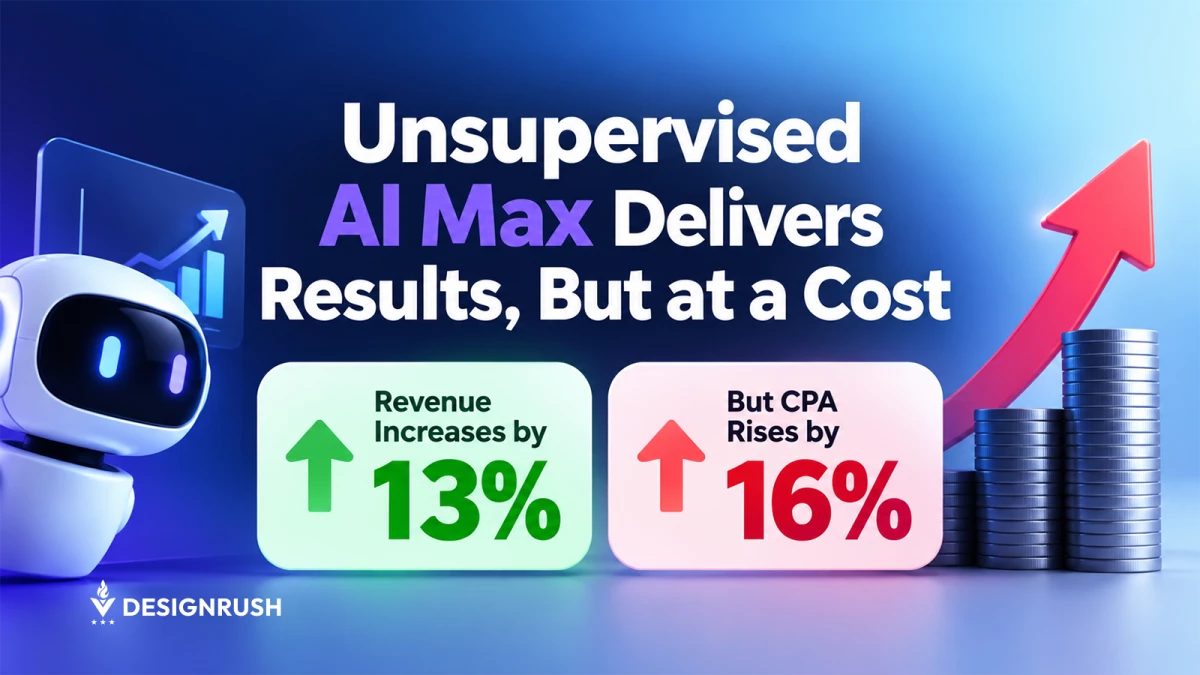
A March 2026 Smarter Ecommerce analysisof more than 250 retail-centric AI Max campaigns, reported by Search Engine Land in March, found median revenue rose 13%.
This sits very close to the 14% increase in conversions and conversion value that Google claims for non-retail campaigns.
And while this seems impressive at first glance, a closer look reveals the impact is essentially a “coin flip.”
The ones most likely to move to AI Max are teams that have already created optimized campaigns using previously available tools like Broad Match and Dynamic Search Ads.
Yet, both AI Max and previous tools achieve roughly the same 14% by Google's own metrics.
So if the net median ROAS impact of transitioning to AI Max is 0% and only 22% of campaigns landed near their original ROAS targets, is the tradeoff actually worth it?
For Disruptive Advertising Head of Marketing, Chad de Lisle, this scenario can quickly introduce problems.
“AI Max can expand what a campaign is able to find, create, and serve, but that added automation also expands the number of ways performance can move away from the advertiser’s original intent,” he says.
“The more decisions Google makes on a campaign’s behalf, the more important it becomes for advertisers to understand what is changing and whether those changes are actually improving business outcomes.”
More Reach Can Mean More Expensive Growth
AI Max is built to search beyond the demand advertisers have already identified.
Its search term matching combines broad match with keywordless technology and signals from existing keywords, creative, and URLs to find additional relevant queries.
That can uncover demand a traditional keyword setup would miss.
But it can also spend more aggressively inside territory an advertiser already covers.
The same Smarter Ecommerce analysis found AI Max recycled existing broad-match coverage up to 63% of the time instead of consistently finding new queries.
In one account, competitor brand terms grew to 69% of total search impressions.
Neither result makes AI Max inherently wasteful. They show why more reach and incremental growth are not the same thing.
A search can be relevant to the business without being commercially valuable, and a higher conversion count means less if the next customer costs substantially more to acquire.
If every form submission carries the same value, the system has little reason to distinguish between a lead sales wants and one it never wants to call.
Disruptive Advertising has made the same argument around automated advertising more broadly.
As de Lisle previously discussed in his analysis of AI-driven lead generation, optimizing for cheap CPL can push automated ad platforms toward low-intent volume instead of customers more likely to generate revenue.
AI Max gives Google more freedom to find conversions. That makes defining the right conversion more important, not less.
AI Can Scale the Wrong Message Too
The same issue extends beyond targeting.
AI Max's text customization feature can generate additional headlines and descriptions using an advertiser's domain, landing pages, existing ads, and keywords.
Google says the feature combines generative AI with existing campaign content to create ads for specific searches, according to its text customization documentation.
But a message that earns more clicks is not necessarily attracting better prospects.
Paid search expert Brad Geddes tested AI Max's automated copy across ecommerce, B2B, and B2C campaigns in a July 2026 analysis published by Search Engine Land.
The B2B result was particularly telling.
The automated messaging attracted more B2C searchers instead of properly qualifying the intended business audience.
After three weeks, performance was poor enough that the company stopped the test, returned to pinned ads, and removed the auto-created assets.
That is a much more expensive problem than writing mediocre copy.
An ad can appear successful at the top of the funnel while making the traffic underneath it worse.
And once the platform is simultaneously expanding targeting and generating the message, those two effects can compound.
Google's Guardrails Still Need a Human
AI Max does not take every control away from advertisers.
Marketers can still use negative keywords, brand controls, URL exclusions, and individual settings for search term matching and asset customization.
Google's AI Max setup guide also allows advertisers to switch individual features on and off rather than treating the system as an all-or-nothing product.
Even September's automatic migration preserves some existing boundaries.
For campaigns moving from campaign-level broad match, Google says Search Term Matching will be enabled while Text Customization and Final URL Expansion remain off.
Campaigns migrating from Automatically Created Assets will keep Text Customization and Search Term Matching on, while Final URL Expansion remains off. Google outlined those migration settings in August.
The controls are still there. The question is whether anyone is using them.
For Disruptive Advertising, marketers need to keep checking whether expanded searches carry real buying intent, whether generated messaging attracts the right customer, and whether additional conversions hold up against acquisition costs and revenue.
That changes the media buyer's role.
There is less value in manually controlling every possible search variation when Google can process signals and test combinations at a scale no human team could match.
The human advantage is knowing where to draw the line.
Google can decide which auction looks promising. It can test more queries and creative combinations than a media buyer ever could.
But it cannot decide what a customer is worth to the business. That is the guardrail marketers cannot automate away.
Want to assess how your current ad campaigns are performing? Request a free audit to identify opportunities to improve your campaigns.