
Go-to-Market Planning (GTM): Key Findings
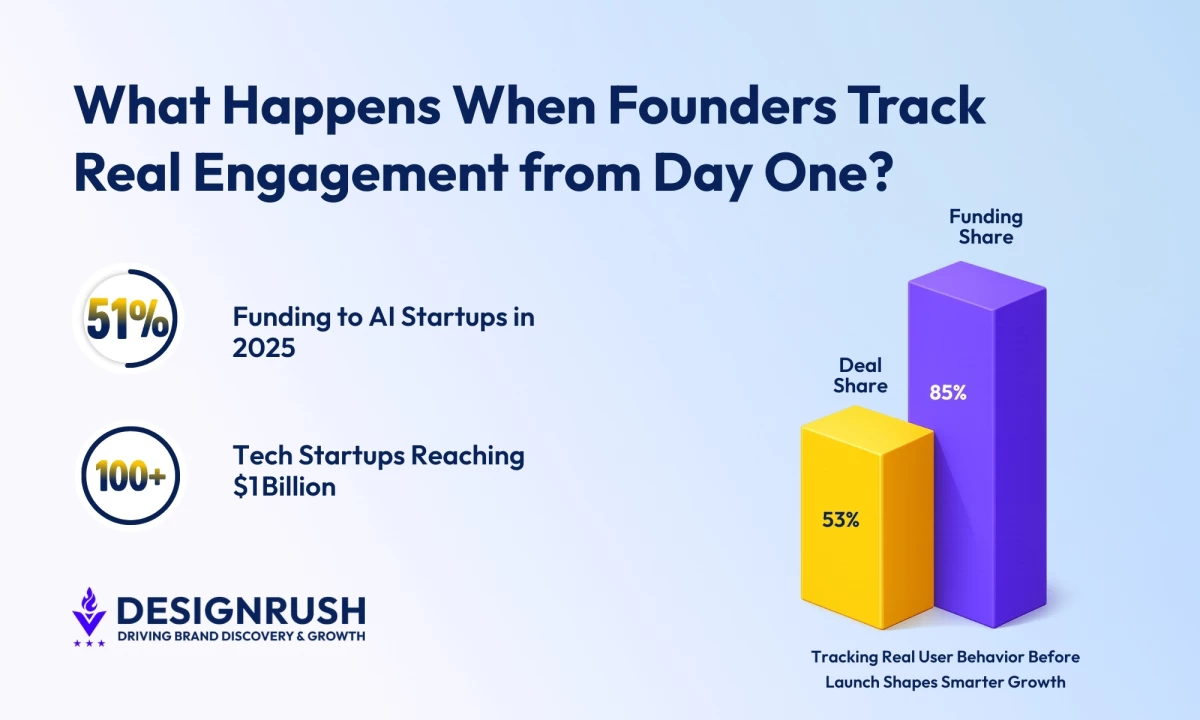
- 51% of global VC funding in 2025 went to AI startups, showing founders should track early signals in high-demand sectors to attract funding.
- Tracking real user actions before full launch guides, which features, pricing, and messaging to prioritize.
- Combining product development with GTM planning from day one gives clear adoption insights for smarter growth.
Unicorn valuations are reported every week.
In 2025 alone, more than 100 tech startups reached $1 billion valuations (nearly two per week), according to reporting by TechCrunch.
This level of competition means founders cannot mess around with their go-to-market strategy in 2026.
Why? Because it’s often the make-or-break factor, no matter how strong the idea.
“Planning how to introduce the product, gather evidence of demand, and refine the offering before launch shapes early momentum,” says David Barlev, co-founder and CEO of leading software development and digital product agency Goji Labs.
Barlev works with startup teams on this exact problem and believes a sophisticated product must connect to real interest from real users, or else it risks failure.
Unicorn status signals investor interest.
For example, Belgium-based startup Aikido Security reached its $1 billion valuation earlier this year after showing sustained revenue growth across multiple enterprise customers, Reuters reports.
Unicorn valuations, funding rounds, and market signals appear in the news almost daily. For many startup teams, turning that attention into actual product use is still a challenge.
Editor's Note: This is a sponsored article created in partnership with Goji Labs.
Go‑To‑Market Planning Defined
A go-to-market (GTM) plan shows how a startup will get a product in front of the people who will actually use it.
UserMaven, a privacy-focused product and marketing analytics platform, frames it as choosing target segments, channels, messaging, pricing, and ways to test whether real users are interested and engaging early.
That work begins as soon as a team has an idea and starts talking to potential users.
When go-to-market planning happens alongside product work, teams can see how people actually use the first version.
Those observations guide choices on features, pricing, and messaging before opening things up to more users.
At Goji Labs, this planning starts small and coordinated, long before a wide release.
The agency helps founders:
1. Define the core user with clear signals of interest
The initial user group should show clear interest in the problem being solved.
Teams should watch who’s using the product, what they do, and what feels useful to them.
2. Build a lean minimum viable product (MVP)
A lean MVP includes the functionality needed to address the core problem.
Early versions are released to observe how users interact with the product.
3. Run controlled experiments
Beta programs, limited pilots, and targeted launches allow teams to observe user behavior.
These efforts produce usage data that informs product decisions.
4. Capture user data and refine
Analytics, surveys, and usage tracking show patterns of adoption and retention. Teams update the product based on observed engagement.
The same types of early signals often surface later in how investors evaluate and fund high-growth startups.
Evidence From 2025 Unicorns
In its 2025 roundup, TechCrunch spotlighted Unconventional AI, valued at $4.5 billion, and Luma, valued at $4 billion.
Investors clearly liked what these startups were building.
As a result, unicorn data now serves as a reference point for assessing early progress.
The Economic Times reported that AI startups attracted more than half of all global venture capital in 2025, capturing around 51 % of total investment.
U.S. AI startups led the way, accounting for about 85 % of the funding and 53 % of deals.
So, with investors pouring money into AI, startups need to see early if their product is working.
Goji Labs helps teams track user actions that show value, like signing up, returning, completing tasks, or making purchases.
The trick is getting this right from the start.
In an interview with DesignRush, Barlev outlined how startup teams often misprioritize feature breadth over user validation, assuming they know what users want without putting it in front of them.
“A great MVP gives you real feedback from real users, so you’re building what people actually want, not just what you think they want,” he said.
Barlev’s point shows why startups need a structured approach to go-to-market work.
The next steps outline how teams can plan early actions that generate real user insights.
Key Steps for Smart GTM Work
Make planning part of product development. Goji Labs recommends these foundational steps:
- Choose a group that’s most likely to use the product. Note what they do and the value they gain from it.
- Connect while the product is still taking shape. Conduct interviews, surveys, or test prototypes.
- Build only what proves value. Keep feedback loops tight. Skip features that haven’t shown a clear impact.
- Set up simple tracking from day one. Look at actions that show interest, repeated use, or retention. Let real behavior, not assumptions, guide tweaks to features and messaging.
- Start small. Test, adjust, and expand slowly.
Tracking early users, testing prototypes, and seeing what actually gets used shows what matters.
That insight helps shape features, messaging, pricing, and how the product is rolled out.
Teams that combine product development and GTM planning from day one get data that actually shows where value exists and how adoption grows.
Applying GTM Planning in 2026
Unicorn valuations and sector trends give context, but they don’t show what users actually want.
Goji Labs advises tracking early actions like sign-ups, returns, task completion, or first purchases to guide product decisions.
How do founders know which changes matter most?
- They watch what users actually do and adjust features, pricing, and messaging based on that.
- They keep notes on how people use the product so investors can see who the first users are and what they value.
- They plan as they build, checking where people find value and how adoption grows.
For agencies and brands, keeping an eye on real behavior helps shape smarter product and marketing decisions.
Starting this work early makes it clear what works, what needs tweaking, and how to show real user interest.