
EU GDPR AI Privacy Framework Changes: Key Findings
- Responsible data handling is a competitive advantage, because consumer trust strongly influences AI adoption and long-term loyalty in regulated markets.
- EU enterprises use AI unevenly, with adoption growing steadily but lagging in smaller firms due to compliance and resource constraints.
- GDPR reforms will reshape consent and AI data use, pushing developers to strengthen governance, not weaken it, as AI innovation accelerates.
Nearly ten years after GDPR became the world’s most influential privacy framework, the EU is rewriting parts of its digital playbook to better accommodate AI development.
The European Commission’s proposed Digital Omnibus package aims to streamline consent requirements, clarify what qualifies as personal data for AI training, and delay strict obligations for high-risk AI systems.
For developers and enterprise teams integrating AI into digital products, these changes mark a pivotal moment, accelerating innovation while tightening expectations around governance and accountability.
“These reforms don’t weaken Europe’s data protections,” says Malay Parekh, CEO of Unico Connect, a leading global software development firm.
“By clarifying training data use and simplifying compliance, the EU aims to ease innovation without compromising trust.”
Firms like Unico Connect, which operate at the intersection of AI development and data architecture, are already adapting their technical strategies to meet evolving standards.
With 11+ years of experience and more than 300 digital products delivered, the team focuses on helping clients stay ahead of EU regulations, particularly where AI, data infrastructure, and data compliance converge.
“Europe wants to compete globally in AI, but not at the expense of privacy,” Parekh says.
“The message from regulators is clear: the future belongs to organizations that scale responsibly, document rigorously, and treat data protection as strategy, not a speed bump.”
The video below outlines how the EU plans to simplify digital regulation while updating GDPR rules that affect AI development and data use.
Editor's Note: This is a sponsored article created in partnership with Unico Connect.
How Data Reveals the Real Barriers to AI Scale
While AI adoption is quickly accelerating on a global scale, privacy concerns remain a deterrent for many.
This is particularly relevant in the EU, where regulation, consumer perception, and business risk converge.
“To understand the stakes for AI developers now and in the future, it helps to zoom out from policy language and focus on adoption patterns,” Parekh says.
While lawmakers are attempting to simplify certain consent mechanisms, the broader data ecosystem shows that privacy expectations are not softening, but are evolving into a business imperative.
The adoption of AI technologies in Europe points to a technology that is slowly materializing across organizations.
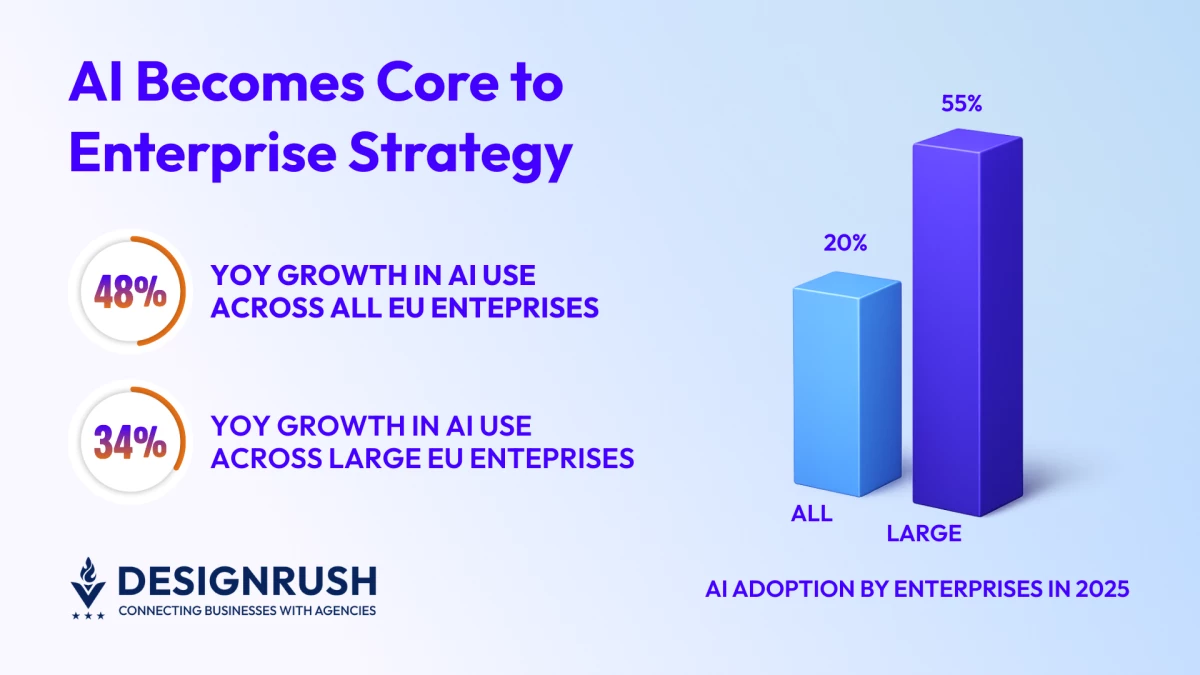
But according to Eurostat, deployment is accelerating much faster among large enterprises:
- 20% of EU enterprises used AI in 2025, up from 13 % in 2024 (YoY growth of nearly 48%), showing growing but still emerging adoption across sectors.
- 55% of large EU enterprises used AI in 2025, up from 41% in 2024 (YoY growth of nearly 34%), demonstrating that bigger organizations lead in AI maturity and deployment.
Despite enterprises harnessing the potential of AI, global data suggests that consumer trust remains scarce, as the following numbers show:
- 68% of global consumers are somewhat or very concerned about their online privacy, reflecting widespread trust issues with digital data handling.
- 71% of consumers globally would stop doing business with companies that mishandle their data, proving data governance’s impact on commercial success.
These figures are evidence that while AI innovation may be scaling, trust remains the adoption bottleneck.
Key Reforms in the GDPR and AI Landscape
The European Commission’s “Digital Omnibus” proposal signals a pragmatic shift.
It acknowledges the economic importance of AI while aiming to reduce compliance friction for both businesses and users.
The reforms touch on data classification for AI training, timelines for high-risk AI enforcement, and the UX of digital consent, aiming to replace exhaustion with clarity and process with practicality.
1. Clarifying AI Training Data Uses
Proposed changes could clarify when anonymized or pseudonymized datasets qualify under GDPR in ways that may allow broader use for AI training, subject to strict conditions.
2. Simplifying Cookie Consent
Cookie consent requirements are projected to shift toward broader, browser-level controls to reduce repetitive pop-ups without eliminating user choice.
3. New Deadlines for High-Risk AI Compliance
The enforcement timeline for high-risk AI obligations, originally expected in August 2026, could be extended through the end of 2027 or later, giving companies more runway to prepare.
“These proposals don’t weaken GDPR entirely but attempt to modernize it,” Parekh says.
“Still, organizations that use any personal or near-personal data for model training will need to ensure governance is airtight.”
Why Responsible AI Development Will Matter More, Not Less
While custom AI systems thrive on high-quality data, compliance risks can’t be ignored.
The companies exposed to scrutiny the most aren’t necessarily the most ambitious but the least prepared.
And in Europe, where privacy awareness is mainstream, organizations must demonstrate that innovation and data ethics are moving in lockstep.
As such, developers should treat the reforms as a cue to strengthen internal systems now.
“This consists of consent design, dataset audits, and documentation will increasingly influence market trust, procurement decisions, and brand reputation,” Parekh says.
Practical Steps to Stay Compliant and Trusted
As regulations evolve, Unico Connect advises organizations and developers involved in building AI systems to prioritize the following:
1. Privacy by design from day one
Bake data minimization, impact assessments, and processing purpose into product planning, not product patching.
“Start with privacy in architecture, not as a final checkbox,” Parekh says.
“It saves rework and builds trust into the product itself.”
2. Transparent and auditable consent frameworks
Consent is becoming less intrusive, but more strategic. Clarity beats cleverness every time.
3. Cross-functional alignment
Legal teams should understand training pipelines; developers should understand GDPR principles.
“Compliance isn’t a silo,” Parekh says. “It’s a conversation between engineers, lawyers, and product teams, early and often.”
4. Document everything
High-risk AI delays don’t excuse poor documentation; they increase the importance of proving responsibility when enforcement arrives.
“When regulators come knocking, your documentation tells the story of your intent,” Parekh explains.
“Good logs and change records are as critical as the code itself.”
The Real AI Edge? Building Responsibly at Scale
For organizations and developers, the EU’s GDPR reset cannot be seen as the finish line, but the starting gun.
And those who seize this moment won’t win by sprinting the fastest, but by running the smartest.
The digital landscape ahead belongs to companies that innovate without cutting corners, protect data without hiding from complexity, and build systems that users, partners, and regulators can trust.
“While AI progress is inevitable, trust, however, is still earned and will be the currency that separates leaders from laggards,” Parekh says.
“The brands that understand this now will be the ones shaping the ecosystem later, when personalization, data access, and AI enforcement rewrite the rules again.”