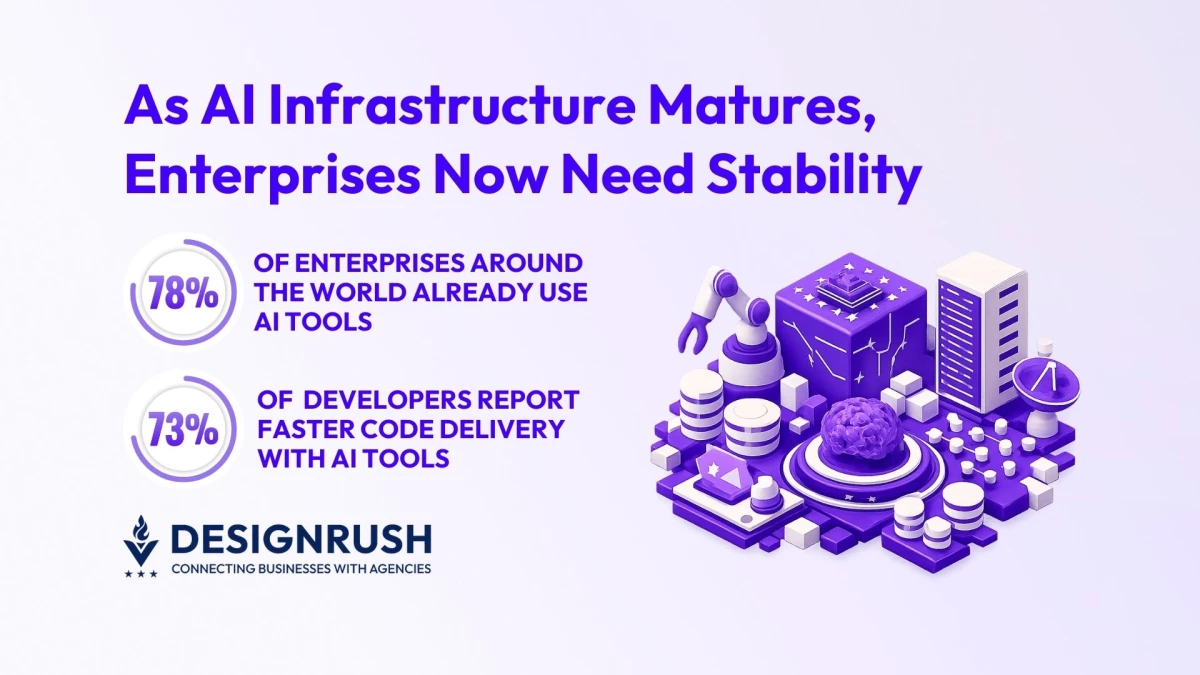

Growth of AI Infrastructure: Key Findings
- Nvidia’s $57B third-quarter revenue, up 62% year over year, confirms that AI infrastructure is no longer the limiting factor for adoption.
- With 78% of enterprises already using AI in 2025, early prototype-first approaches are colliding with real operational and regulatory demands.
- As 73% of developers report faster code delivery with AI tools, the real competitive risk shifts from speed to fragile, non-reproducible software systems.
Nvidia’s latest earnings offer a bright outlook for decision-makers looking to ride the AI wave.
In a recent third-quarter earnings report, Nvidia CEO Jensen Huang revealed that the company recorded $57 billion in revenue. This figure represents a 62% increase from the third quarter of 2024.
Huang attributed the growth to Nvidia’s data center business, which hauled in a record $51.2 billion, a 66% increase from 2024.
The numbers reinforce a truth that many have already accepted: AI infrastructure is here to stay.
Adoption metrics tell a similar story.
According to a report from Hostinger, 78% of enterprises had already adopted AI technologies in 2025.
On the engineering side, 73% of developers report faster code delivery using ChatGPT, per OpenAI.
While the numbers certainly signal opportunities for many enterprises and AI software developers, it also presents a few challenges.
For many organizations, early AI success came from moving fast, shipping prototypes, and proving feasibility.
However, leading enterprise AI software developers like Unico Connect warn that such a mindset worked when expectations were low and use cases were limited.
“Early AI wins trained teams to optimize for speed and proof, not durability,” said Unico Connect CEO Malay Parekh.
“That approach works when models are isolated and optional. It breaks down the moment AI becomes operational, regulated, or revenue-bearing. At that stage, software discipline matters more than novelty.”
When Infrastructure Stops Being the Problem
Nvidia’s performance confirms that compute is no longer the bottleneck.
The question enterprises and software developers must now face is whether their custom AI systems are built to survive real-world pressure rather than just impress during demos.
Unfortunately, the rapid developments in the field of AI have led to three core issues:
- Faster experimentation cycles are compounding technical debt. Rapid iteration rewards short-term progress, but it often leaves behind fragile logic, undocumented assumptions, and dependencies that are difficult to unwind later.
- Reproducibility breaks down as models move into production. AI systems pushed live without disciplined versioning and environment controls become hard to explain, audit, or reliably replicate across teams and regions.
- Prototype-grade pipelines collapse under real-world pressure. Workflows built for demos struggle once they face sustained traffic, regulatory scrutiny, and integration with core enterprise systems.
When usage scales or market conditions tighten, brittle systems fail first.
They fail visibly, and they fail expensively.
“Speed is intoxicating,” Parekh said.
“But unreproducible pipelines and fragile architectures compound risk silently. When conditions change, those systems fail fast and publicly.”
What Disciplined AI Software Development Looks Like
With infrastructure confidence high, enterprises are being pushed toward an architecture-first mindset.
Experimentation still matters, but it can no longer drive the entire lifecycle.
According to Unico Connect, several practices are quickly becoming non-negotiable:
- Reproducible pipelines ensure models behave consistently across environments. Without them, teams cannot trust outputs, diagnose failures, or satisfy auditors when questions arise.
- Disciplined model lifecycle management brings order to constant change. Versioning, testing, and rollback procedures allow teams to improve models without gambling on production stability.
- Scalable architecture planning anticipates success instead of reacting to it. Systems designed only for current use cases struggle the moment adoption widens or data volumes spike.
- Clear separation between experimentation and production protects both sides. Innovation can move quickly without destabilizing systems that customers and regulators depend on.
Together, these practices shift AI from a collection of experiments into something closer to durable infrastructure.
Build Software That Can Handle Success
As AI becomes embedded in core operations, tolerance for fragile systems shrinks.
As such, the organizations that recognize this shift early and respond with discipline rather than speed alone will be the ones to find success early and often.
This means treating AI software as infrastructure, and investing in reproducibility, governance, and architecture before success forces the issue.
And while speed tends to impress people in the beginning, it’s stability that keeps the lights on.