
Meta's former ad chief, John Hegeman, is set to run a dating app that spent 2025 slashing its paid ads.
Bumble announced on October 13 that it agreed to be acquired by Ithaca Holdings in an all-cash deal valued at $1.3 billion.
Shareholders will receive $6.05 per share, a 138% premium to Bumble's unaffected closing price on October 9.
Ithaca Holdings co-founders Ravi Gupta and Hegeman will take over as Bumble's co-CEOs once the deal closes.
"People and societies will always need connection, relationships, love, and family, and we are excited to build on Bumble’s legacy and share its mission with the next generation of members," Gupta and Hegeman said in a statement.
Today, we’re sharing a meaningful moment in Bumble’s story: we have entered into an agreement to be acquired by Ithaca Holdings. This is a new chapter, but not a new mission. Bumble will continue to be driven by the same purpose that inspired us from the beginning. Find out more here: https://t.co/5oq4qVPucS
— Bumble (@bumble) October 13, 2026
Hegeman spent 17 years at Meta, ending as chief revenue officer before he left in November 2025 to start his own company.
Gupta is a Sequoia Capital partner who served as Instacart's COO and CFO from 2015 to 2019.
Founder Whitney Wolfe Herd, who returned as CEO in 2025, said she will stay actively involved with Bumble.
"As Bumble’s Founder, my belief in this company and its potential to positively impact people around the world has never been stronger.
That is why I will remain actively involved with Bumble," she said in the official announcement.
"I believe deeply in Bumble’s future, and I look forward to working alongside Ravi, John, and the Bumble team as we continue to innovate, create meaningful connections, and write the next chapter of Bumble’s story."
Wolfe Herd and Blackstone have already approved the deal through written shareholder consent, so it needs no public vote.
Bumble went public in February 2021 and peaked at over $14 billion in market value.
Its shares had since dropped over 90%, leaving a market value of about $389 million before the deal talks surfaced.
Gupta and Hegeman named Bumble's trusted brand and loyal community as its strongest assets.
Paying more than double the market price puts a number on brand equity that public investors had stopped valuing.
Marketing Spend Fell to 17% of Revenue
Wolfe Herd spent her first year back running what she called a quality reset, raising the bar for who gets onto Bumble.
Performance marketing fell well over 80% year over year as the company leaned on brand and organic growth.
Selling and marketing expenses dropped to $165 million in 2025, or 17% of revenue, down from $261 million a year earlier.
Bumble said registrations and active users stabilized despite the smaller budget.
Bumble pinned its comeback on "For the Love of Love," a global brand campaign it launched in August 2025 to rebuild trust in the app.
The push featured real couples who met on Bumble across OOH ads, podcasts, and invite-only Singles Nights in cities like New York and London.
Paying users still kept sliding, falling 16.4% to 3.2 million in the second quarter of 2026.
Revenue dropped 15.2% to $210.5 million over the same period.
Bumble then retired its signature rule on August 11, letting either person in a match send the first message.
The company cited a survey in which 66% of women said they prefer men to send the first message.
Two months later, Wolfe Herd's deal statement still described Ithaca as a partner that "believes in our women-first mission."
One of the co-CEOs inheriting this promise built his career in the paid channel that Bumble had just scaled back.
Hegeman joined Meta in 2007 as an engineering lead on its ads system and was running monetization across its apps by 2022.
A brand that knows how far organic demand stretches can measure every paid dollar against a real baseline.
Rebuilding a digital marketing budget from an organic floor lets a brand keep only the paid channels that outperform it.
Two-Thirds of Singles Stay Off Dating Apps
Only 33% of U.S. singles currently use dating apps, according to a February 2026 survey from The Harris Poll.
In the same survey, 72% of Americans said apps have made dating more transactional than romantic.
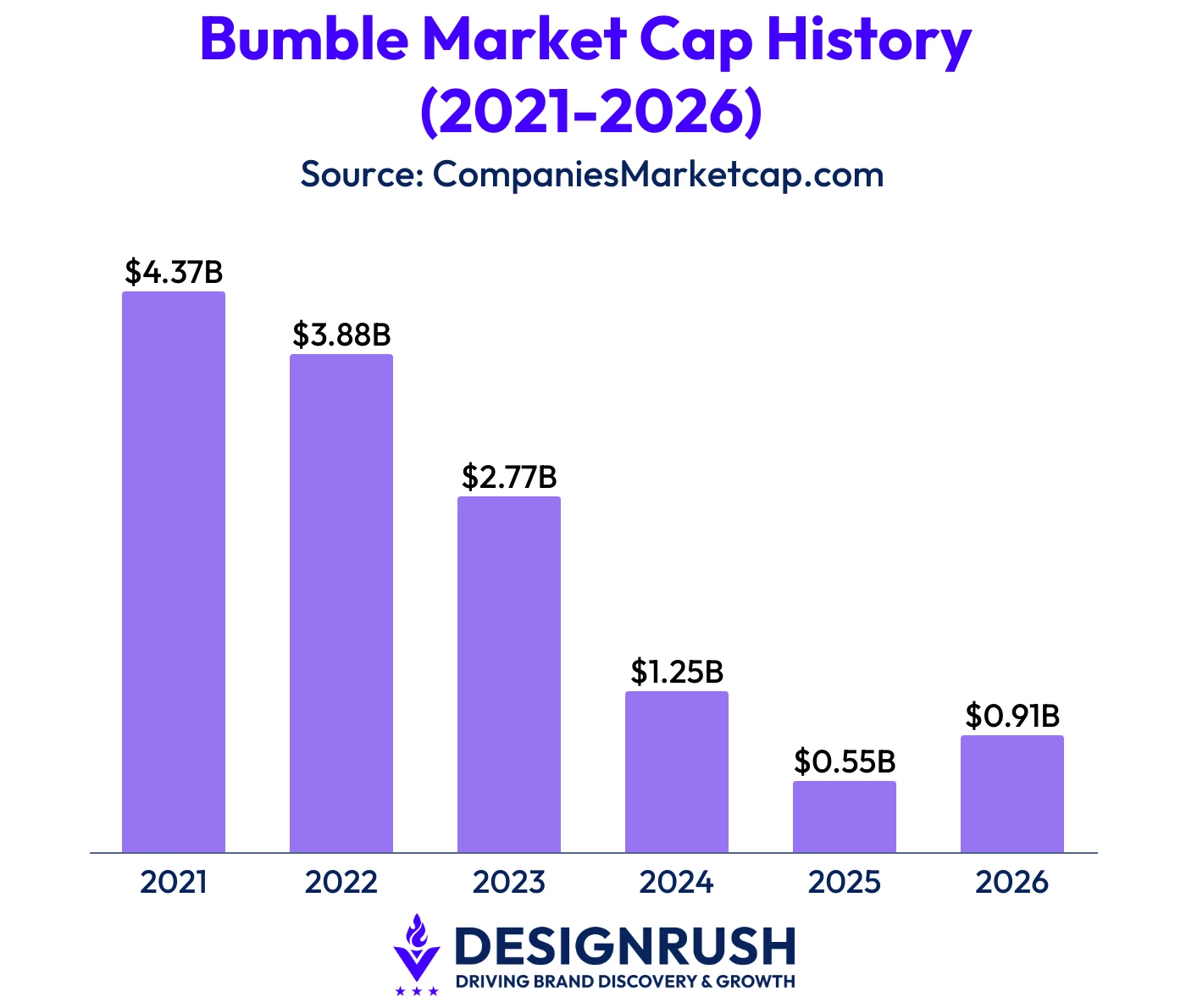
Bumble's valuation tracked this retreat, with its year-end market cap falling every year from $4.37 billion in 2021 to $550 million in 2025.
Match Group felt the same drag, posting $853 million in second-quarter revenue, down 1% from a year earlier.
Its payer count fell 6% to 13.3 million, even as Hinge, its fastest-growing app, lifted revenue 22% on international expansion.
Hinge also grew payers 17% to 2 million in the quarter, while its global monthly users rose 13%.
Daters are still paying for intentional dating, which gives Bumble's quality reset a real audience to win back over the next few years.
Going private moves Bumble's rebuild out of quarterly public view, starting with the third-quarter earnings call it already scrapped.
Private owners can grade a brand strategy on a multiyear clock, which suits slow fixes like rebuilding trust.
And much of this trust rides on Wolfe Herd, who built Bumble to give women more control over online dating.
Ithaca's co-CEOs are both men, so keeping her visible on the brand tells users that the women-first mission still has its backer.
Bumble's buyout points to three moves any consumer brand weighing a sale should take note of:
- Value the brand on its own. Buyers will pay well above market for a recognized name and loyal community, even while the operating numbers keep falling.
- Match the buyer to the gap. The strongest acquirer has deep expertise in whatever the brand has been missing, whether that's paid growth or new technology.
- Protect the brand promise. Users judge new owners by whether the product still matches what the brand stood for before the sale.
Brand reputation sets the price in mergers and acquisitions once the growth numbers stop helping.
Our Take: Can an AI Holding Company Win Back Daters Who Distrust AI?
Ithaca was set up to apply frontier technology to established companies, and Bumble is one of its first major tests.
Our read is that Ithaca can win daters back, as long as the AI stays out of their way.
The Harris Poll found that 75% of singles say AI has made online dating profiles harder to trust.
Hinge kept growing on a "designed to be deleted" pitch that sells the date and keeps the tech in the background.
Ithaca's AI will do the most good in verification and match quality, where daters feel the results without seeing the machinery.
If the first post-deal campaign leads with AI, we'd expect the trust numbers to sink before paying users recover.
Growing on a leaner ad budget takes sharper targeting and stronger creative.
Find your match among these top digital marketing agencies in our directory.