
Enterprise blockchain adoption has moved past the sales pitch phase. Auditors and regulators are the ones asking for it now.
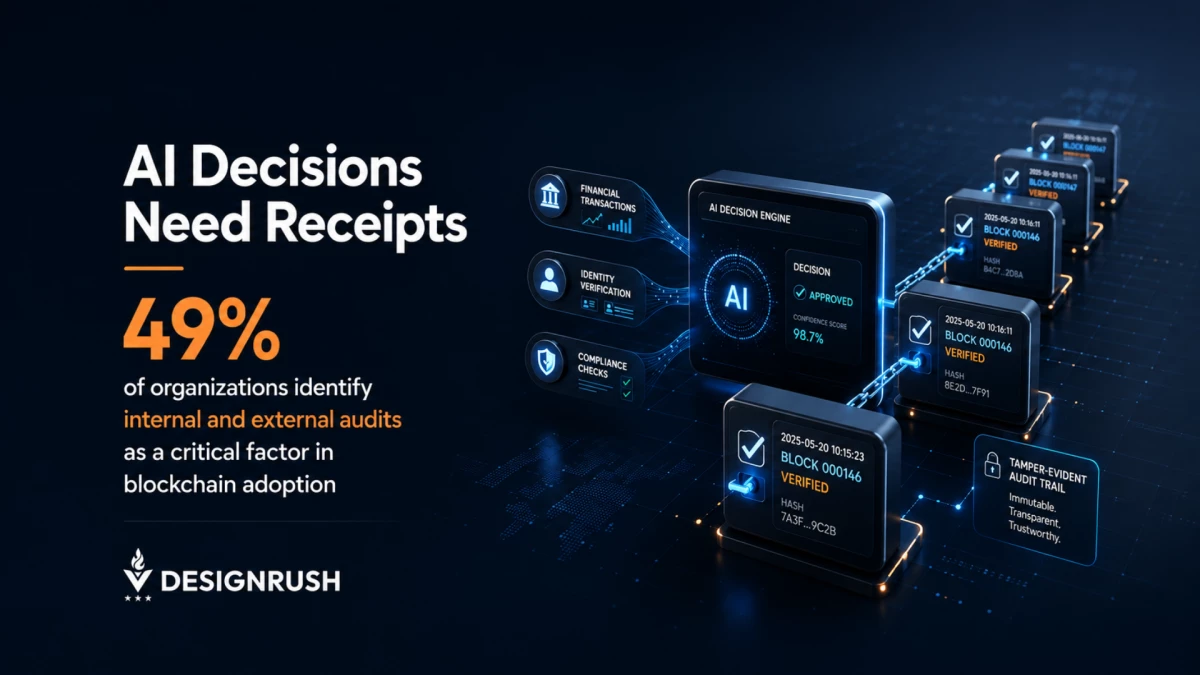
In fact, 49% of organizations identified internal and external audits as the most critical factor behind blockchain adoption, according to Deloitte's Global Blockchain Survey.
That audit-first logic has only strengthened since, as frameworks including the EU's Markets in Crypto-Assets regulation gave enterprises clearer rules to build compliance programs around.
Finance Leaders Are Past the Exploration Phase
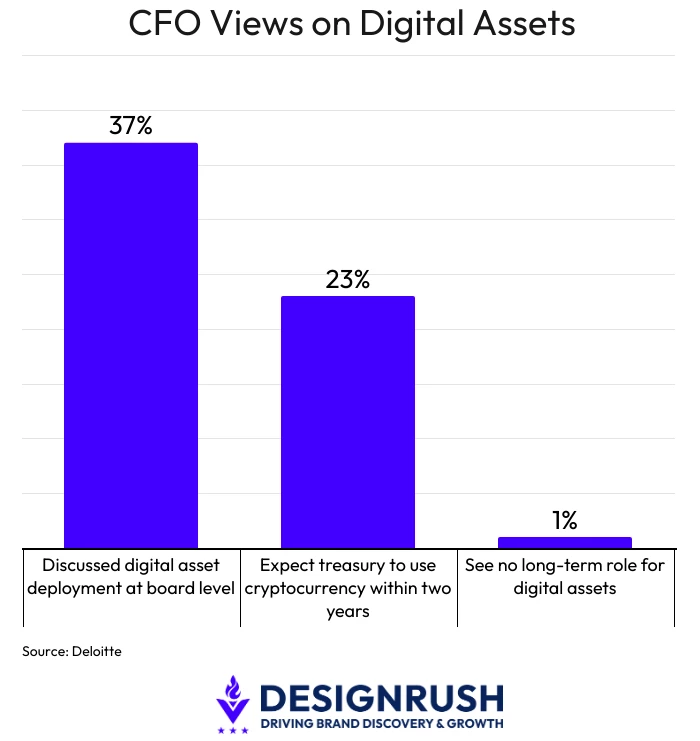
In its survey of 200 CFOs at companies with at least $1 billion in revenue, Deloitte found that 37% of finance chiefs have already discussed digital asset deployment at the board level.
Another 23% expect their treasury departments to use cryptocurrency for investments or payments within two years.
Only 1% said they see no long-term role for digital assets in their business. That leaves plenty of room for companies to decide where they make sense.
In that context, auditability and accountability are more practical concerns than blockchain's original promise of disruption.
Suffescom Solutions, which advises businesses on blockchain development, brings an enterprise perspective to that shift.
Its view is that blockchain strategy is increasingly tied to what companies need to prove, rather than what they want to experiment with.
“The conversation has shifted from whether blockchain is worth exploring to where it can create a verifiable record that stands up to scrutiny,” says the company’s CEO, Gurpreet Singh Walia.
AI Systems Now Need a Record Humans Can Trust
AI systems now approve loans and flag medical scans on their own. Enterprises need proof of what the system saw and why it acted.
A blockchain-based audit trail provides that proof, a timestamped record of the data and logic behind each decision.
"An AI model can explain its decision in plain language. It cannot prove that the explanation matches what actually happened at the time. Blockchain closes that specific gap," Walia says.
After all, governance and compliance frameworks have become a required step in AI agent deployment for the same reason.
That requirement means AI agents making autonomous decisions inside regulated workflows still need a clear record. The record should show what the agent did and why.
For blockchain-based systems, that record can be stored as a timestamped trail. It gives compliance teams something they can review after the decision is made.
Zero-Knowledge Proofs Put Verification Before Data Disclosure
A payment can be cleared without exposing the transaction record. An identity check can be confirmed without handing over the personal data behind it.
Zero-knowledge proofs make that possible. They let a company verify a claim while keeping the underlying information private.
That has a clear use case in compliance. A company can verify that a Know Your Customer (KYC) check was completed without sharing the information used to complete it.
Anti-money-laundering checks can work the same way.
The same setup can also support identity verification, which Suffescom Solutions identifies as another potential use case.
Platforms can confirm that a user passed a check without exposing the underlying records.
“That can reduce the amount of personal data available to fraudsters targeting synthetic identities,” Walia adds.
zkSync, StarkNet, and Polygon zkEVM support zero-knowledge applications. That gives developers existing infrastructure to build on rather than starting from scratch.
A Blockchain Pilot Can Fail When Transaction Volume Rises
A ledger that becomes expensive or congested under real transaction volume reintroduces the exact bottlenecks and opacity that transparency initiatives exist to eliminate.
In production, enterprise-grade transparency depends on infrastructure built for high transaction throughput at predictable cost.
Networks vary substantially in throughput and cost at scale, and that variance is exactly what separates a pilot that works from one that collapses under real volume.
“The biggest issue in failed blockchain pilots is production capacity. Teams need to know whether the network can handle real transaction volume before moving into deployment,” Walia says.
The scaling challenge becomes more important as a business moves beyond a single-agent pilot.
A payment confirmation and fraud check may eventually run on the same ledger. The network needs to handle both without slowing down.
Blockchain Works Best When It Fixes a Specific Audit Problem
Businesses considering this shift do not need to commit to a full platform rebuild on day one.
Start with one process that already has an audit problem. Claims validation, vendor payments, compliance checks. Prove the concept there before touching anything else.
“That sequencing mirrors how blockchain has entered other regulated industries," Walia says.
“Insurers use smart contracts to automate claims validation. The contract triggers a payout once a police report or physician's statement confirms the claim.”
Elsewhere, global supply chain networks use shared ledgers to give every authorized participant the same record, from producer to shelf. No single party controls the data.
That's when transparency actually pays off, when it replaces a process people stopped trusting on paper or inside a private, siloed system.
Most enterprises already have at least one such process sitting untouched.