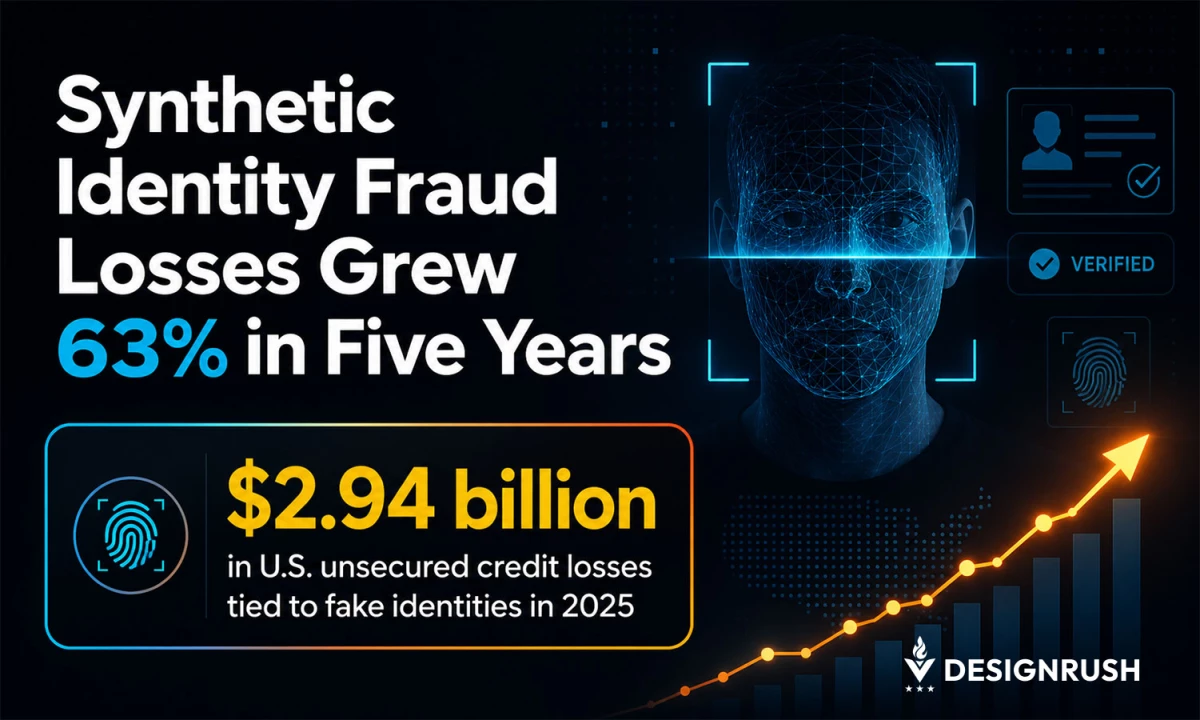

Synthetic identity fraud caused $2.94 billion in U.S. unsecured credit losses in 2025, up from $1.8 billion in 2020, according to research from Mitek and Datos Insights.
In fact, 84% of fraud executives now rate it a high or moderate risk.
Part of why the number has climbed is deepfakes, which now account for one in five biometric fraud attempts.
Furthermore, deepfake selfie attacks rose 58% over the last year, according to Entrust's 2026 Identity Fraud Report.
Overall, deepfake identity fraud is on pace to grow by nearly 495% in 2026, according to ASIS International.
Generating a convincing fake identity has gotten cheap enough that fraud teams can no longer treat it as a rare edge case.
For fintech platforms, that shift changes what "verified" is supposed to mean.
Why a Signup Check Stops Being Enough
Most identity verification checks only happen when someone opens an account. A user submits a document, takes a selfie, and passes a liveness check.
From that point forward, the system treats them as confirmed and won't initiate another verification check at any other time.
This approach is problematic because it assumes fraud shows up at the door on day one, or not at all.
Fraud rings have built their whole strategy around that blind spot. They design synthetic identities specifically to pass the signup check, then let those identities sit and operate normally.
That normal-looking history is exactly why fraud is so hard to catch later, since the accounts already look established.
To solve this, identity verification needs a different starting assumption.
And one of the firms rethinking what that infrastructure should look like is Suffescom Solutions, a custom software and AI development company.
" Fraud used to concentrate at onboarding, so that's where the budget and the tooling went. Most platforms aren't built to notice when something changes after initial verification," says the company’s CEO, Gurpreet Singh Walia.
"That is why the identity has to keep matching the behavior for as long as the account stays open."
What Continuous Verification Requires
Continuous verification means identity is something a system keeps re-checking against behavior. That check has to live inside the platform's architecture from the start.
Retrofitting it later, based on patterns Suffescom Solutions sees, means rebuilding around a decision the system was never designed to make.
"That means the platform needs to notice when an account's behavior stops matching the identity it verified at signup," Singh Walia says.
"And it needs to do that continuously, not on a quarterly audit cycle."
Most fraud tooling can already flag a mismatch once it's built to look for one. So who decides what happens next?
That decision could mean an automatic hold on the account, a manual review by a fraud team, or a request to re-verify.
What's missing on most platforms is a clear rule for what happens the moment that flag goes up. Without it, the alert just sits in a queue instead of triggering an action.
Bolting On Tools Only Buys Time
The instinct, when new fraud data comes out, is to allocate the budget for another detection tool and add it to the stack.
Every additional point solution is another system that has to talk to the others. And that's another point where a sophisticated identity can slip through the handoff.
"Each new tool has to be integrated, maintained, and reconciled with everything already in place," Singh Walia says.
“Synthetic identities are built to exploit exactly those integration points, the same ones that keep multiplying every time a platform adds another fix."
Case in point, the fintech platforms handling this well treated identity as core infrastructure from the start.
For those platforms, there's no new tool to integrate every time fraud tactics shift. For everyone else, each new report means another vendor call.