
A well-designed website and a high-performing B2B website are not the same thing.
Over the past decade, design aesthetics dominated the conversation about what makes a website successful.
From the likes of full-screen animations, layered motion effects, scroll-triggered interactions, and visually complex layouts, these all became common measures of craft.
However, in B2B environments, these decisions often work against the people the site is supposed to serve.
The B2B Buyers Are Evaluating
The behavior of a B2B buyer on a website is different from that of a consumer's.
They are not exploring for inspiration. They are assessing credibility, validating capabilities, comparing differentiation, and looking for reasons to advance a vendor to the next stage of evaluation or remove them entirely.
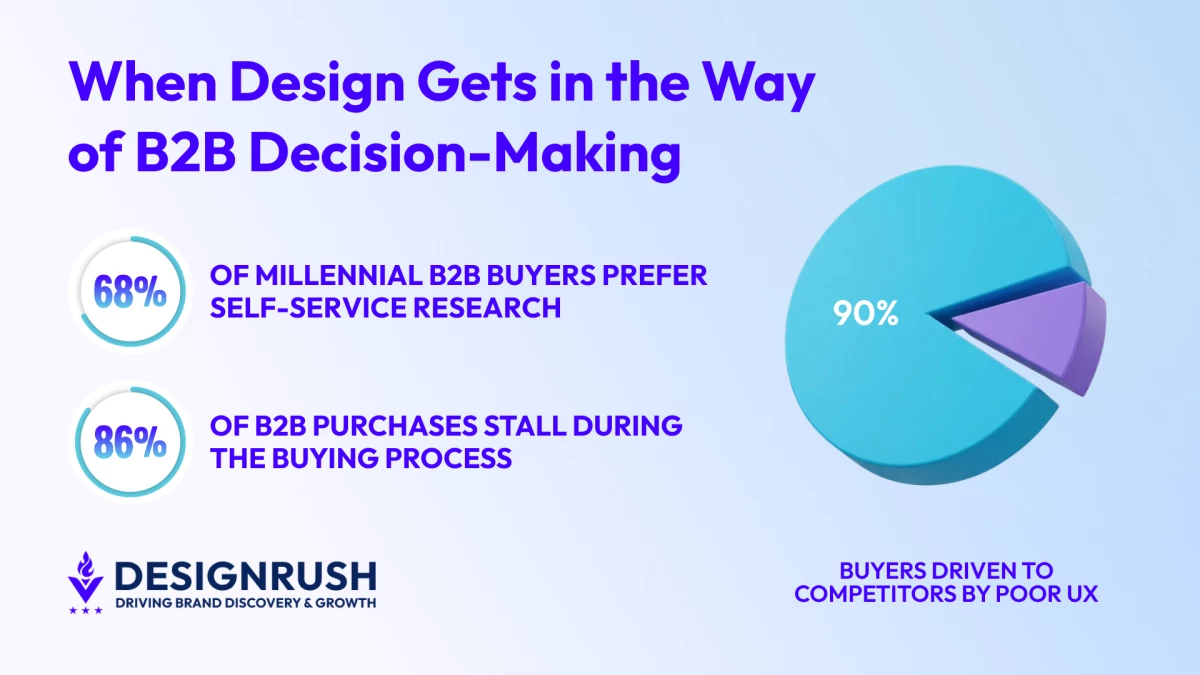
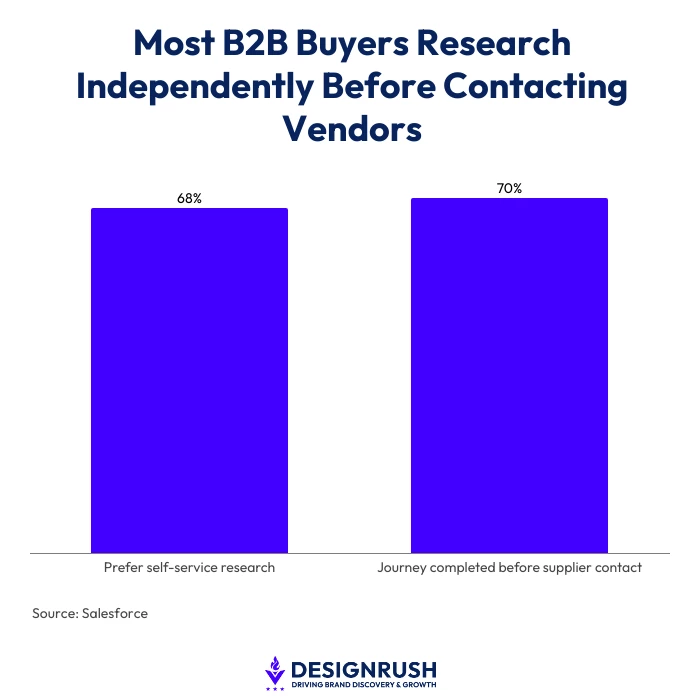
In fact, 68% of millennial B2B buyers prefer self-service research tools over speaking to a sales rep, and many complete up to 70% of the buying process online before engaging with a supplier, according to Salesforce's State of the Connected Customer report.
Likewise, 67% now prefer a rep-free buying experience, per a March 2026 Gartner survey of nearly 650 B2B buyers.
The website is no longer supporting the sales process. For most of the buyer's journey, it is the sales process.
And yet many B2B websites are built as if the primary audience is a design award jury.
Elaborate entrance animations delay access to information. Heavy visual layers slow load times. Sparse, aesthetic copy answers no questions.
The result is a website that impresses briefly and informs poorly.
HubSpot Marketing breaks down why B2B websites need to focus on usability:
Visual Complexity Has a Measurable Performance Cost
Overdesigned websites carry a direct performance penalty that translates into lost pipeline in B2B contexts.
For example, a B2B site loading in one second has a conversion rate three times higher than a site loading in five seconds, and five times higher than one loading in ten seconds, according to WP Rocket.
Heavy animations, large media assets, and script-heavy interactions are among the primary drivers of load time increases.
This matters because the probability of a bounce increases by 32% as load time moves from one second to three seconds, according to SiteBuilder’s Website Speed Statistics 2026.
In B2B, where a bounced visitor may be a procurement manager in the middle of a vendor shortlist exercise, the cost of that exit is not a lost pageview. It is a lost deal.
Buying Committees Need Information, Not Visual Theater
B2B purchases are rarely made by one person. Ten years ago, the typical B2B buying journey involved five stakeholders. Today, it involves an average of eleven to twenty.
Each one evaluates the website differently. Technical teams assess implementation feasibility, finance reviews pricing signals, procurement validates credibility, and leadership reviews positioning.
A visually elaborate but informationally thin website fails all of these audiences simultaneously.
The CTO cannot find technical documentation. The CFO cannot locate case studies with measurable outcomes. The procurement manager cannot verify legitimacy through recognizable trust signals.
Directive Consulting's 2026 analysis of high-performing B2B sites found a consistent pattern.
The best performers are not the ones winning design awards, but the ones that reduce buyer work by clarifying positioning within seconds and guiding high-intent visitors to the right next step without friction.
Forrester's State of Business Buying research found that 86% of B2B purchases stall during the buying process, and 81% of buyers express dissatisfaction with the provider they choose.
Stalled purchases and buyer dissatisfaction are not exclusively sales problems. They are frequently symptoms of a website that failed to help buyers reach a confident decision.
ReelFlow tells us why B2B websites have become a critical source of trust and information, as buyers increasingly research, evaluate, and shortlist vendors long before speaking with a sales representative:
Trust Is Built Through Clarity, Not Design Sophistication
The signals that build trust in B2B buying environments are not primarily visual. They are informational.
Redpoint Insights' 2025 B2B Buyer Insights report, found that the content types most likely to build trust during the buying process are customer testimonials (55%) and case studies (54%), with 42% of buyers reporting they trust content published directly on vendor websites.
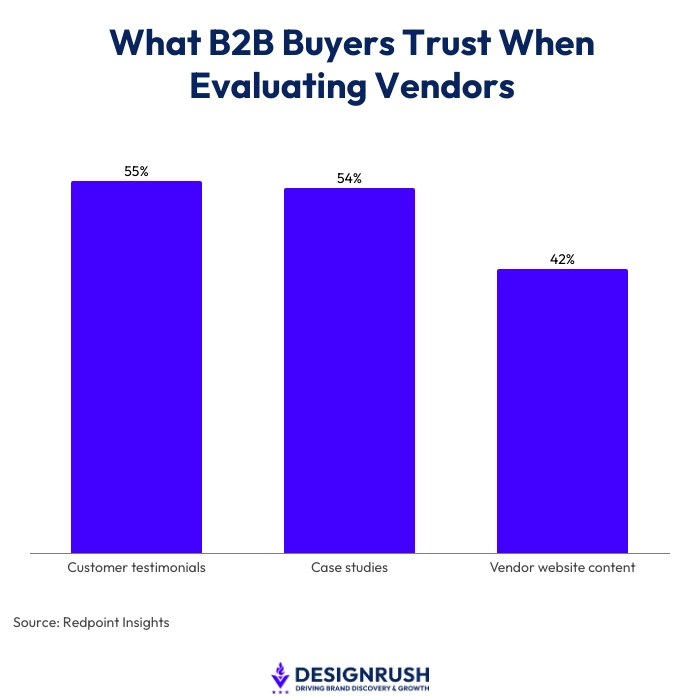
These are the elements that move a buyer from consideration to confidence.
Many overdesigned B2B websites eliminate exactly these elements in pursuit of visual cleanliness.
Case studies get buried behind modal popups. Pricing pages are removed to encourage discovery calls. Navigation hierarchies collapse into hamburger menus. The brand looks polished while the buyer's actual questions remain unanswered.
Experts suggest that as many as 90% of B2B buyers will switch to a competitor if a supplier's digital experience does not meet their expectations.
This is evidence that a visually impressive site that creates informational friction does not meet those expectations. It simply looks like it does.
Decision Flow Is the Real Design Brief
High-performing B2B websites in 2026 are built around helping the right people reach confident decisions faster.
That means visible, hierarchical navigation, which includes:
- Case studies with measurable outcomes positioned prominently, instead of being gated behind forms.
- Clear service architecture that maps to how buyers categorize their own needs.
- Performance-optimized pages that load quickly on every device.
Design still matters in this framework. Visual credibility, consistent branding, and professional presentation all contribute to the trust signals buyers rely on.
But in B2B, design is a support function for the information architecture, not the primary event.
The website that wins a B2B deal is the one that answers the committee's questions before the first sales call. That outcome requires clarity as the primary design objective, with aesthetics in service of it.