
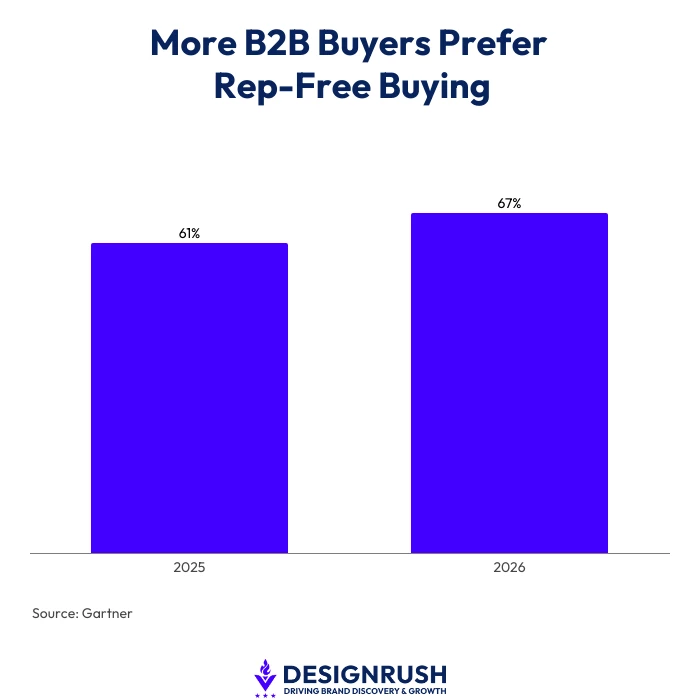
Over 67% of B2B buyers prefer a rep-free experience, up from 61% in 2025, according to two Gartner studies.
Yet 69% prefer to validate AI-generated insights with a sales rep.
For B2B websites, the harder design problem is deciding when self-service should give way to sales.
As an award-winning digital agency, Baunfiredesigns and develops B2B websites where that decision appears in conversion paths, from pricing and demo requests to contact forms.
For the agency’s CEO, Juan Sanchez, those paths have to account for what buyers can resolve on their own and what still requires a person.
"The handoff should happen when the buyer’s question becomes specific to their company," he says.
"That’s where sales can add context, validate what the buyer has already learned, and help them make a decision."
B2B Websites Should Support Self-Service Before Sales
Gartner found that 70% of buyers prefer a completely digital, self-service buying experience.
For general information and learning, buyers prefer to stay online, where they are more likely to involve a seller when the question is specific to their company, such as whether a product or service fits their needs.
Pricing, use cases, customer proof, implementation details, and self-service tools can cover much of that evaluation before a buyer provides contact information.
Baunfire’s B2B guidance includes transparent pricing and interactive tools such as calculators and product configurators among the ways websites can help people evaluate an offering.
For companies that can’t publish a fixed price, Sanchez says there is still useful information they can give buyers.
"Show them the model, the variables, or the range they should expect," he says.
"They need enough information to decide whether it makes sense to keep evaluating before they book time with sales."
Demo Requests and Trials Mark the Sales Handoff
Baunfire’s work for enterprise AI company, Instabase, provides one example of a conversion path built around buyer intent.
The team reworked the corporate site’s content and interactions to make that path easier to follow. Demo inquiries increased after the redesign.
But a demo request also carries a different kind of intent from downloading a resource or reading a customer story. Trials and sandbox access can signal the same move from learning about a product to testing it.
"A demo request usually means the buyer wants to talk about their situation," Sanchez adds.
"A trial or sandbox can mean they want proof. Those actions should change what sales does next."
One buyer may arrive from pricing with a commercial question, while another may come out of a trial with a technical one.
But treating both as the same generic lead throws away useful context.
RevOps Co-op examines how demo requests, pricing-page visits, and other intent signals should influence when and how sales follows up:
B2B Lead Forms Should Pass Context to Sales
A name, company, and email can be enough to submit a form and still be too little for a useful handoff.
Baunfire’s conversion guidance recommends asking only for essential information in lead forms and using analytics to understand behavior across conversion paths.
"Keep the form simple, but don’t throw away the context," Sanchez says.
"A pricing question and a sandbox request shouldn’t arrive in the same queue. The route should reflect what the buyer is actually asking for."
This is particularly relevant given that Gartner found that 69% of B2B buyers reported inconsistencies between information on a supplier’s website and what its sellers told them.
"The first sales conversation should pick up from what the buyer already did on the website," Sanchez says.
"If the rep gives them different pricing, positioning, or product claims, the buyer has to stop and figure out which version is right."
RevOps discuss how qualification, routing, direct booking, and response time affect what happens after a high-intent buyer submits a form:
Measure B2B Sales Handoffs Beyond Form Volume
Raw form volume doesn’t show whether sales received a useful opportunity.
Sanchez says four measures can show whether the handoff is working after a buyer asks for human help:
1. Sales-Accepted Lead Rate
How many demo or contact requests does sales consider worth pursuing?
2. Demo or Trial-to-Opportunity Rate
How often does a high-intent action become an active sales opportunity?
3. Conversion by Handoff Path
How often do visitors on pricing, demo, trial, or contact paths take the intended next step?
4. Sales Response Time
How quickly does a buyer receive a useful response after asking for human help?
Those measures, however, are more useful when teams compare individual handoff paths instead of grouping every form submission together.
"Sales should be able to start with the buyer’s actual question," Sanchez says.
"If the first call is spent rebuilding context the website already had, the handoff still needs work."