
Key Takeaways:
- AI is doing more of the coding by itself, especially with tools like Claude Code that automate nearly 80% of developer tasks.
- Web and app development are most affected, with frontend languages like JavaScript and HTML dominating AI-assisted work.
- Startups are adopting AI coding tools faster than enterprises, suggesting a growing gap in speed and innovation.
AI tools are rapidly changing how developers write software, and startups are leading the charge.
A new report from Anthropic analyzed 500,000 interactions with its AI models.
It found that small, fast-moving companies are adopting coding automation tools far more aggressively than larger enterprises.
The study compares usage patterns between Claude.ai, a general-purpose chatbot, and Claude Code, a more specialized AI "agent" designed to autonomously handle multi-step coding tasks.
Claude Code was used for automation in 79% of cases, while Claude.ai showed a lower automation rate of 49%.
The difference suggests that more advanced AI tools are shifting developer workflows from AI-assisted collaboration toward AI-led execution.
Startups appear to be the primary adopters of this agentic approach.
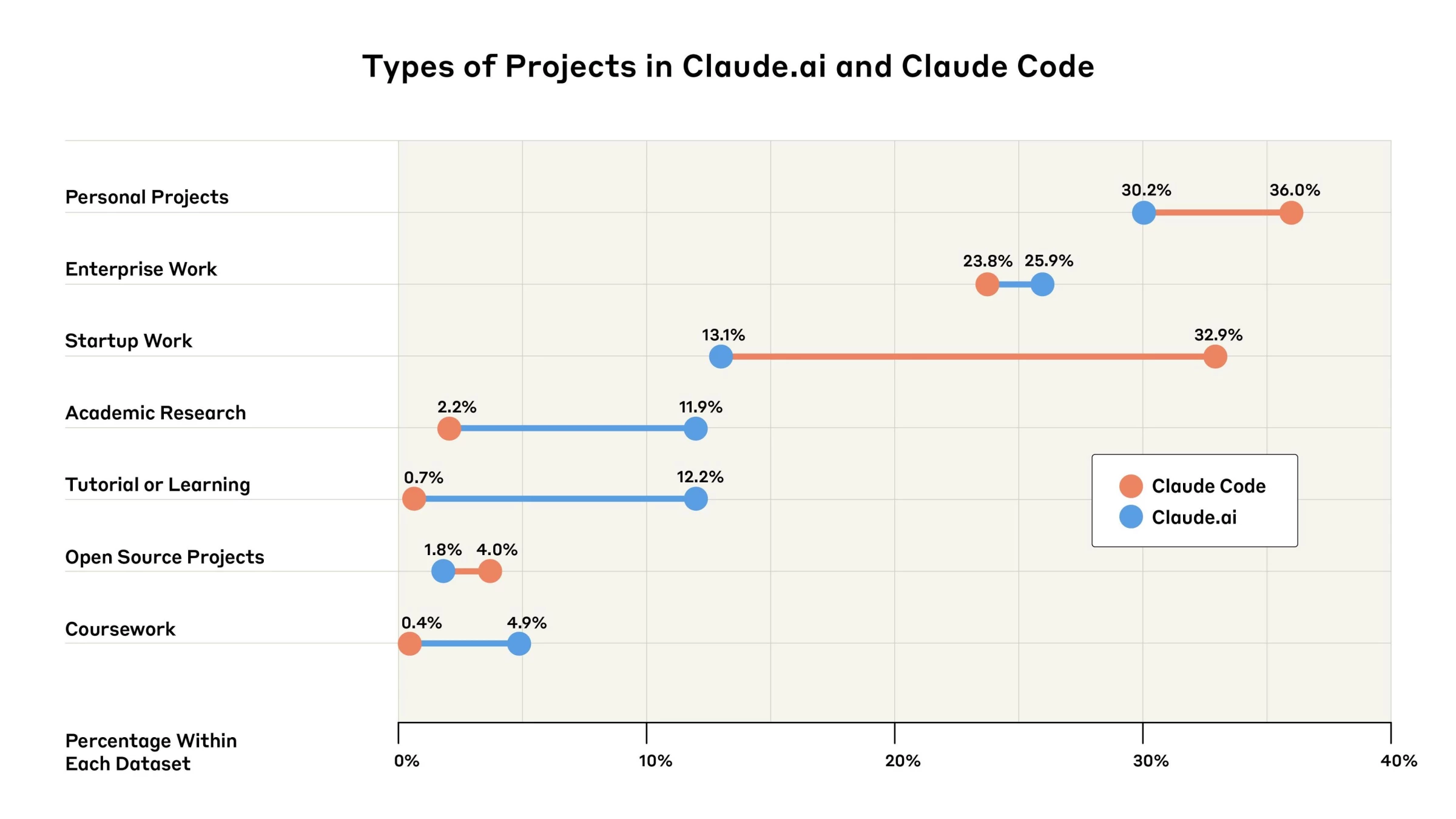
Claude Code usage skewed heavily toward startup-related work, accounting for nearly 33% of sessions, compared to just 13% attributed to enterprise projects.
Anthropic notes that this adoption gap reflects the typical divide seen in earlier tech cycles.
Startups are quicker to experiment with new tools, while enterprises often take longer due to security and integration concerns.
David Barlev, CEO and co-founder of Goji Labs, said startups adopt tools like Claude Code quickly because speed equals survival.
“That agility lets them innovate quicker and outpace slower-moving enterprises. Big orgs don’t need to be startups — but they should steal a few pages from the playbook: test early, move fast, and let small teams experiment.”
Coding Gets a Vibe Shift
The most common tasks where AI coding is used include building user-facing applications, such as websites and mobile interfaces.
Languages like JavaScript, HTML, and CSS dominate Claude's interactions, while backend and data-related tools like Python and SQL also feature prominently.
This points to a potential disruption in frontend roles, as AI may just be capable of generating production-ready components based on natural language instructions, sometimes referred to as "vibe coding."
Even in automated settings, human oversight remains common.
A large share of interactions involved "feedback loop" patterns, where users reviewed and corrected Claude's outputs.
However, the trend leans toward tools that require less input, particularly as agentic AI becomes more capable.
The report acknowledges limitations, such as the focus on early adopters and the exclusion of enterprise API usage.
Still, it offers an early view into how AI is likely to impact developer productivity and staffing models, especially in smaller organizations that prioritize speed.
Brands and businesses need to seriously consider that AI is no longer a side experiment in software development.
It's becoming a core part of the workflow, and those who adopt it early will most likely gain a competitive edge.