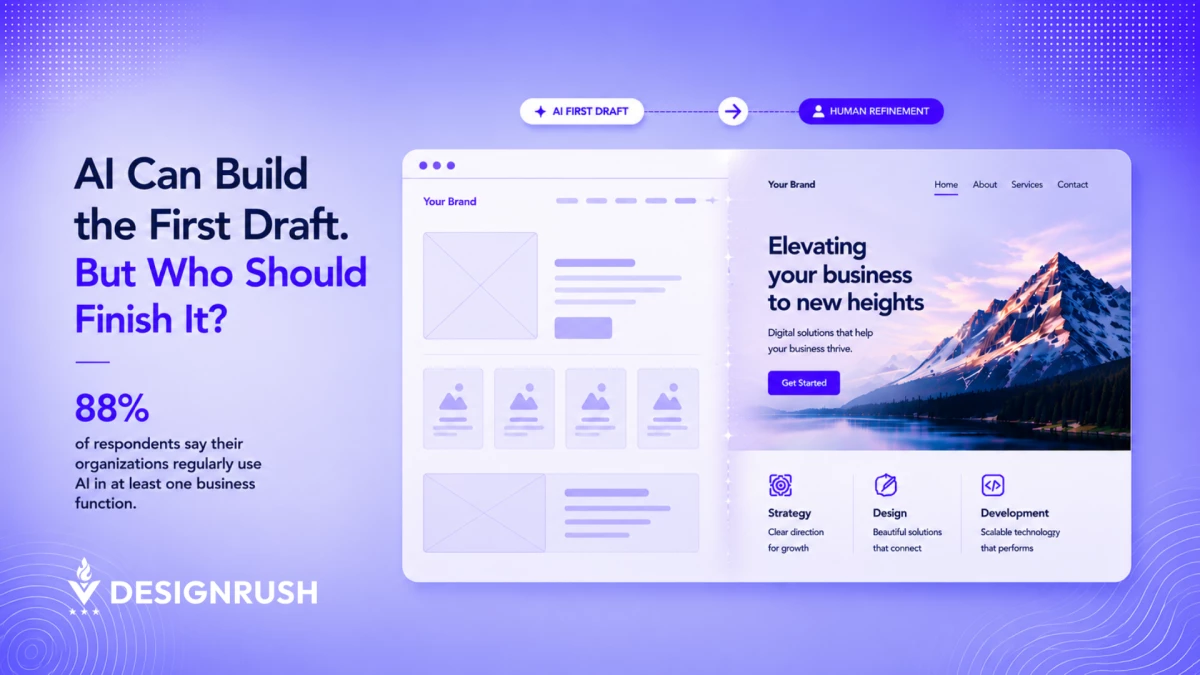

AI website builders can now turn business information, content, page requirements, and visual preferences into a responsive first version of a website.
For agencies, that can remove much of the setup between receiving a client brief and having something concrete to review. Pages need to be mapped out, content organized, and an initial visual direction established before more detailed design work can begin.
Brizy is one company applying AI to this stage of website production.
Brizy AI can use existing business information and assets to create an initial site that professionals can review and refine before opening it in Brizy's visual editor, where they have direct, precise control over the final result.
For Bogdan Condurache, CPO and co-founder of Brizy, the opportunity starts with getting designers to something they can work with sooner.
“The blank canvas takes more time than people realize. You have the brief and the client's materials, but someone still has to turn all of that into something you can actually work with,” Condurache says.
“That's where AI is useful. It gets you to that first version faster, while the designer still decides what the final website needs to be.”
AI Website Builders Can Speed Up the First Draft
AI website builders can take on more of that early setup by working from information that already exists about the business.
With Brizy AI, those inputs can include a prompt, logo, images, documents, an existing website, Google Business Profile, and social profiles. Users can also define or review the page structure, colors, and typography before generation.
If the prompt specifies particular pages, Brizy AI can include them in the initial structure and can also suggest pages based on the business information provided.
The generated website can then be reviewed and refined at the preview stage before the project moves into the visual editor.
“A useful first draft has to understand more than a short prompt,” Condurache says.
“If there's already a logo, content, an existing website, or other information about the business, you want to use it. The closer that starting point is to the real business, the less time the designer spends correcting assumptions before the actual design work begins.”
AI Creates the First Draft and Designers Shape the Final Website
Once the initial website exists, designers have something specific to assess.
For website designers, that review includes whether the copy communicates what matters, whether important actions receive enough prominence, and whether the brand hierarchy, information architecture, accessibility, and user experience fit the client and its audience.
The point is not for the designer to simply correct what AI generated, but to apply the strategic and creative judgment that turns a usable first draft into a website built around the client's specific goals.
After the first version is created, professionals can open the site in Brizy's drag-and-drop editor and directly select, move, resize, restyle, replace, or rewrite individual elements.
The editor also gives professionals control over global styling and responsive behavior, including changes across the site and for different screen sizes.
“Once you can see the website, different questions start coming up," Condurache says. “Is this really what the client needs to emphasize? Does the page lead people where it should? Does it still work when you get down to mobile?”
“Those aren't decisions you want to accept just because they came out of the first generation.”
What Agencies Should Look for in AI Website Builders
For agencies, evaluating an AI website builder requires looking at how the tool holds up through the rest of client production.
Responsive output, editability, and precise visual controls affect whether an agency can take a generated site through review and final production without rebuilding work unnecessarily.
Agencies should also look at how much real business context the AI can use. A first draft based only on a short prompt may require considerably more correction than one that can incorporate existing content, brand assets, business profiles, and other source material.
Client access can matter when customers need to review or work with their websites, while repeatable workflows become more important for teams handling multiple projects rather than a single site.
The production process itself offers a practical test.
For many agencies, that makes a hybrid workflow more practical than either extreme: starting every project from a blank canvas or expecting AI to carry the website all the way to the final result.
An agency can collect the client brief and existing assets, define the essential pages and initial visual direction, generate and review the first version, and then make precise changes in the visual editor.
Content, conversion, responsive behavior, and final quality checks follow before publication.
“For an agency, I'd look closely at what happens after the website is generated. Can your team get into it and make the exact changes the client needs without fighting the tool?” Condurache adds.
“You're going to revise the site and the client is going to have feedback. That part of the workflow has to be just as practical as generating the first version.”
Where AI Should Fit in the Agency Workflow
For agency leaders, adopting an AI website builder starts with deciding which work can be handed to AI, when professional review begins, and who has responsibility for the decisions that reach the client.
Leaders should also evaluate AI website builders under the conditions their teams actually work in. A generated first version is one part of that test.
The tool also has to fit the agency's review process, client involvement, publishing requirements, and the volume of projects the team handles.
Agency leaders also need to decide where they want designers spending their time.
Automating setup has practical value when that time can go toward understanding the client's goals, improving the message, working through the user experience, or checking the final site before publication.
“The important decision for agencies is where they want AI in the process. You need to know what you're comfortable automating, where your team needs control, and who is responsible for the final result,” Condurache says.
“Once you define that, AI becomes much easier to evaluate because you're judging it against the way your team actually works.”
AI website builders should not be judged by how completely they remove the designer from the process.
For agencies, the more useful measure is whether they shorten the path from a client brief to a credible first version while preserving precise control over the final website.
Used that way, AI eliminates the blank canvas and gives designers more time for the strategic and creative decisions where their judgment matters most.