
Our analysts track the weekly developments reshaping organic visibility and AI discovery. Brands building search programs can partner with vetted SEO agencies for strategic implementation.
Google shipped three AI search changes this week, and each one gave publishers less to work with than the last.
- Search Console reports AI visibility worldwide now, without a single click metric attached.
- AI Overviews now expand into full AI Mode-style answers for some queries, pushing organic results further down the page.
- Gemini 3.8 Flash shipped inside AI Mode without citing sources on some top-of-funnel queries, a bug Google has confirmed and is fixing.
Here's the full story behind each change and what to check in your own data.
Our Take: Is Google Cutting Links on Purpose, or Just Breaking Them?
Two of this week's three changes came out of a product roadmap, and only one came out of a bug tracker.
We think Google is doing both at once, but only the accident gets treated as a real problem.
Robby Stein called the Gemini 3.8 Flash citation failure unintentional and promised a fix.
Google tested dynamic AI Overview expansion and shipped it because its research showed people asking deeper follow-ups once the full answer loads.
A bug gets patched on a timeline, while a shipped feature working as designed gets defended.
The new Search Console report sits in the middle, with real data on schedule but still silent on whether an impression became a visit.
Search Console's AI Report Ships Without Click Data
Search Console's generative AI performance reports and opt-out control finished rolling out worldwide on August 31.
Google confirmed this in a note added to two blog posts and a help page.
The rollout began quietly in June with a subset of UK sites.
The report now covers five dimensions: impressions, pages, countries, devices, and dates, down to the hour, but click data isn't part of it.
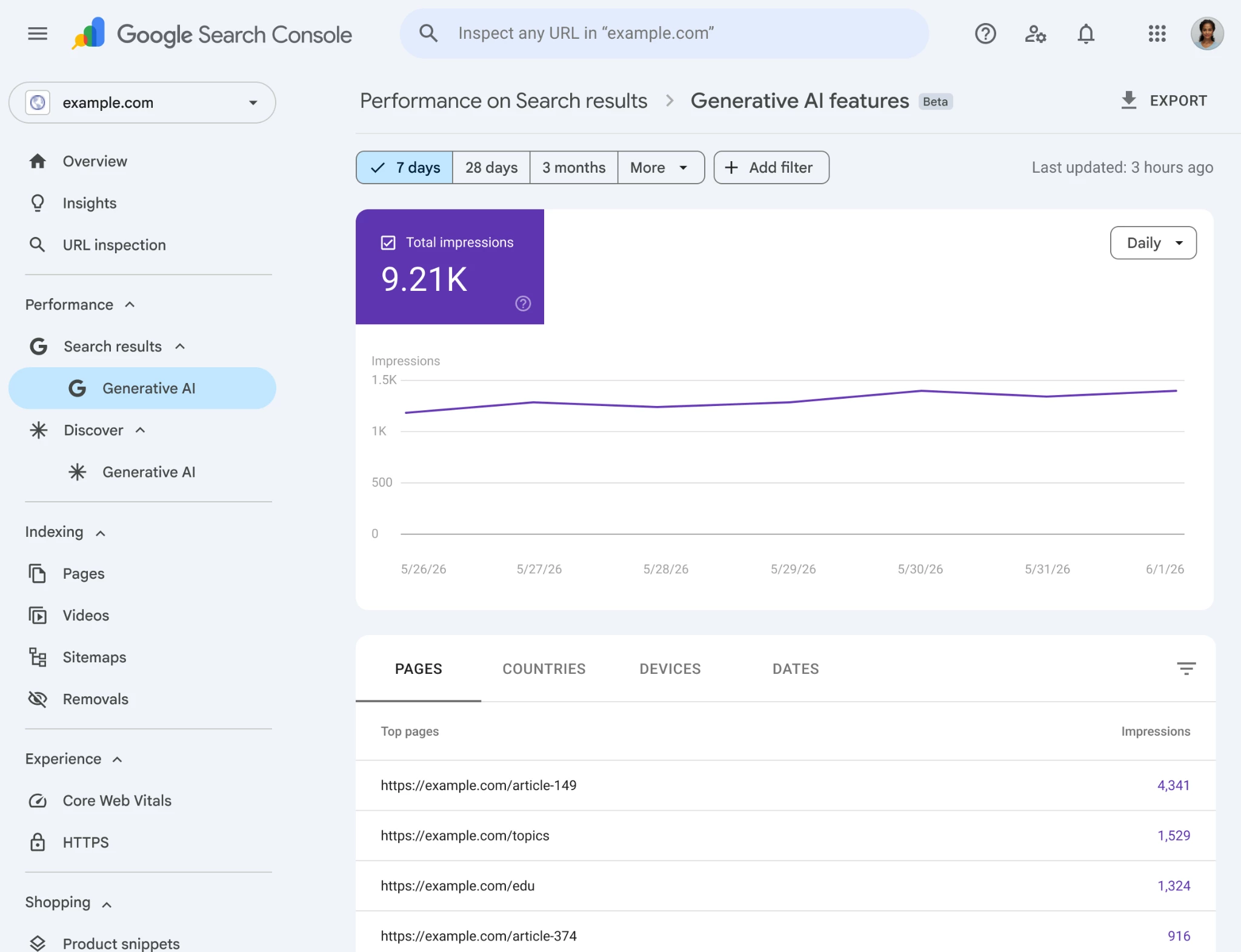
A site can see how often its pages appeared in AI Overviews, AI Mode, and Discover's AI features.
However, no metric shows whether these appearances ever led anywhere.
The opt-out control travels with the report, and a website can now exclude its content from grounding these same AI features entirely.
Google says the setting isn't a ranking signal for regular search results.
It's separate from Google-Extended, the crawler control that governs AI training specifically.
Any site weighing this opt-out has to use the same report to decide, because the data runs out at the exact point where a publisher needs it most.
Michael Melen, co-founder of SmartSites, an agency that offers AI search optimization, says the clicks that still arrive are worth more than they used to be.
"While website clicks are going down, we've seen a big increase in conversion rates from the clicks that do reach the site. This is especially true for traffic from AI sources, where we're seeing an average conversion rate of 6.5%, compared to a baseline of 3.6%," Melen told DesignRush.
AI Overviews Expand Without the 'Show More' Button
For some queries, AI Overviews now expand to full length automatically, removing the "Show more" button.
The change also pushes organic results further down the page.
Google confirmed it after SEO consultant Chris Long posted an example on August 27.
Robby Stein, Google's VP of Product for Search, said the expansion only triggers on topics that Google's systems flag as most useful to the searcher.
Hey Barry, jumping in here with more context, AI Overviews only dynamically expand for topics where our systems determine it to be most useful. If you’ve already started scrolling, the expansion stops to keep your place.
— Robby Stein (@rmstein) August 28, 2026
We're always testing and tuning these experiences, so…
If someone has already started scrolling past the AI Overview, the expansion cancels so they don't lose their place.
Stein said the feature is still being tested and tuned based on user feedback.
The default answer now includes a persistent "Ask anything" box loaded open beneath it.
The old button forced a small decision about whether to read more or scroll down to the links.
The box now catches the next question, routing the follow-up back into Google's own answer.
Gemini 3.8 Flash Debuts Without a Single Citation
Gemini 3.8 Flash arrived on September 2 as a model option inside AI Mode for Google AI Pro and Ultra subscribers.
Responses stopped showing links or citations on some top-of-funnel queries.
SEO consultant Gagan Ghotra documented it first with screenshots on X.
Glenn Gabe posted a side-by-side comparison against the default model on September 3.
"This isn't working as intended, and we'll roll out a fix soon," Robby Stein responded.
Whoa, Gagan is right. See below between default model and 3.8 Flash. What is going on here? First is 3.8 Flash and second is default model. @rmstein@rajanpatelhttps://t.co/EH958CMDOnpic.twitter.com/VIY201Mbva
— Glenn Gabe (@glenngabe) September 3, 2026
The replies underneath suggest the fix hasn't shipped yet. Google gave no date, scope, or mechanism for it. The bug's reach is limited for now.
Gemini 3.8 Flash sits behind a paid subscription, so free AI Mode users see the default model.
The timing is still awkward for Google after it has spent the year promising to send more links to the open web.
And its newest model launched sending none.
SEO Industry Insights
The SEO community is still arguing about Claude's watermark, the disclosure feature DesignRush covered when it changed what AI disclosure clauses can verify.
A fresh op-ed adds a sharper complaint.
Statistical detection can't separate a lightly edited human draft from fully AI-written text.
A positive reading flags legitimate editing the same way it flags AI slop.
We’ve written an FAQ to answer some of the questions we've received about watermarking.
— Anthropic (@AnthropicAI) August 14, 2026
In summary:
• We’re implementing watermarking to comply with the EU AI Act. Other major model developers have signed the same Code of Practice and will also be implementing watermarking;…
Diagnosis and recovery run on separate clocks, and Reddit gave the SEO community a fresh example this week.
A site owner asked on Reddit why traffic hadn't recovered after disavowing "valuable backlinks," and John Mueller's answer pointed elsewhere.
A handful of disavowed links won't tank a site on its own, and Mueller suggested two more likely causes.
One was a spam update that hit around the same time, with effects that can take months to show.
The other was a big technical error, closer to blocking the whole site than mis-setting a canonical tag.
Long found that Gemini's fan-out searches weigh freshness heavily, with "2026" and "2025" ranking as its top two search terms.
Both models sometimes use the site: operator, which restricts a query to a single domain.
Gemini rarely does it, and when it does, it points at Reddit almost every time.
ChatGPT runs them more often, but the domain it picks isn't always the one it wanted.
Lily Ray reported a client case where a root domain was accidentally blocking OpenAI's crawler.
ChatGPT kept citing a subdomain, the only part of the site it could actually reach.
"By the way, this is NOT a recommendation to go spamming things. (Who, me? Never!) But I do think some cool SEO experiments could come out of this," Ray wrote.
Each case here turns on a signal being read as proof of something that it never measured.
A watermark score reports statistical patterns, while a disavow file only records a request.
Treating either as a verdict costs teams weeks of misdirected technical SEO work.
What This Means for Anyone Measuring AI Visibility
Each story above opens a new blind spot, and these three checks close them:
- Treat the new AI report as a floor. No click data means a rising impression count still needs a downstream metric to confirm anything.
- Stop blaming your content for a citation drop. A model-level bug can zero out links regardless of what a page did right.
- Check crawler access before checking the page. A blocked root domain can hide an entire site from fan-out searches.
Remember that a citation bug and a blocked crawler produce the same symptom.
Neither one surfaces until someone checks their own setup first.
For a breakdown of the cats.txt experiment, AI referral mismatches, and Google's ranking volatility, check out last week's SEO roundup.
If Google's own newest model can't cite a source correctly, how much should a missing citation really tell a brand about its content?
These leading SEO agencies help brands find out what AI actually says about them before a customer does.