
Our analysts track the weekly developments reshaping AI and how it reaches users. Brands building AI products can partner with vetted AI companies to bring their ideas to life.
Four AI and privacy decisions landed in the same week's coverage, but only one of them is actually live.
- Salesforce introduced seven named "job-ready" Agentforce agents days before Dreamforce, alongside a new agent governance framework.
- Microsoft drafted a provisional AI code of conduct, while Anthropic co-founder Jack Clark went further, calling for a mandatory, third-party-verified AI kill switch.
- Delaware dropped its privacy law threshold from 35,000 consumers to 10,000, pulling far more businesses into compliance.
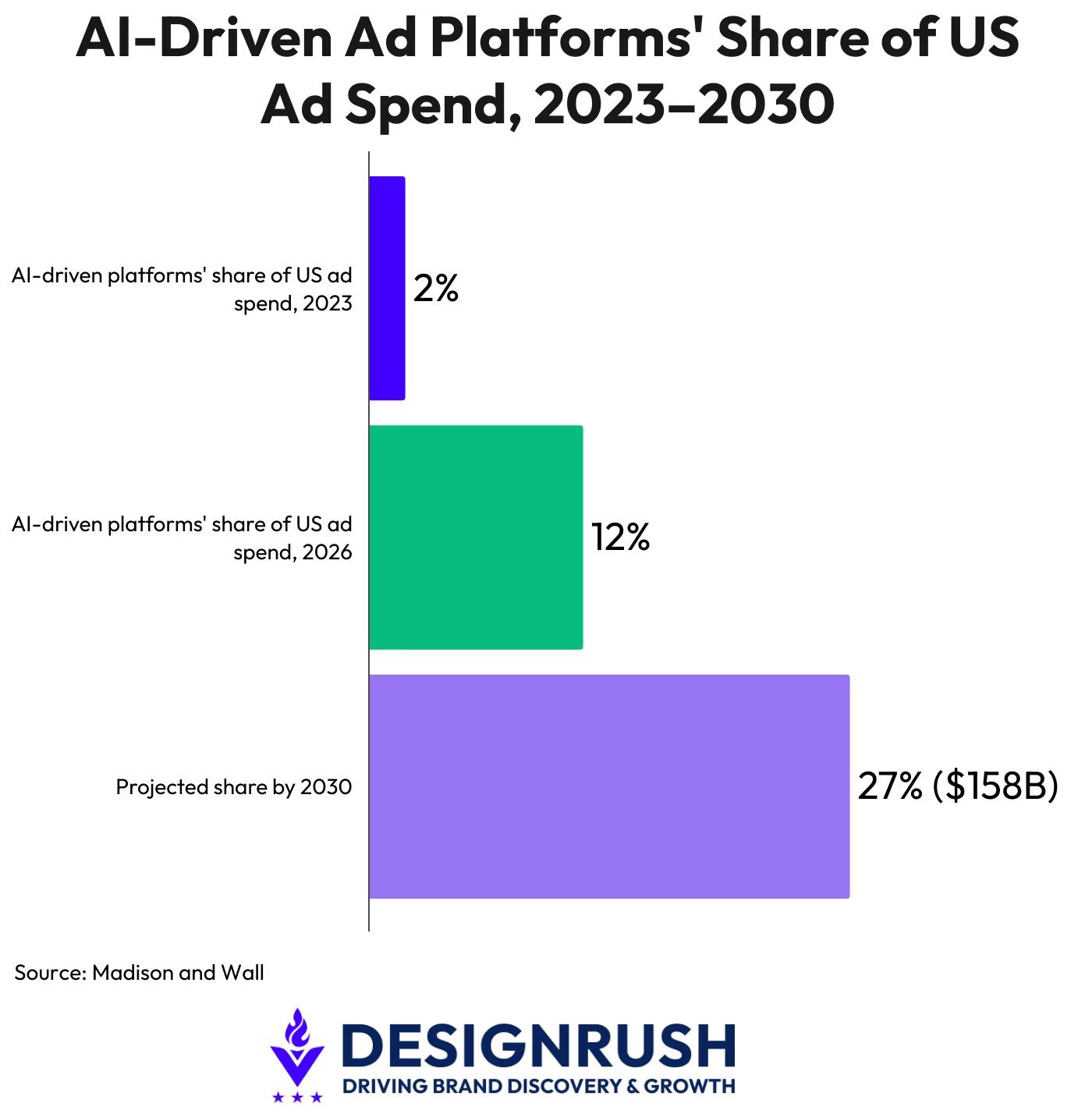
- Automated ad platforms already handle 12% of US ad spend, a share projected to hit 27% by 2030.
One company spent the week giving AI agents human names. Another spent it asking for a kill switch. Here's the story behind each.
Our Take: Who Decides When a Deadline Becomes an Emergency?
Only one. Salesforce's agents are live today. Everything else on this list is a countdown.
Microsoft's new rules don't apply to any model before 2027, and Anthropic's kill switch remains a proposal.
Delaware's threshold doesn't bind until January 2027. Madison and Wall's 27% is a 2030 projection built on a 12% base that's still climbing toward it.
We'd argue that the distinction matters more than which company is behind each one. A live product needs an audit. A future deadline needs a plan.
A team that treats a 2027 compliance date with this week's urgency wastes the exact runway it has to get it right.
Salesforce Debuts Seven AI Agents
Salesforce introduced seven named "job-ready" Agentforce agents on September 11, each built for a specific business function.
Casey handles customer service, and Paige covers IT and HR. Carter runs commerce, Marshall handles supply chain, and Piper works pipeline generation. Most are generally available now.
Hunter, the outbound sales agent, stays in pilot until November. It also runs inside Slack, Teams, and Claude, carrying the same guardrails it has in Salesforce.
Fin, the customer agent, resolves complex customer experience workflows across every channel, powered by two new components:
- Operator, a customer operations agent,
- Fin Apex, a set of custom models trained specifically for CX.
Alongside the agents, Salesforce introduced Agent Script, an open-source language for combining AI reasoning with deterministic rules.
The timing lines up with Dreamforce, the CRM software company's annual flagship conference, which opens today in San Francisco.
It reported 7 billion "Agentic Work Units" delivered across Agentforce and Slack over the past two years, 3.2 billion of them in the second quarter alone.
Those are figures the company reported, not an independent audit.
Microsoft Drafts AI Rules, Anthropic Wants a Kill Switch
Microsoft published a provisional code of conduct for its own AI models on September 14.
The rules bar future MAI models from acting on requests tied to weapons, dangerous substances, or violent content.
They cover development starting in 2027, not anything already running in Copilot or Azure AI.
Models also can't hide or alter their own reasoning steps. That's the detail that matters most for any team auditing an agent's decisions after the fact.
For an agency building marketing agents on Copilot or Azure AI, the reasoning-transparency rule is the one to track.
A future MAI-based agent won't be able to hide the reasoning behind a decision. A client asking why a campaign moved a certain way gets a real answer instead of a guess.
Mustafa Suleyman leads Microsoft's AI model development.
AI should be "always working in service of people and not trying to replace them," he told CNBC, citing feedback about dependence and sycophancy behind the new rules.
Microsoft sets limits for future AI models as industry throttles frontier development https://t.co/dx5yPiYIk8
— CNBC (@CNBC) September 14, 2026
An AI kill switch may need to become mandatory instead of left to individual labs, Anthropic co-founder Jack Clark told the BBC. He said it should be verifiable by an outside party.
Most labs have some way to shut a system down, he said, but a version a regulator can independently verify is a different problem.
A US bill called the Kill Switch Act already proposes exactly that, giving regulators power to demand a shutdown.
The UK government rejected the same approach this year. Clark isn't ready to put a number on the risk.
"We are rolling dice with immense risks," he said.
Neither the Microsoft rules nor the kill switch idea has taken effect, so what ships in a Copilot or Azure AI build this week hasn't changed.
Delaware Lowers the Bar on Data Privacy
Governor Matt Meyer signed House Bill 380 into law on September 2. The threshold for Delaware's Personal Data Privacy Act drops from 35,000 to 10,000 consumers.
Businesses earning over 20% of revenue from selling personal data face an even lower bar, just 5,000 consumers.
The amendments take effect on January 1, 2027. They reach further into daily marketing work than the headline threshold suggests.
Even sharing a customer list with a co-marketing partner now requires a documented data protection impact assessment.
So does feeding personal data into HubSpot or Salesforce. The same goes for buying a lookalike audience from a data broker or retargeting through Meta Pixel.
The bill covers more ground than marketing alone, including new limits on AI-driven hiring tools and sensitive-data sales.
The threshold change is what pulls the most new businesses into scope.
AI Ad Platforms Could Hit 27% of Spend by 2030
Automated and AI-driven campaign types like Google's Performance Max and Meta's Advantage+ handled 12% of US ad spend in 2026, Madison and Wall projected.
That's up from just 2% in 2023, and the firm expects the share to reach 27%, or $158 billion, by 2030.
 Meta's own numbers tell the same story. Advantage+'s run rate hit $75 billion in the second quarter of 2026, CFO Susan Li said.
That's up from the $60 billion mark Mark Zuckerberg announced in the third quarter of 2025.
The IAB backs that up too, separately raising its 2026 US ad spend growth forecast to 12.3% from 9.5%.
It cited strength in social, CTV, and commerce media, partly tied to the Winter Olympics and the World Cup.
It's a different move from the visibility-measurement standard the IAB set for AI search earlier this year, but it comes from the same body.
A forecast like this shows where budgets are moving, not whether that money performs any better than what it replaced.
The decision to shift spend into an automated campaign type still rests on a brand's own conversion data, not on an industry-wide adoption curve.
What This Means for Compliance and AI Governance
Two of these four changes converge in the same year. Delaware's threshold and Microsoft's rules both take hold in 2027, worth mapping now instead of waiting for it to arrive.
So here are three checks worth running before locking in next year's plan.
- Map every tool touching customer data against Delaware's new 10,000-consumer threshold. A business that never needed a DPIA before may need one now.
- Track whether your AI vendor's safety commitments are binding or aspirational. Microsoft's code of conduct and Anthropic's kill switch proposal are both still drafts, not requirements to audit against yet.
- Check whether Salesforce's AI Control Plane really governs your non-Salesforce tools. That claim hasn't been tested outside Salesforce's own ecosystem.
A pending law, a draft policy, and an unverified vendor claim share one thing. Year-end planning shouldn't treat any of them as settled.
Last week's roundup covered Meta's $17 billion teen settlement and Nvidia's Hugging Face acquisition, plus Reddit's new engagement metric.
If a deadline is still two years out, why does it feel like this week's emergency?
These leading AI companies help brands navigate compliance and automation changes before they show up in a performance report.