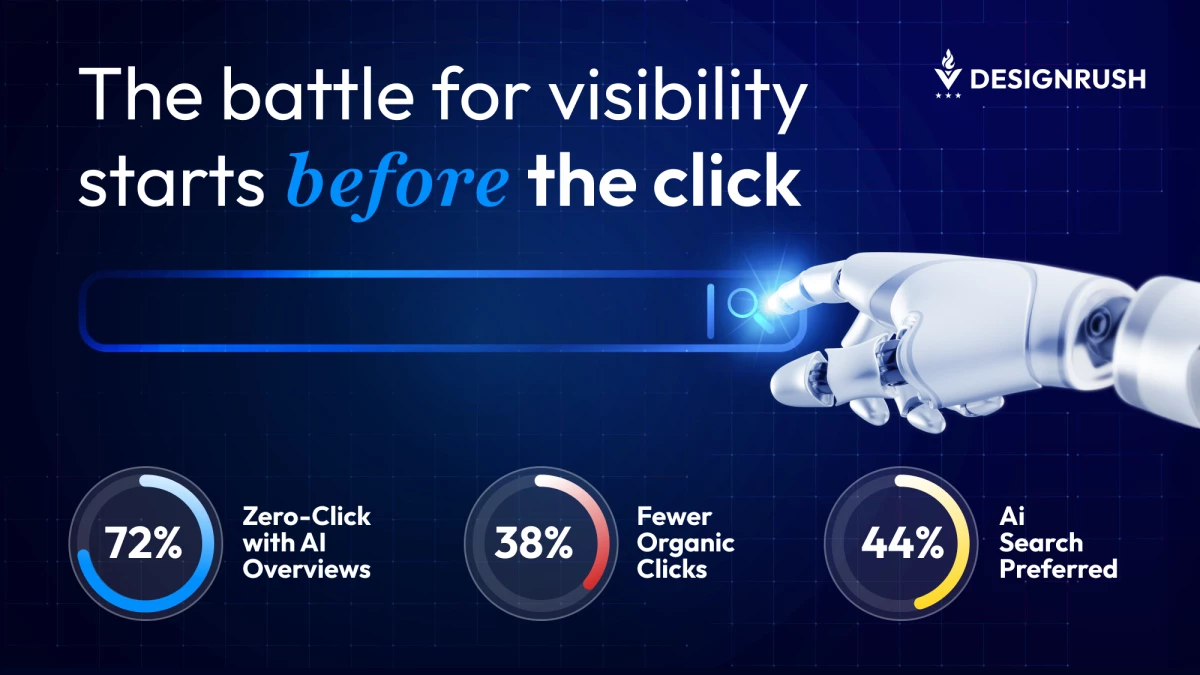

A randomized field experiment by the Indian School of Business and Carnegie Mellon University found that Search queries with AI Overviews saw organic clicks fall by 38%, while zero-click searches increased from 54% to 72%.
These findings were reported by Search Engine Journal.
Search satisfaction barely changed when those AI summaries were removed.
This fits with what McKinsey & Company is seeing in consumer behavior.
The strategy and management consulting firm found that 44% of users said that AI search is their primary and preferred source of query insight, 31% ahead of traditional search, 9% of retailer or brand websites, and 6% of review sites.
It also found that more than 70% of AI-powered search users ask top-of-funnel questions to learn about a category, brand, product, or service.
This means the answer arrives before the click, and it’s also why the old SEO comfort blanket is fraying.
Furthermore, a brand’s own website only accounts for 5 to 10% of the sources AI search references, and even top brands can disappear from some answers.
It just goes to show that owning a website isn’t enough when the engine pulls from affiliates, user-generated content, and other third-party sources.
Instead, the job of a website is changing.
How Brands Appear in AI Answers
AI systems typically surface brands based on how consistently they appear across trusted external sources, how clearly their entities are defined, and how easily their content can be extracted and summarized.
Between July 2024 and February 2025, AI-driven traffic to retail websites jumped more than tenfold, Adobe found.
By February 2025, those visits had a 23% bounce rate, 12% more page views, and 41% longer visit duration than non-AI traffic.
This is the practical case for GEO, or generative engine optimization.
Intero Digital works with brands on this problem directly, focusing on how they appear inside AI-generated answers.
Its GEO approach centers on improving how entities are understood by answer engines, strengthening structured content, and increasing visibility across the external sources these systems rely on.
“If AI search is where buyers start now, the question should be whether a brand gets cited, summarized, mentioned, or trusted inside the answer itself,” says Christina Adame, president of SEO and GEO at Intero Digital.
According to McKinsey, the winning brands improve their visibility and positive sentiment on AI summaries and AI platforms.
“They also rethink how they structure and amplify their content, influencing the broader set of sources that AI-powered search uses to generate answers,” Adame adds.
This is where GEO comes in.
GEO accounts for the fact that AI search pulls from a mixed set of sources, not just a brand’s own domain.
It also accounts for AI search being the deciding factor in influencing decisions before a user reaches a website.
The play is to make the brand more visible in the sources that search engines rely on while making owned content clearer, more structured, and easier to extract.
“AI Overviews are interrupting the chain from ranking to traffic and revenue by resolving intent before users reach a website,” says Adame.
“The problem is that many brands are still measuring search success through rankings and traffic alone.”
That worked when users had to click through to find information, but is now less useful as AI systems increasingly provide the answer themselves.
Why Rankings No Longer Guarantee Inclusion
A strong keyword position no longer guarantees inclusion in an AI-generated response.
The system can just as easily surface competitors, third-party commentary, or aggregated sources instead of the brand’s own content.
But being “found” is less important than being represented correctly inside the answer itself.
“The impact is influence moving away from owned channels and into environments where traditional SEO reporting does not reach,” Adame adds.
Intero Digital argues that GEO requires brands to move away from focusing only on keywords and rankings.
According to the agency, visibility in AI search depends on how well AI systems understand a brand and its products, services, and areas of expertise.
That means optimizing content and the entities and relationships that help large language models determine relevance and authority.
The agency's GEO framework focuses on several areas, including:
- Analyzing how AI systems interpret a brand
- Identifying which sources generative engines rely on
- Structuring content for AI retrieval
- Implementing schema and structured data
- Increasing visibility through digital PR and strategic brand mentions
The agency also places significant emphasis on external signals.
“AI systems draw from a broad mix of publications, forums, datasets, and online communities when generating responses,” says Adame.
“Visibility increasingly depends on where a brand is discussed and referenced across the web, not just what appears on its own website.”
If AI-generated answers influence decisions before users reach a website, brands need a way to affect the sources, entities, and signals those systems rely on when constructing a response.
The new challenge is ensuring that when AI systems assemble an answer, the brand is part of the information being used to create it.