
As AI has become part of the buying journey, the first conversation many customers have with a brand no longer happens with the brand itself.
Before visiting a website or speaking to a company, many people now ask AI which products to choose, which businesses stand out, and, ultimately, which brands deserve their trust.
For brands, that means they no longer control every first impression.
And even though 53% of U.S. consumers don't trust AI-powered search results, according to Gartner's 2025 Consumer Community Survey, the distrust hasn't stopped AI from becoming a part of how people research companies, compare products, and decide where to spend their money.
It's a contradiction that David Kessler, CEO of leading branding and creative agency Starfish, has been watching closely.

Who Is David Kessler?
As the Founder and CEO of Starfish, David is renowned in the industry for his strategic acumen, business savvy, and customer focus that has driven the agency for more than 20 years.
"Customers aren't always experiencing the brand a company intended them to see, but meeting AI's version of it first," Kessler explains.
"Brands now have to be built to survive interpretation."
When AI Introduces Your Brand Before You Do
Before someone reaches a company's website, they've often already been introduced to the brand by AI.
For Kessler, that's where many organizations misunderstand what's really happening.
"Companies often think they're still sending messages to customers, but they're not," he says. "They're publishing source material, and AI is reconstructing a signal from it."
At Starfish, that process is known as lossy reconstruction.
"It's the phenomenon in which a brand's meaning is compressed, flattened, or inadvertently conflated with competitors during AI-mediated translation," Kessler adds.
The idea is borrowed from information theory, where compression always comes at a cost, and some details are often left behind. Kessler believes that this is where brands are beginning to face the same trade-off.
AI isn't intentionally changing the story but shortening it. And somewhere in the process, parts of the brand inevitably get lost. Most of the time, it's the details that make people remember it in the first place.
That's where the relationship between brands and customers begins to change in three ways:
1. Brands Become Source Material
Every website, product page, campaign, and article now serves a second audience. AI draws on that information to answer questions, compare companies, and explain what a brand stands for.
Before a brand can connect with people, AI has to understand it first. And before customers hear directly from a business, AI has often already pieced the story together.
2. Brands Appear Across Multiple AI Experiences
Someone might first encounter a brand through ChatGPT, Google's AI Overviews, Gemini, Claude, Perplexity, or an AI shopping assistant. Ask the same question in different places and there's no guarantee you'll get the same answer about the same company.
3. AI Doesn't Protect Brand Identity
AI optimizes for utility to the user, not fidelity to your brand.
"If your brand strategy doesn't give AI something structurally distinctive to work with, the AI will use its discretion and present its best guess," Kessler explains.
Those guesses are already influencing how people discover new businesses. In a Semrush survey of more than 1,000 U.S. shoppers who use AI tools, 43% had discovered a new brand through AI.
Why Emotional Connection Is Harder to Build in the AI Era
People don't usually remember brands overnight.
The connection takes time to develop, be that through a helpful conversation with a member of staff or a product that exceeds expectations.
Eventually, those moments stop standing out on their own and become the reason people keep coming back.
"The common fear is that AI drains the emotion out of a brand by being cold and utilitarian," Kessler says. "That risk is real, but it's a surface reading. The deeper issue is structural."
A great example of this is Trader Joe's.
People don't become loyal because of one shopping trip. They remember the crew members, the handwritten chalkboard signs, the Fearless Flyer, and product names that feel a little unexpected.
And while none of those details defines the experience on its own, together, they create something instantly recognizable.
"Compression destroys texture," Kessler says.
Some of the details that make a brand memorable don't survive a summary. They're easy to experience but much harder to condense.
Moreover, Kessler adds that averaging destroys the opportunity for differentiation.
AI models learn from vast amounts of information, and unless a brand has clearly established what makes it different, it drifts toward the middle of its category.
Here, Trader Joe's starts sounding more like Aldi. Patagonia begins resembling a more environmentally conscious North Face.
The characteristics that inspire loyalty are often the same ones most vulnerable to disappearing during summarization.
But that doesn't mean that emotional branding becomes impossible.
"Emotional connection becomes harder by default," Kessler adds. "It becomes achievable by design."
Starfish built a diagnostic tool for exactly that.
ALBERT.ai evaluates an organization across four dimensions, covering its key attributes and characteristics, core competencies, customer needs, and ambitions.
Kessler starts from the idea that brands can't assume people will work out who they are on their own. A company's emotional and philosophical core needs to be defined as clearly as everything else.
Regardless of how someone gets to know a company, the picture they leave with should always be the same.
When that picture is consistent, AI doesn't have to guess.
What AI Actually Remembers About Your Brand
Some brands still sound like themselves when AI talks about them. Others end up sounding much like everyone else.
Kessler notes that the difference here isn't accidental and has led to the development of Starfish's High-Fidelity Brand Strategy framework.
Built around five elements, the framework is designed to help a brand hold onto what makes it distinctive, even after AI has condensed the story.
1. Semantic Boundary Conditions
Most companies spend their time explaining what they are. Kessler argues they should spend just as much effort explaining what they aren't.
"We're not disruptive. We're restorative. We're not ambitious. We're grounded," Kessler adds.
Those kinds of explicit boundaries reduce the chance of AI drifting into neighboring categories or describing a company using language that fits a competitor better.
2. Differentiation Invariants
These are the qualities that remain true no matter where customers encounter the brand.
"If deliberate scarcity as a form of curation defines Trader Joe's, that idea survives whether AI explains it in one sentence or twenty," Kessler says.
3. Canonical Definitional Language
A brand's distinctive language gives AI something specific to use rather than falling back on generic descriptions.
Terms like Trader Joe's "crew members" and the "Fearless Flyer" become distinctive markers that AI associates with one company.
"AI is a pattern-matching system," Kessler says. "And the distinctive language used becomes a brand's fingerprint."
4. Narrative Coherence
Brands with a consistent story running through everything they publish give AI something stronger than a list of features.
"If your purpose consistently comes through in every customer interaction, AI has a narrative it can follow instead of assembling disconnected facts."
5. Verified Functional Claims
AI favors what it can verify. This means that evidence, measurable results, and a proven track record are more likely to make it into a summary than claims about being innovative or customer-focused.
"And while emotion still matters, it needs to be anchored to something concrete," Kessler says.
How Brands Can Influence What AI Says
The answer isn't controlling AI. It's helping AI understand the company before anyone asks the question.
This is particularly relevant given that many organizations still treat AI as something happening around them rather than something actively learning from everything they publish.
"AI is already reading your website, your press releases, your reviews, and your thought leadership," Kessler adds.
"It will reconstruct your brand whether you take part or not. The only question is whether you've given it something worth reconstructing."
The first step is creating a canonical brand reference.
Many companies document their visual identity but leave the meaning behind the brand scattered across strategy decks, executive presentations, and institutional memory. Kessler argues that isn't enough anymore.
"The brand strategy shouldn't live as a PDF sitting in a shared drive," Kessler explains. "It should exist as a structured, machine-legible reference that clearly defines your identity."
That reference should explain the company's purpose, differentiation, semantic boundaries, defining language, narrative, and evidence-backed claims in a way that's clear for both people and AI systems.
Kessler recommends asking platforms such as ChatGPT, Gemini, Claude, Perplexity, and Google's AI Overviews to describe the brand, explain its category position, and identify what makes it different.
"The gap between how you describe yourself and how AI reconstructs you is your fidelity loss," he says. "You can't close a gap you haven't measured."
Sometimes those summaries closely match the intended positioning. Other times, they expose generic language, weak differentiation, or unexpected similarities with competitors.
Those gaps are often the first sign that a brand isn't coming across the way it was intended.
Kessler argues it's time to replace sentiment with structure.
Words like innovative, authentic, customer-centric, and passionate are everywhere. They sound positive, but they could describe pretty much any business.
Brands should be specific, he says. Vague language produces vague reconstruction. The more distinctive the language, the easier it is for both people and AI to recognize what makes the brand different.
Kessler encourages organizations to go a step further by developing what he calls owned semantic territory.
"Build vocabulary, frameworks, and concepts that belong to you," he explains. "AI can't replace language that exists nowhere else."
That doesn't mean inventing terminology for the sake of it. It means giving the market a distinct way of understanding the problem the company solves, supported by language competitors aren't already using.
Rather than treating AI as an external technology, organizations should begin treating it as another stakeholder. Brand strategy now has to account for a non-human reader as well as a human one.
Every product page, executive interview, article, customer review, and press release contributes to the picture AI builds of a brand.
"You should be asking one question every time you publish something," Kessler says. "'If AI had to summarize this tomorrow, would it understand what actually makes us different?"
Consistency is where most brands fall short. 75% of shoppers say a consistent experience across websites, apps, email, social media, and stores is important, while only 41% say brands deliver it, according to Adobe's 2025 AI and Digital Trends Retail Report.
A memorable brand isn't built only on polished messaging. People have to experience the same company every time they interact with it. And that's the version AI is far more likely to reflect accurately.
The companies that thrive won't be the ones producing the most content, but the ones making every piece of content reinforce the same unmistakable identity.
How Brands Stay Memorable When AI Does the Talking
Many organizations are still asking the wrong question.
"The honest answer is that you cannot prevent compression," Kessler says. "AI will always compress. The goal is not to avoid compression. It's to control what survives it."
For years, brands focused on breadth of expression, creating more messages for more audiences. AI changes that equation. Today, depth of definition matters far more.
"AI doesn't reward breadth. It rewards coherence," Kessler adds.
Brands with one clearly defined identity are far more likely to survive AI summaries than those relying on dozens of disconnected messages.
Three principles determine whether a brand remains memorable after AI has condensed it:
1. Irreducibility
If a brand can be reduced to a single sentence that could describe anyone else, the problem isn't the copy. It's the brand.
"The issue isn't the wording," Kessler says. "It's that the brand hasn't defined itself clearly enough."
2. Linguistic Ownership
Brands that develop distinctive language, frameworks, and concepts give AI something unique to associate with them.
Trader Joe's crew members and the Fearless Flyer aren't just branding. They're the language people immediately associate with one company.
3. Structural Documentation
Brand identity can't exist only in internal strategy documents or inside the minds of leadership teams.
"Meaning that lives only inside your company is invisible to AI," Kessler says. "But meaning that's written down, consistently expressed, and publicly available has a much better chance of surviving reconstruction."
Why Trust Has Become a Brand's Greatest Competitive Advantage
Customers are often evaluating a reconstruction before they ever experience the original brand.
"The underlying brand has to become more trustworthy, not less," Kessler adds.
He compares it to hearing someone describe another person's character.
People with a clear reputation are usually described consistently, even by different people. But those who appear inconsistent often sound like entirely different individuals depending on who's telling the story.
Brands with a clearly defined identity create stronger signals for AI to recognize and repeat. The stronger those signals become, the more faithfully AI tends to represent the brand. Conversely, those with vague positioning leave far more room for interpretation.
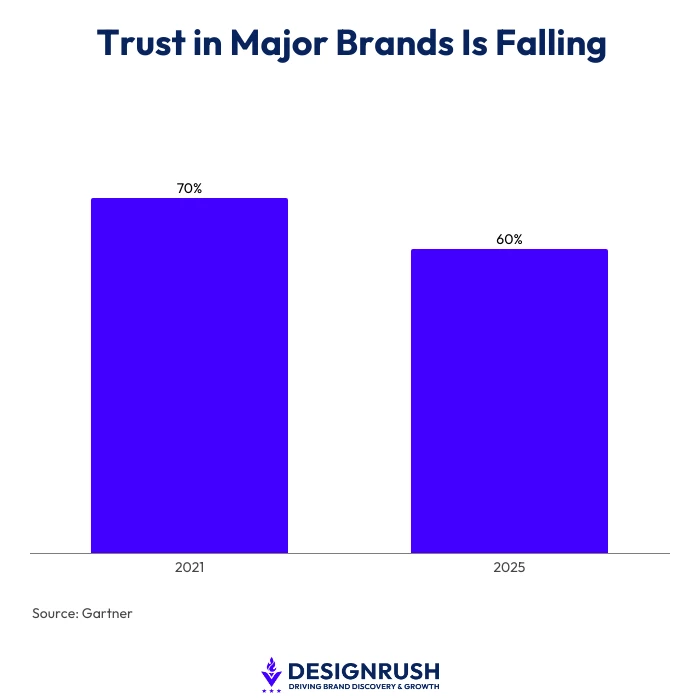
That consistency matters even more as trust continues to fall. Gartner found that trust in major brands among UK consumers dropped from 70% in 2021 to 60% in 2025.
To mitigate this, Kessler advises that brands focus on three things:
1. Provenance
As AI-generated content becomes more common, people will pay closer attention to where information comes from and whether the organization behind it has earned a credible track record.
2. Consistency
People notice when the brand AI describes doesn't match the one they experience. That gap is hard to ignore.
3. Specificity
Brands that clearly define who they are, and who they aren't, give people something real to remember. Generic promises rarely do.
"The brands that win on trust will be the ones whose identity is so precisely defined, so consistently expressed, and so well documented that AI has little choice but to represent them accurately," Kessler concludes.
So if AI continues to become the first voice people hear, perhaps the question brands should be asking isn't how to stand out, but whether they're giving AI something distinctive enough to remember in the first place.