
AI in eCommerce: Key Findings
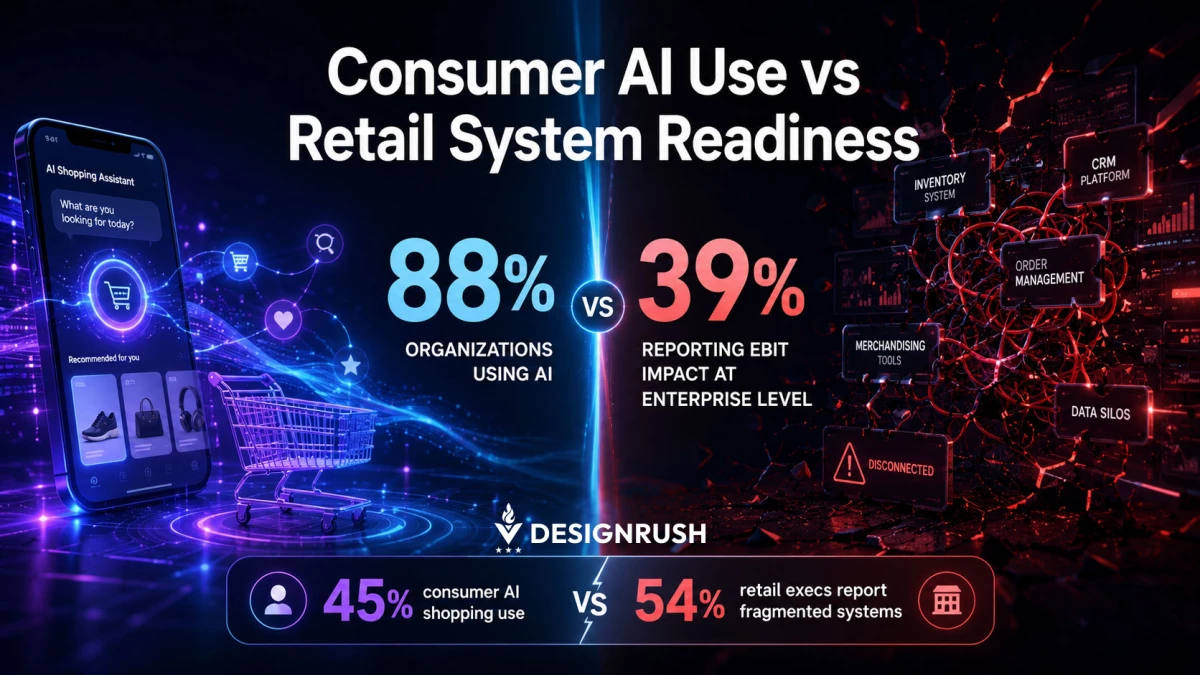
- AI in eCommerce adoption is 88%, but only 39% see EBIT impact, so brands should focus on execution alignment across product and operations instead of scaling AI tools in isolation.
- With 64% of desktop and 63% of mobile eCommerce sites still underperforming in checkout UX, companies should fix core journey and checkout design before layering AI features that can’t compensate for broken flows.
- As 45% of consumers already use AI in shopping and 54% of retailers report fragmented systems, brands should prioritise integration across channels to make AI usable in real customer journeys.
Shoptalk 2026, recently held in Mandalay Bay, Las Vegas, brought retail and digital product leaders together to try and make sense of a familiar yet increasingly uncomfortable reality: that AI is everywhere, but scaling isn’t the hard part.
Making it work in real operations is.
For David Barlev, founder and CEO of Goji Labs, the event reflected a turn from experimentation to execution.
“One of the biggest takeaways for me was that AI is no longer being treated as a future differentiator. It’s quickly becoming table stakes,” he said.
About 88% of organizations now use AI in at least one business function, but only 39% report EBIT-level impact from AI at the enterprise level, according to McKinsey’s 2025 State of AI report.
And that is to say, AI adoption is high, but enterprise-level value is still limited.
Editor's Note: This is a sponsored article created in partnership with Goji Labs.
AI Is Now Widespread, but Value Is Uneven
What stood out at Shoptalk wasn’t AI itself, but how unevenly it’s being applied in production environments.
According to Barlev, real value comes from system redesign, not feature layering.
“The value isn’t in shipping the most advanced thing the fastest. The value is in designing the right product experience around it so that it’s useful, intuitive, and sustainable over time,” he said.
This gap between adoption and impact aligns with McKinsey’s finding that most organizations still operate in partial deployment modes rather than scaled AI systems.
There’s another recurring product issue inside retail teams.
Across the various Shoptalk sessions, teams described pressure to move faster with AI while still managing operational complexity once systems reach production.
“The challenge now is not just what a product can do, but how clearly it helps users do it,” Barlev noted.
The second theme he observed was a sharper focus on user experience fundamentals.
“There was a clear emphasis on making interfaces feel lighter, more guided, and more adaptive rather than simply adding more functionality,” he said.
Considering that 64% of desktop ecommerce sites and 63% of mobile sites still perform at a “mediocre or worse” level in checkout UX, the issue is clearly persistent across large-scale retail platforms.
This is according to Baymard Institute’s 2025 checkout UX benchmark research.
Performance is also part of the user experience, and not just a separate technical concern.
“I also noticed a stronger focus on performance as part of the user experience, not just as a technical metric,” Barlev noted.
“Fast load times, clean handoffs between touchpoints, fewer steps to complete an action, and more thoughtful mobile interactions all came up repeatedly.”
That framing carries into how users experience products in practice.
They don’t separate design and performance; they experience both as one outcome.
Consumers Are Already Using AI Before Retailers Catch Up
One of the clearest external signals influencing retail strategy comes from IBM and the National Retail Federation’s 2026 consumer research.
The study found that 45% of consumers now use AI during their shopping journey, especially for product research and comparisons.
But 54% of retail executives report fragmented systems across channels that limit consistent AI execution.
This is a big integration problem, as it created a timing mismatch.
Consumers are using AI-assisted discovery, but many retail systems aren’t equipped to respond consistently across all those touchpoints.
Barlev connected this issue to product execution.
“The challenge is not just whether systems can talk to each other. It’s whether that connectivity actually creates a better product experience,” he said.
The issue came up repeatedly at Shoptalk, but now the focus is on whether connected systems improve decision-making and usability.
Checkout Reality Shows Where Experience Breaks Down
Another topic that made the rounds at Shoptalk was where product teams have to focus their optimization efforts.
The average large eCommerce site can improve conversion rates by up to 35% through checkout UX improvements alone, Baymard Institute’s 2025 research shows.
However, around 70% of online shopping carts are still being abandoned due to issues tied to checkout design, flow, and clarity.
Barlev described this as a broader pattern emerging across teams.
“The value isn’t in shipping the most advanced thing the fastest. The value is in designing the right product experience around it so that it’s useful, intuitive, and sustainable over time,” he said.
McKinsey’s data reinforces this execution gap: AI adoption is high across organizations, yes, but only a minority have managed to scale it into workflows that produce consistent enterprise outcomes.
“Integrations came up a lot, but the conversation felt different this year. It wasn’t just about connecting tools for the sake of connectivity. It was more about building systems that can adapt as teams evolve,” Barlev added.
And that shift exposed a core challenge in enterprise product work: that systems are easier to connect to than they are to sustain.
What Brands and Agencies Should Do Next
AI has already passed the threshold of experimentation within enterprises.
The real constraint for brands and agencies now is whether product, engineering, and operations teams are aligned enough to turn AI into consistent outcomes rather than isolated features.
That puts more pressure on internal workflows than technology choices.
Most digital products are still being judged on UX debt that sits in plain sight.
Checkout and core journey issues continue to suppress performance even in mature eCommerce environments, which means optimization work focuses on removing structural friction that has accumulated over time.
In practice, this is where structured strategy sprints are often used to align teams, clarify priorities, and stress-test assumptions before full build decisions are made.
And with consumer behavior running ahead of internal retail systems, and many organizations still relying on fragmented data and disconnected channels, the implication is coordination across systems that were never designed to operate as a single experience layer.
Execution is now defined by what survives after launch.
The differentiator is whether systems remain usable, integrated, and coherent once they hit real users and real operational pressure.