AI in eCommerce Dispute Systems: Key Findings
- Post-purchase is becoming a critical part of eCommerce infrastructure, as disputes and exceptions are increasingly built into core transaction systems.
- Most AI systems fail due to poor integration and overlooked edge cases, so teams should focus on how decisions connect to real workflows and scale under pressure.
- Effective eCommerce AI systems rely on structured design and control layers, with clear data, defined boundaries, and fallback mechanisms ensuring consistency.
As eCommerce keeps growing, what happens after a purchase is starting to matter just as much as the transaction itself.
Disputes and chargebacks are piling up, and for many businesses, that part of the experience is becoming harder to manage.
Case in point, Visa processed more than 106 million disputes globally in 2025, up 35% since 2019, according to CNBC.
To keep up with the pace, Visa introduced six new dispute-focused AI tools, with half aimed directly at merchants dealing with that growing volume.
These tools were designed to shorten resolution times and reduce the need for manual review, making dispute handling faster and more consistent.
The video below explains exactly what chargebacks are and what happens behind the scenes when a credit or debit card transaction goes wrong:
Why eCommerce Systems Are Under Pressure
For product teams working across fintech and eCommerce, this pressure isn’t new.
It’s been building beneath the surface as transaction volumes outpace the systems designed to support them.
Multidisciplinary software design and development agencies like Shakuro have been designing around that reality, particularly where operational complexity begins to affect speed, cost, and reliability.
Their work across eCommerce solutions reflects a growing need for platforms that can handle what happens after payment with the same level of precision as the transaction itself.
Alex Chaly, Chief Technology Officer at Shakuro, explains that while disputes have traditionally been handled as support tasks, they’re becoming part of the core transaction infrastructure.
“The focus is moving from handling exceptions to designing systems where exceptions are predictable and manageable.”
That’s where a lot of teams still struggle. They treat exceptions as something unusual, instead of building systems that expect them from the start.
The video below outlines the rise of AI tools across the financial industry, with the likes of JPMorganChase recently launching tools to streamline processes:
The Rising Cost of Chargebacks
Teams are no longer just reacting when something goes wrong. They are starting to design systems that expect issues to happen and deal with them as part of the flow.
That’s why post-purchase is starting to feel like a second checkout. It’s the point where the experience either holds up or starts to break.
For business leaders, it means treating post-purchase as part of the product itself, not something that sits off to the side in support.
The financial impact reinforces that urgency.
According to a 2025 analysis from Mastercard, the true cost of a chargeback extends well beyond the original transaction, factoring in fees, operational overhead, and lost goods, often costing merchants multiple times the initial purchase value.
Cost is only part of the picture.
According to Custom Market Insights, the global retail eCommerce market was valued at $3.5 trillion in 2022 and is projected to reach $7.9 trillion by 2032, increasing the volume and complexity of post-purchase interactions that businesses need to manage.
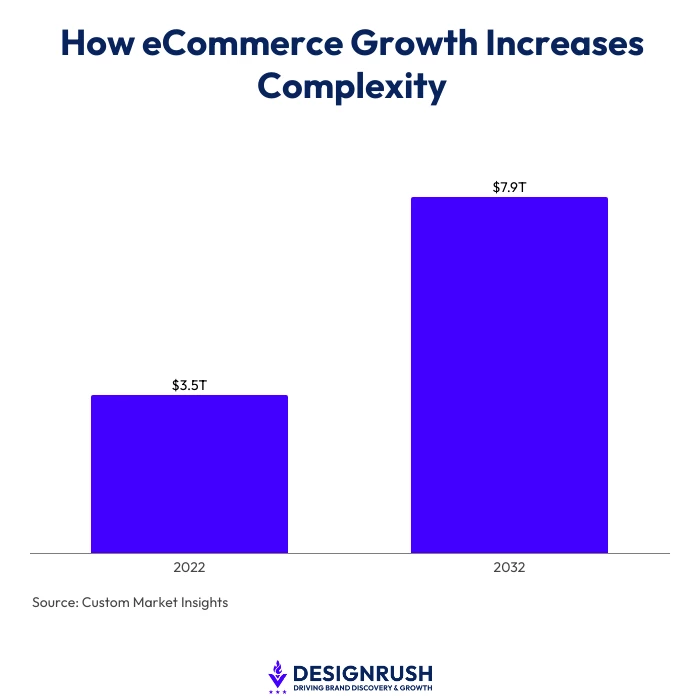
Scale is no longer just about transactions, but about how well systems handle everything that follows them.
How AI Dispute Tools Should Be Built
As transaction volumes climb, consistency becomes harder to maintain, and harder to ignore. What used to be handled as exceptions now needs to be accounted for upfront, built into the way systems operate from the start.
“Accuracy at scale depends on data quality, system boundaries, and fallback mechanisms,” Chaly says. “You need consistent, well-structured data and clearly defined decision scopes, along with safeguards that prevent failure in edge cases.”
This is where the difference shows. Systems usually hold up when everything goes as expected, but they start to struggle when something falls outside the norm.
That’s where validation rules, confidence thresholds, and fallback paths come into play. They help teams stay in control as things get more complex.
It also changes how teams think about building these tools. It’s less about adding new features, and more about how everything connects to real workflows and decision logic.
What starts to change is how decisions are handled.
Most systems don’t rely on a single layer of automation anymore. The work gets split. Some parts deal with uncertainty and patterns, while others are there to keep things consistent and within clear rules.
That balance is what allows systems to scale without becoming unpredictable.
Antom shows why AI-powered tools are revolutionizing payment processes to prevent disputes:
Why AI Tools Fail at Scale
But even with the right tools, many teams fall short because of how systems are implemented.
“One mistake is treating AI as a standalone solution rather than part of a system,” Chaly says. “Without proper integration into business logic and workflows, even accurate models don’t deliver value.”
That disconnect becomes more visible as systems grow. Tools that aren’t embedded into real workflows struggle to influence outcomes, regardless of their accuracy.
For leadership teams, the priority is not just adopting AI, but ensuring it operates within clearly defined systems that can support it at scale.
The difference comes down to structure.
eDesk shows 10 ways to leverage AI into an eCommerce business:
How Edge Cases Break AI Systems
Where systems often break isn’t in common scenarios, but in the ones that happen less frequently.
“Teams often underestimate edge cases and long-tail scenarios, which are common in financial systems,” Chaly says.
“Another issue is underestimating the importance of monitoring and iteration after deployment.”
These issues don’t always surface immediately. They build over time, particularly when systems lack proper observability.
Logging, monitoring, and feedback loops are what help teams catch issues early and keep improving performance over time. Without them, small problems can quietly build into something much harder to fix.
That’s where many systems fall short. Not in the usual cases, but in the situations they weren’t designed to handle.
Alex and his team’s experience reflects this.
Shakuro has built dispute systems that reduce manual review while maintaining auditability, helping businesses resolve cases faster without introducing risk.
YouTube channel, Learning to Code With AI, delves into edge cases and how to use AI to handle them:
Why AI Transparency Builds Trust
As systems take on more responsibility, user expectations begin to shift.
“Users don’t need to understand the algorithm,” Chaly says. “They need to understand the outcome.”
That distinction shapes how trust is built. Clear explanations, consistent behavior, and the ability to challenge decisions matter more than technical transparency.
In practice, that also means giving users a way to challenge or override decisions when needed, so they retain a sense of control.
Without that clarity, even accurate decisions can feel unreliable.
And for brands, trust is no longer just about accuracy, but about how clearly decisions are communicated and controlled.
Walter Lironi, Visa’s Head of Value-Added Services for CEMEA, explains why the adoption of responsible AI with bolster trust in the payments sector:
How Brands Scale eCommerce AI Safely
Growth introduces pressure in different ways, from increased transaction volume to more variability across edge cases.
“The main challenge is maintaining consistency under growing variability,” Chaly says. “We approach this by separating concerns, with AI handling probabilistic decisions while deterministic systems enforce rules and constraints.”
That separation allows systems to scale without becoming unstable. Observability then ensures performance stays visible, giving teams the ability to adjust before issues escalate.
Post-purchase operations need to be treated as part of the product, not an extension of support. That means designing systems that can explain decisions, handle exceptions without constant escalation, and maintain consistency as volumes increase.
Visa’s latest rollout makes one thing evident.
The transaction is no longer the defining moment in commerce. What happens after it is where systems are tested, and where businesses either absorb friction or design it out before it ever happens.