
Most of the advice you hear on whether to hire an agency or build an in-house marketing team is, to put it bluntly, outdated.
It relies on the same tired oversimplification you’ve no doubt heard countless times in that agencies are fast but expensive, whereas in-house is focused but hard to scale.
A volatile economy has forced brands to squeeze agency retainers. Generative AI has turned execution into a commodity, forcing teams to redefine what "work" actually looks like.
That pressure is showing up in marketing budgets too, where Gartner found that budgets remained flat at 7.7% of company revenue for a second consecutive year
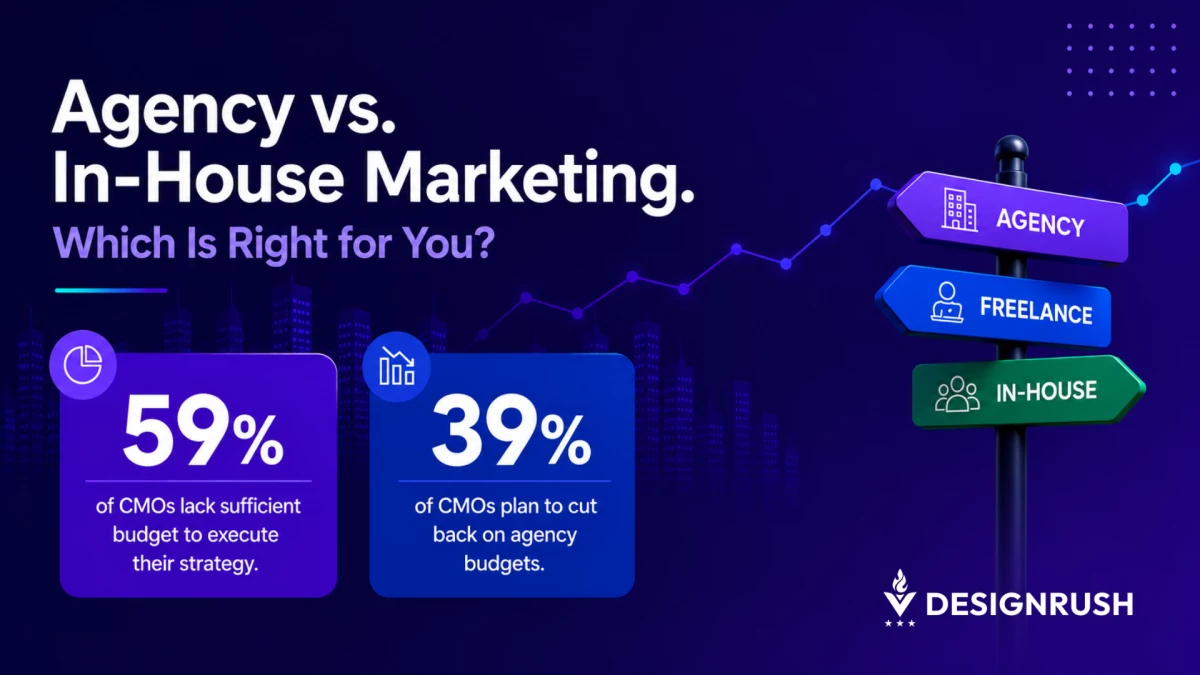
Meanwhile, 59% of CMOs said they still lack sufficient budget to execute their strategy.
Up-and-coming marketing talent is also actively shunning traditional employment in favor of "portfolio careers," a trend recently highlighted by Reuters.
At the same time, major players are centralizing highly specialized roles, as illustrated by Apple’s high-profile move to hire a dedicated VP of AI Marketing.
Having spent the last 18 years navigating all three worlds (as an agency leader, a solo freelancer, and now an in-house executive), I can tell you that the decision often comes down to three things:
- Understanding where each path structurally fails
- What talent actually costs today
- How to build a team that doesn't fall apart from the inside
And that can sometimes be easier said than done.
The Real Strengths and Weaknesses of Marketing Agencies
For early-career marketers, agencies provide quite the training ground. Managing multiple accounts exposes professionals to various business models, industries, and platform dynamics in a more compressed timeframe.
This variety helps create marketers who understand how to launch campaigns and analyze performance data quickly.
For the brand hiring them, however, the structural incentives of the agency model eventually create operational friction.
Conflicts With Utilization Metrics
Most marketing agencies structure their strategies around metrics like billable hours and client retention, so their profitability relies on maximizing the number of accounts an individual strategist can handle.
What you get is that when macroeconomic pressures squeeze margins, agencies then need to optimize their internal staffing ratios.
This means the senior strategist who led the initial pitch frequently transitions into a high-level oversight role, leaving daily execution to mid-level or junior managers who are also juggling up to a dozen other accounts.
Unfortunately, that pressure is unlikely to ease anytime soon, with Gartner finding that 39% of CMOs plan to reduce agency spending.
The Scope of Agency Expertise
Over time, agency professionals become highly specialized in agency operations rather than general business growth. They excel at platform mechanics, creative testing, and their client communication becomes second nature.
The problem here is that they operate externally, and in turn are rarely exposed to the broader realities of running a business.
Agency teams can have a tough time seeing a client’s internal profit and loss (P&L) statements, inventory challenges, cross-departmental product roadmaps, or organizational politics.
They are structured to deliver specific channel outputs, which means they do not (and largely cannot) own the ultimate business outcomes or defend marketing spend directly to a CFO.
When Freelance Marketers Make Sense
A newfound reliance on independent consulting is shaping how teams build and deliver on their strategies.
Experienced freelancers are now choosing to manage their own portfolio of clients rather than climbing traditional corporate ladders.
If you’ve ever worked with or as a contract specialist, you know that it often includes direct, highly focused execution on a specific challenge, such as a complex search infrastructure setup or a specialized copy audit, without agency markups or full-time employment overhead.
The thing is, relying on independent contractors introduces clear operational boundaries that brands must learn to navigate.
The Capacity Bottlenecks of Single-Operator Models
A solo consultant’s business model is inherently limited by their personal time.
Compared to an agency or an in-house department, a freelancer has no internal team to absorb sudden spikes in campaign volume, manage administrative details, or provide cover when they are sick or taking time off.
If a brand needs to scale its operations quickly or execute a multi-channel campaign, a single operator can rapidly become a critical bottleneck.
The Diagnostic Limitations of Channel-Specific Experts
Freelancers are typically hired to solve highly specific, pre-defined problems. Because their business relies on their core expertise, they naturally view your growth challenges through the lens of their specific skill set.
A freelance paid media specialist will almost always look for performance solutions within the ad accounts they manage.
If your hiccups lie in a slow product onboarding flow, poor pricing strategy, or a broken checkout page, a specialist focused purely on acquisition will struggle to diagnose or fix the underlying business issue.
The Biggest Risks of In-House Marketing Teams
Building an internal marketing department allows an organization to align its growth team directly with its unit economics, product roadmap, and customer feedback loops.
When successful, an in-house team develops deep institutional knowledge that external partners can rarely replicate, integrating marketing strategies directly with executive vision.
That said, these teams don’t come without systemic risks.
The Erosion of Platform Competency in Single-Brand Sandboxes
The most common drawback of a permanent in-house structure is the rapid decline of a cross-industry perspective.
While agency specialists constantly observe algorithm shifts, budget performance, and consumer behavior trends across dozens of accounts simultaneously, in-house marketers operate within a single business sandbox.
Without exposure to diverse environments, internal teams can easily fall into an operational echo chamber.
And after the course of a few years, what was once a killer marketing strategy can turn into "just the way we do things here."
On top of that, platform skills can stagnate, leaving the brand vulnerable to competitors who are actively deploying modernized, cross-industry strategies.
How High-Stakes Internal Structures Incentivize Risk-Averse Execution
In an agency environment, losing a client is a manageable setback, where the agency simply reallocates resources.
For an in-house marketer, however, the stakes are highly personal. A failed product launch, a poorly performing campaign, or a misallocated budget can lead directly to restructuring, budget freezes, or layoffs, as we’ve seen, especially as more and more investment is directed at AI.
Even so, many organizations remain cautious about how they apply the technology. The same Gartner study found that 27% of marketing organizations still report limited or no adoption of generative AI.
This high-risk environment often means that instead of pitching bold, high-impact strategies that could drive significant growth, internal teams are incentivized to default to safe, conventional campaigns.
Your Marketing Structure Is Not Set In Stone
After 18 years of navigating these structures, the most critical lesson I have learned is that none of these paths are permanent. The marketing organizational chart you design today is not a lifetime commitment.
When I was in my twenties, agencies handed me the high-volume reps and cross-industry exposure I needed to build a foundational skill set.
Later, freelancing forced me to master the actual business of marketing, from client acquisition and pricing negotiation to managing my own P&L.
And today, leading an in-house team lets me apply those skills to go deep on a brand’s long-term strategy.
If your organization is currently struggling to scale, the solution is rarely to fire your agency, hire a new freelancer, or build a massive in-house department in a vacuum. Instead, look closely at your current bottleneck:
- If you lack skills and platform data, look to the diversified volume of an agency
- If you lack execution on a specific technical problem, bring in an experienced freelancer
- If you lack strategic alignment and deep product integration, that’s when you’d invest in your in-house team
If I can leave you with one important piece of advice, it’s that the most successful brand leaders accept the structural trade-offs of their chosen path, actively manage its inherent points of failure, and remain agile enough to restructure when the market demands it.