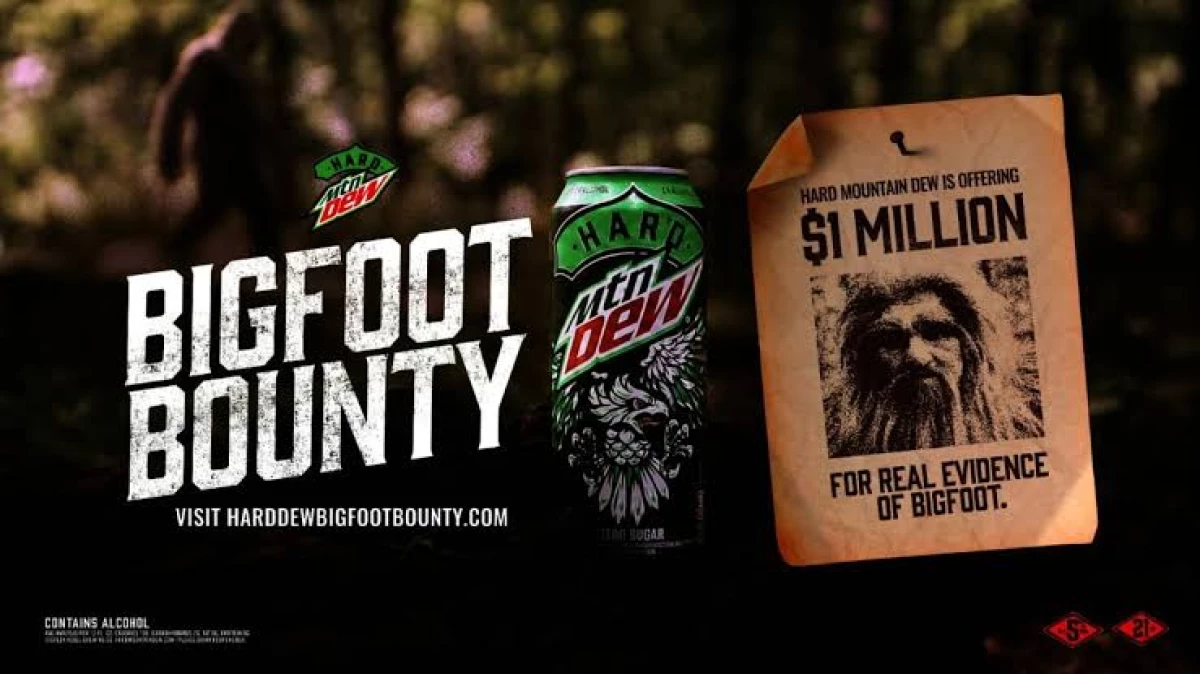

No one has had substantial evidence that Bigfoot exists, and Hard Mountain Dew is offering $1 million the first person who can prove it.
The brand's first "Bigfoot Bounty" opened September 16 and runs through November 30, inviting fans 21 and older to submit evidence at HardDewBigfootBounty.com.
To be considered, entrants need at least four of the seven accepted evidence types, and the specs are where the campaign shows its hand:
- A paw print measuring 37 to 38.5 inches long
- A clearly documented 13-inch handprint
- Night vision footage of a seven- to nine-foot heat signature moving 20 to 25 mph through dense forest
- A hair sample containing unknown DNA markers
- An audio recording of high-frequency vocalizations, knocks, or calls
- Environmental remnants with no machinery or storm damage nearby
- A photo showing what appears to be Bigfoot
Hard Mountain Dew is offering a $1 million prize to anyone who can provide verified proof that Bigfoot exists pic.twitter.com/pHOP6WTw8g
— Dexerto (@Dexerto) September 16, 2026
To make things more interesting, entries will be judged against standards co-developed with Bigfoot researcher Bryce Johnson.
He stars in and produces "Expedition Bigfoot," a docuseries following a team of Sasquatch specialists.
Erica Taylor, senior brand director for Hard Mountain Dew, sees the hunt as an extension of a seasonal habit.
"Every fall, someone's got a story of a shape in the trees or a sound they can't explain," Taylor said.
"Whether you catch Bigfoot or just catch a good story trying, there's nothing better than an ice-cold Hard Mountain Dew at the end of the hunt."
View this post on Instagram
The window lines up with peak Bigfoot sighting season, when cooler temperatures push more people outdoors, and softer ground holds tracks longer.
Hard Mountain Dew is timing its promotional marketing to a season that already sends people into the woods.
This approach saves the brand the work of creating the behavior it needs.
The Consolation Prize Comes With Its Own Fine Print
Landing the full $1 million requires evidence that would upend decades of failed sightings.
Which is why Hard Mountain Dew built in a smaller, certain payout.
Up to 100 randomly selected entrants who submit valid evidence get reimbursed for one pack, paid out as $20 in cash, while supplies last.
So the backup prize is neither guaranteed nor automatic, even though the brand sells it as a guaranteed win.
Everything runs through the microsite, where the rules, entry form, and evidence guidelines sit in one place.
@thebigfootfiles HARD MTN DEW just put a $1 million bounty on Bigfoot. Here’s what you need to know. #bigfoot#hardmtndew#bigfootbounty#onemillion#bigfoothunters♬ original sound - thebigfootfiles
Brands have attached real money to a long shot before, and Boston Beer has now done it twice this year.
Truly Hard Seltzer ran the same belief-driven play in June with "Drink Like a Believer," tied to the U.S. men's national soccer team.
Boston Beer produces both Truly and Hard Mountain Dew, and both promotions only pay out in an outcome almost nobody expects.
Sweepstakes keep showing up because they ask for participation without asking for a purchase.
Entrants hand over an email address and a piece of content, and the brand gets both for the cost of a prize pool it controls.
The Bounty Rests on 28% of the Country
The premise only works because a meaningful share of the country is already primed to believe it.
About 28% of Americans say Bigfoot definitely or probably exists, according to a YouGov survey of 1,114 adults conducted in November 2025.
Outdoor recreation hit a record 183.2 million U.S. participants in 2025, with 59% of Americans age six and older taking part, per the Outdoor Industry Association.
These numbers put Hard Mountain Dew's odds in context.
A sizable audience already leans toward belief, and a much larger one spends time in the settings the contest asks people to search.
Three takeaways stand out:
- Borrow credibility instead of claiming it: Attaching the contest to a researcher with standing in the space keeps verification from resting on the brand's word alone.
- Build in a guaranteed outcome: Paying 100 entrants a free 12-pack regardless of their evidence keeps participation worthwhile even for fans who know they'll never find real proof.
- Match the calendar to the premise: Running the window through peak sighting season links the mechanic to a real-world condition, giving the contest a built-in reason to exist right now.
A cash consolation prize doesn't require Bigfoot to be real. It only requires enough people willing to look for evidence of its existence.
Our Take: What Happens to the Fans Who Don't Win?
Hard Mountain Dew wrote a $20 reimbursement into the terms and called it a guaranteed win.
We think that the fans who don't win are the actual product, because the campaign only works at volume.
The $1 million heading is the hook, and the criteria are written tightly enough that nobody clears them.
The real return sits in the volume of amateur trail-cam photos, half-serious hair samples, and posts people share while trying.
Every publicly posted submission does more for recall than a paid placement.
The best part for Hard Mountain Dew is that the grand prize will almost certainly go unclaimed.
Explore these top brand strategy agencies in our directory to turn existing equity into something that still lands.