
Systems for Agency Growth: Key Findings
- Most founders think they’re delegating, but vague handoffs lead to rework, making clear outcomes essential to save time and margin.
- Operational leaks don’t hit the balance sheet, but show up as churn and burnout, which is why systems must scale before sales do.
- Scale fails without clarity, so define ownership and process early to avoid breakdowns when growth kicks in.
Growth without systems is almost always chaos.
Yet, many agencies scale the frontend (clients) faster than the backend (ops).
Don't believe us? Check out the data.
In 2025, 54% of workers across industries reported using AI in the past year, but only 14% used it daily, according to a PwC report.
This gap reveals the real issue: experimentation is up, but true integration still lags.
In agencies, where time and margin are always under pressure, the difference between dabbling and systematizing AI is what separates scalable firms from stuck ones.
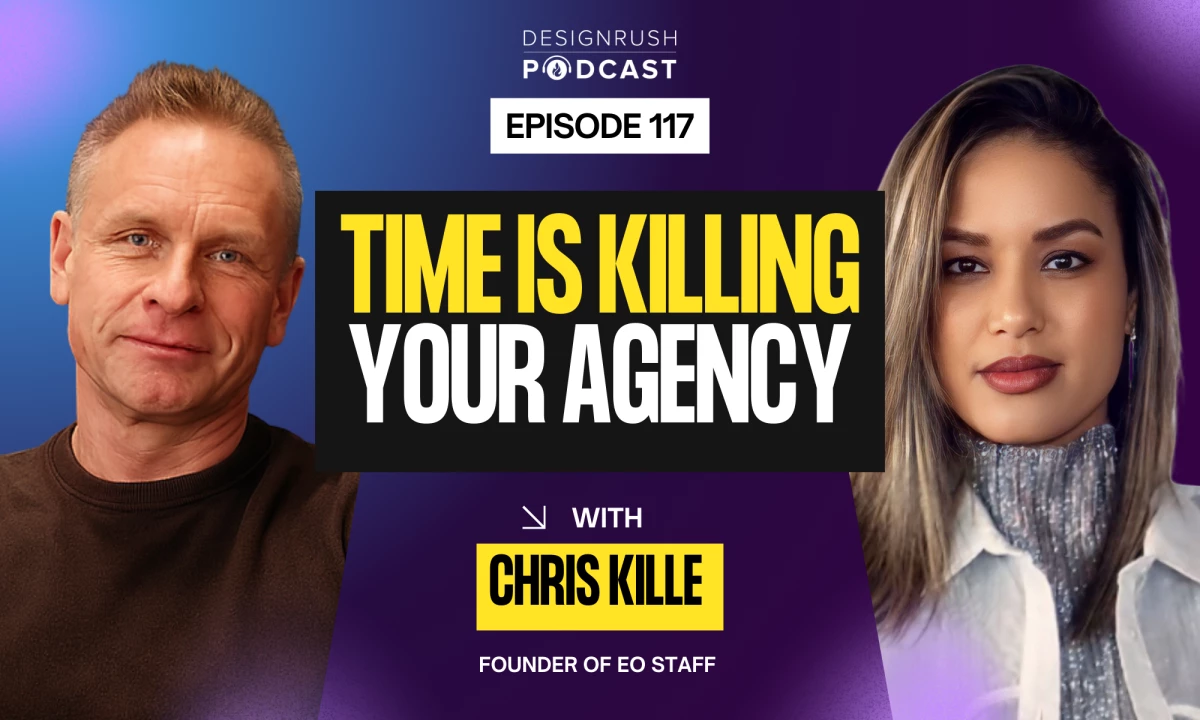
Chris Kille, CEO of EO Staff, joined the DesignRush Podcast to unpack how systems thinking, strategic delegation, and support structure now define whether agencies scale or stall.
EO Staff helps founders reclaim 10 to 20 hours a week by removing $10 per hour tasks from their plate and replacing reactive chaos with proactive systems.
Watch the full episode now on YouTube or listen on Spotify.
How Smart Operators Buy Back Time and Margin
Agency founders aren’t short on effort.
The real problem is working on the wrong things without the right systems in place.
These three practical shifts show how to get out of the weeds and start building real momentum.
1. Fix Delegation with a 'Definition of Done'
Most agency leaders don’t have a delegation problem.
They have a clarity problem.
They hand off tasks, then circle back to recheck or redo them, wasting time and margin.
Kille teaches a system called the “definition of done,” a way to describe what success looks like before a task starts.
"Rather than just saying, hey, I need you to go do this, right, it's like, okay, Kia, here's the thing that we're gonna be working on together. Here's what it looks like when it's successfully completed," Kille says.
2. Triage the Inbox to Reclaim Your Time
Your inbox is not a task list. It’s a public to-do list that anyone can add to.
Kille shares how delegating inbox management helped him focus, reduce distractions, and regain control of his day. Even without a VA, CEOs can use time blocks, filters, and escalation rules to triage communication.
"My assistant, Faye, is in my inbox all day long organizing.
So I never see spam. I never see solicitations. I never see anything that doesn't require my attention because she understands, you know, how we do things, where things are supposed to go, who does what."
3. Scale Operations Before Clients
Founders often assume more clients mean more margin. But that formula breaks when onboarding fails or support lags.
Kille stresses that operational infrastructure must come before scaling sales.
That includes project tracking, team ownership, onboarding processes, and early churn signals.
"Churn is what kills businesses in general.
If you can keep a customer over and over again with that monthly recurring revenue set up, if you're set up that way, then, know, sky's the limit.
But when you start churning and the bottom starts falling out, it's like you're on the treadmill or sometimes even moving backwards," Kille says.
Why Inbox Discipline is More than Hustle Culture
Kille doesn’t believe in hustle. He believes in time blocks.
He color-codes his week by focus type: admin days, creative days, and no-meeting days.
With a $10 desk timer, he trains himself to protect deep focus.
The takeaway?
Founders scale because they’re focused.
When to Hire a VA (And When Not To)
Kille recommends hiring support staff as soon as revenue hits $300K per year.
Below that, founders can use systems and time management to buy time.
But above that threshold, time-saving becomes profit-driving.
A well-trained VA removes distractions and ensures nothing falls through the cracks.

About Chris Kille
Chris Kille is the founder and CEO of EO Staff, a systems-first staffing firm helping business owners reclaim time and scale sustainably. With two decades of entrepreneurial experience, Chris has scaled and exited businesses by focusing on operational clarity and remote team building. He’s been featured in Forbes, Entrepreneur, and over 100 media outlets, and is the author of The Rise of Virtual Assistants.
Why Founders Who Scale Stop Doing It All Themselves
Kille’s closing message isn’t about tools or tactics.
It’s about mindset.
“The ones who actually achieve that vision versus the ones who don't are the ones that can let go and trust that they've made the right hire… and trust that their team can get it done," Kille says.
Scaling isn’t about doing more.
It’s about creating the structure that lets others do the right work without constant oversight.
Founders who grow successfully don’t micromanage.
They create systems that clarify ownership, define outcomes, and make support repeatable.
As production gets faster and cheaper, thanks to automation, the human side of operations becomes even more important. Relationships, judgment, and service are what keep clients loyal.
“When you take that personal touch out of any relationship, you've now turned it into a commoditized relationship," Kille says.
If 2026 is the year to scale, the goal isn’t to move faster. It’s to move smarter.
That starts by letting go of tasks, building the trust and systems that make momentum sustainable.
Watch the full episode now on YouTube, or listen on Spotify.