
Key takeaways:
- Improving email response times can lead to better productivity and happier customers.
- Email analytics offer a deeper look into team performance and how your team communicates.
- Tracking email trends over time helps businesses make smarter, data-driven decisions.
Considering that almost 90% of U.S. marketers use email for customer retention, wouldn’t it be prudent to also focus on optimizing email response times?
Many businesses overlook the impact of email response efficiency, yet small improvements can yield significant gains in productivity and customer satisfaction.
Take HR Covered, for example. By using EmailAnalytics, the human resources company improved its response times by 70% and its Customer Satisfaction Score (CSAT) from 7.9to8.6.
Impressive, right?
In our interview, EmailAnalytics’ founder and CEO Jayson DeMers shares how email analytics can be used to not only improve response times but also optimize team productivity, boost customer service, and drive data-driven decision-making across departments.

Who is Jayson DeMers?
Jayson DeMers is the founder & CEO of EmailAnalytics, an app that visualizes email activity and enables teams to measure and improve email response time. He's also the founder of OutreachBloom, a Seattle-based b2b email outreach agency. Jayson graduated from the University of Washington in 2008 with a degree in Business Administration and immediately entered the field of online marketing. Since then, he has authored hundreds of articles as a frequent contributor to publications including Forbes, Inc., The Huffington Post, Entrepreneur Magazine, and Search Engine Land.
Did you know that there are often overlooked insights within email data that could significantly impact productivity?
Jayson says that it’s unfortunate that many businesses fail to recognize the impact of neglecting their email data:
“These hidden metrics become powerful tools when teams use them to implement targeted improvements in their email management strategies. The tools also reveal critical patterns that would otherwise go unnoticed — like peak email times, average response times to clients, and communication bottlenecks.”
So, what should leaders pay attention to? Jayson highlights four key insights that can drive better decision-making and operational efficiency:
- Communication efficiency gaps: Long email chains often signal inefficiencies. If a conversation extends beyond four or five replies, it might be a sign that a quick call or meeting could have resolved the issue faster. Leaders can use this insight to shape smarter communication policies and free up valuable time.
- Response time disparities: Are internal emails getting faster responses than customer-facing ones? Identifying gaps between internal and external response times can help businesses ensure that customer interactions are prioritized without disrupting internal workflows.
- Workload imbalances: A deep dive into email data can reveal whether some employees are handling a disproportionate number of emails while others have bandwidth to spare. Leaders can use this to optimize team capacity, prevent burnout, and improve overall efficiency.
- Peak productivity windows: Not all working hours are equally productive. Email trends can highlight when teams are most responsive and effective, allowing leaders to align key tasks — such as customer communications or decision-heavy meetings — around these peak performance windows.
This is where email tracking technology takes the first step to gaining detailed insights into engagement and communication patterns.
Maximizing Productivity with Email Tracking
By going beyond simple read receipts, email tracking allows businesses to monitor when emails are opened, response times, email volume, and communication patterns between team members and clients.
“It provides comprehensive analytics that can transform how organizations understand and optimize their email communication,” Jayson says.
He highlights four key reasons why tracking email metrics is essential for scaling operations:
- Improved productivity: Seeing and improving email response times enables agents to boost their chances of securing sales, customer satisfaction, and internal team productivity and efficiency.
- Enhanced accountability: Managers can ensure important emails aren't lost.
- Better customer service: Organizations can monitor and improve their response times to client communications.
- Data-driven decisions: Leaders can make informed decisions about workload distribution and staffing needs.
The takeaway is that properly tracking email metrics yields benefits for both the business and its employees.
Jayson notes this and a natural human desire for improvement are why most teams typically embrace email tracking enthusiastically:
“The analytics create a naturally engaging experience that motivates people to improve their email habits. Team members often get excited to see their own email statistics, particularly their response times, and it creates a positive, game-like environment where they're motivated to enhance their performance.”
“It's similar to how people respond to fitness trackers — when you can measure something, you naturally want to optimize it. Our users often report that the visibility into their email metrics has helped them become more efficient and responsive communicators.”
Email tracking definitely seems to be a handy-dandy tool, especially since limited visibility into email activity is a common challenge for businesses.
Unlocking Insights for Better Performance
According to Jayson, email tracking addresses this issue by providing comprehensive insights into what was previously “a black box of communication.”
This raw data can be churned into actionable intelligence that helps businesses understand and optimize their email operations.
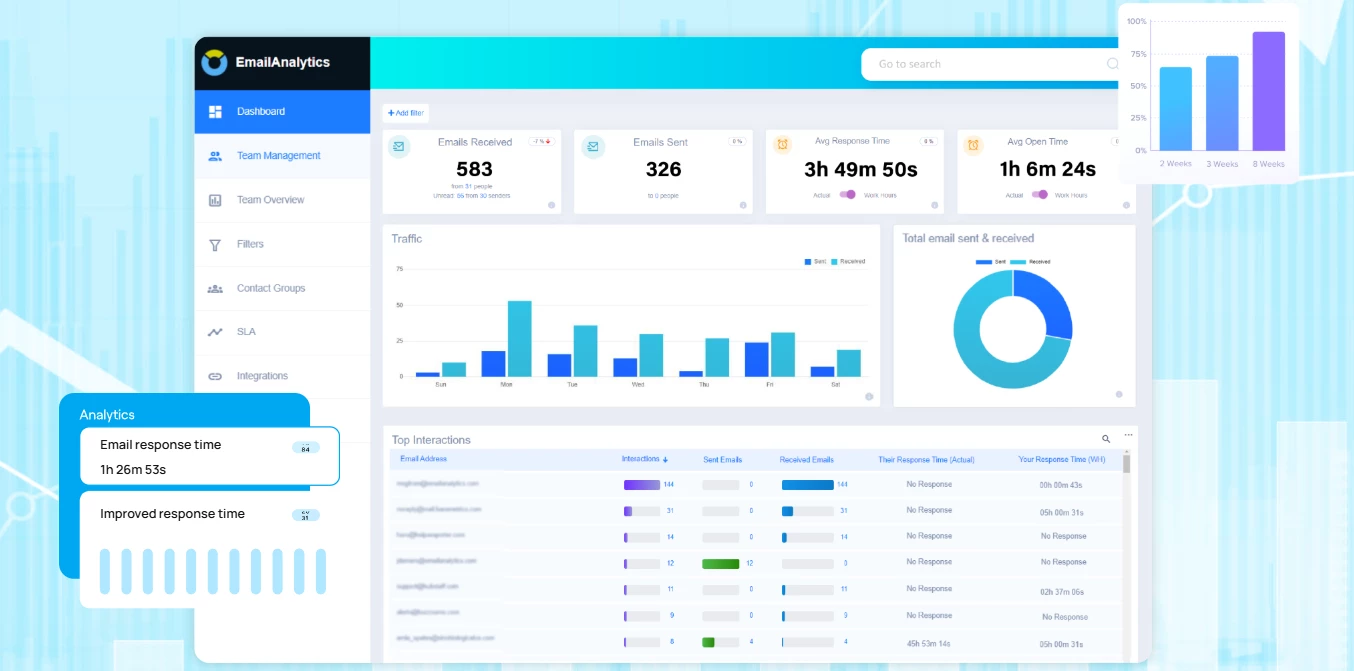
“For example, managers can see exactly how many emails their team members are handling, identify who might be overwhelmed with volume, and spot team members who excel at quick response times."
"This visibility enables data-driven decisions about workload distribution, staffing needs, and process improvements.”
On top of that, the tool reveals crucial patterns in email times, average response times to clients, and communication bottlenecks.
Having access to this data unearths opportunities for improvements — whether adjusting staffing schedules to match peak email periods or implementing automated responses during off-hours.
“Most importantly, this visibility creates accountability and helps establish clear performance benchmarks."
"Teams can set concrete goals for metrics like response times and track progress toward those goals, turning email management from a subjective challenge into an objective, measurable process that can be continuously improved,” Jayson adds.
However, he points out that certain best practices should be put in place to set realistic email performance benchmarks.
The most effective approach, Jayson notes, is implementing automated email reports that deliver key metrics directly to each team member.
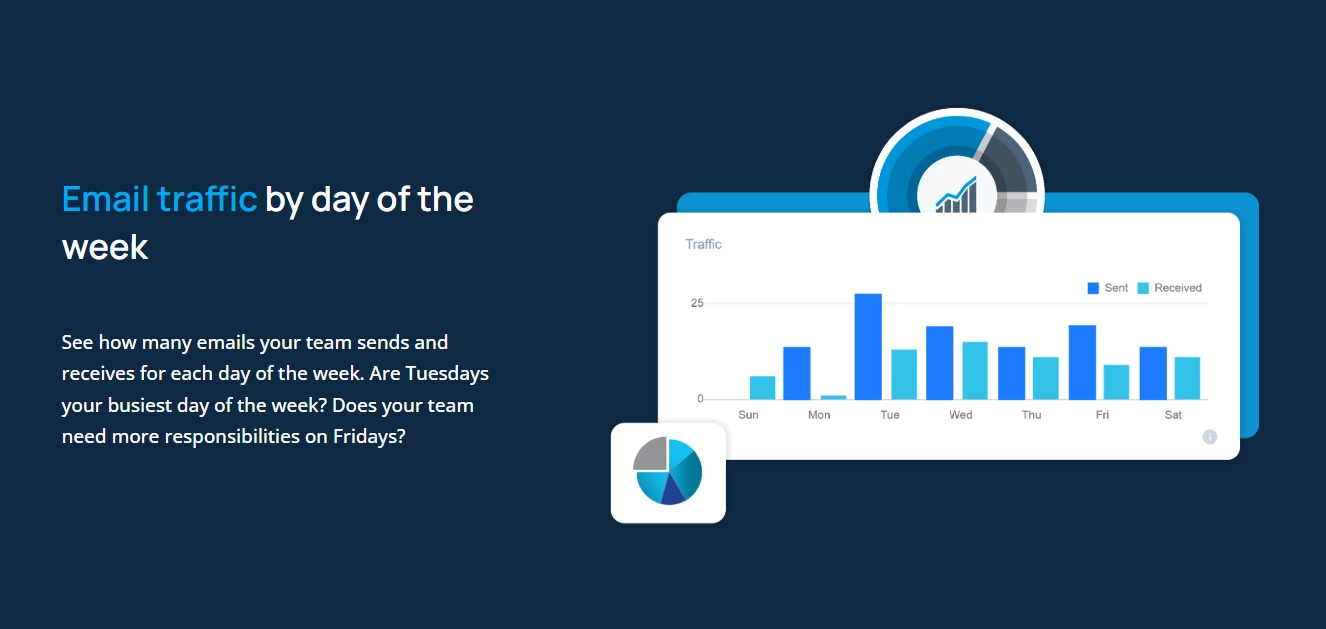
These reports, which can be set up either daily or weekly, provide metrics like total emails sent and received, and average email response times.
“At EmailAnalytics, we've found that simply making these metrics visible drives natural improvement.”
“What makes this approach particularly powerful is its simplicity. When team members can see their own metrics, especially response times, they naturally become motivated to improve.”
Having this level of transparency creates a positive feedback loop where team members can:
- See their metrics
- Identify areas for improvement
- Adjust their habits to enhance their performance
- Track their progress in subsequent reports
Despite the simplicity, these benchmarks shouldn’t feel punitive, Jayson says. Instead, they should serve as tools for personal and team improvement.
“We've consistently seen that when teams can visualize their email metrics, they become more engaged with their email activity and naturally work to optimize their performance."
"Most importantly, this approach doesn't require complex implementation or extensive training. The metrics themselves do the heavy lifting by creating natural accountability and motivation for improvement."
Tracking Long-Term Trends for Growth
The next step is assessing the long-term impact of email tracking on productivity.
To do this, EmailAnalytics developed its own platform to maintain complete historical data, allowing organizations to track their email communication evolution over months and even years.
The agency’s system syncs and preserves all email data to track historical trends. This enables companies to analyze their performance improvements, dating back to even before its implementation.
“This allows organizations to see how key metrics like response times have evolved over extended periods, providing concrete evidence of productivity gains,” Jayson adds.
According to Jayson, tracking historical data gives a clearer picture of the following:
- Email response time evolution: Compares current response times against historical baselines to demonstrate sustained improvement
- Email volume management: Tracks how teams handle email workloads over time
- Communication patterns: Identifies long-term shifts in peak email periods and workload distribution
- Team efficiency metrics: Monitors how individual and team performance evolves
But the real power lies in the ability to pull historical data from any time period.
“For instance, a company can compare current performance against metrics from two years ago, providing clear evidence of productivity improvements and ROI.”
Having access to this historical perspective is invaluable. It empowers companies to justify technology investments, implement effective process changes, anticipate seasonal trends, and set strategic goals for continuous improvement.
“By maintaining this comprehensive historical record, organizations can demonstrate concrete productivity gains and continuously refine their email management strategies based on proven data rather than assumptions,” Jayson reiterates.
The best thing about it is that different departments, like customer support, sales, and internal operations can all use email analytics to address their unique productivity needs.
For example, rapid email response time is huge for sales. Faster responses equal happier customers, which equals more sales.
Past research has proven that leads contacted within the first hour are seven times more likely to clinch the deal.
This is where EmailAnalytics steps in to help the sales team track and optimize their response times to potential customers.
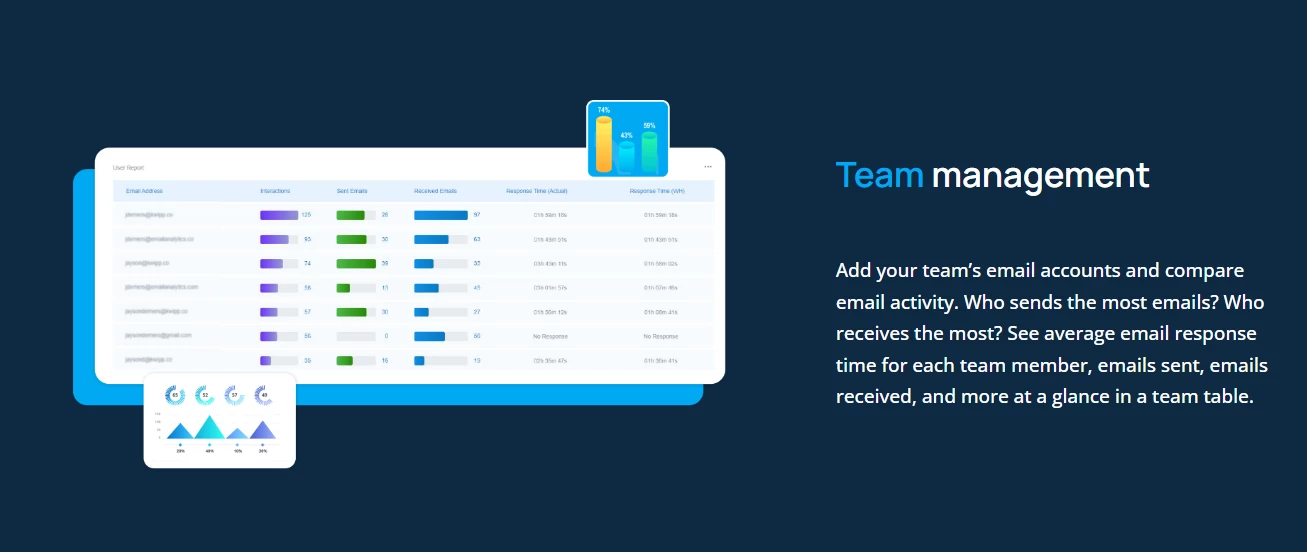
“Sales managers can identify their top performers based on response times and replicate their practices across the team,” Jayson notes.
When EmailAnalytics stepped in to track and improve HR Covered’s performance, the agency set up automatic daily email reports to their reps so that they could see their email response times.
This empowered them to improve.
The result? An increase in response time by 70% over the quarter. It also provided HR Covered a benchmark to operate and improve upon.
By leveraging email analytics, businesses can gain valuable insights to improve team efficiency and drive lasting improvements.