
AI Adoption in B2B Enterprises: Key Findings
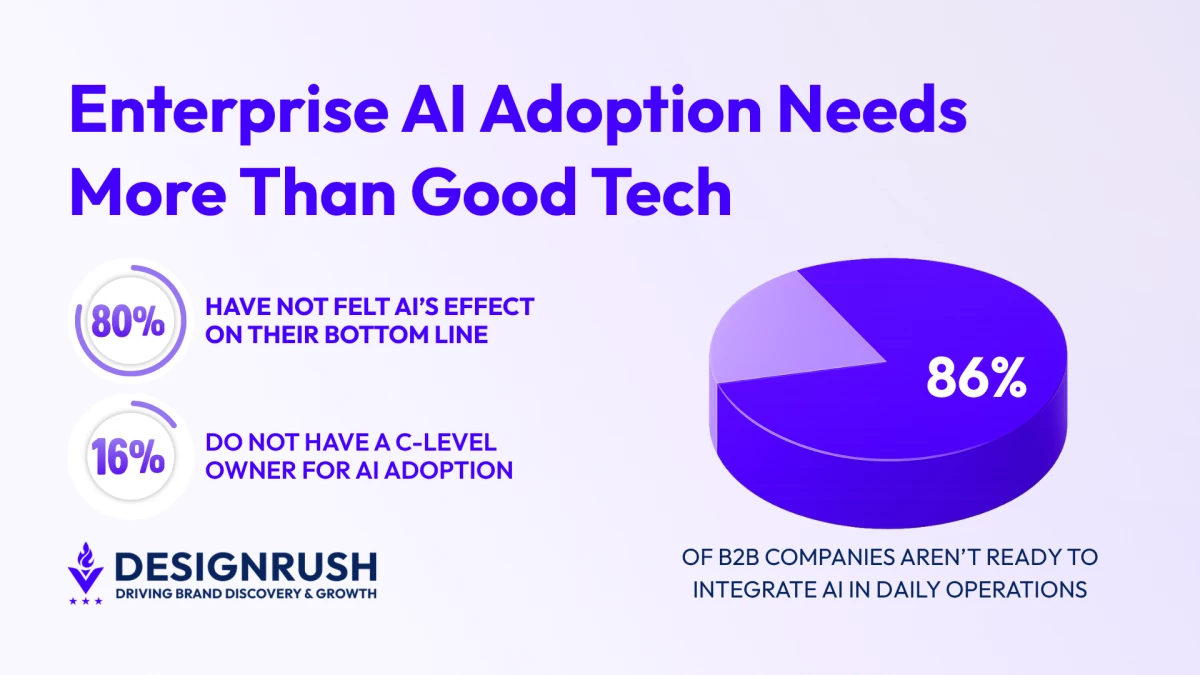
- 86% of B2B leaders say their organizations aren’t ready for AI, revealing a widespread gap between ambition and actual readiness.
- AI adoption struggles are driven more by organizational gaps than technology, with unclear ownership and weak alignment stalling progress.
- Codal recommends structured rollout strategies, clear KPIs, and team training, helping organizations move from experimentation to scalable AI adoption.
AI has built itself a reputation for making businesses and their teams faster and more efficient.
And while organizations claim they are looking to integrate more AI in their daily operations, many leaders do have concerns.
In fact, a new report from McKinsey found that roughly 86% of enterprise leaders say their organizations are not ready to integrate AI into daily operations.
Their worries become apparent since the same McKinsey report found that less than 20% of companies have seen a significant impact on their bottom lines after adopting AI.
Many are quick to blame this on tech infrastructure: not enough data, fragmented data, not enough tools, etc.
That explanation is convenient. Yet, tech is really only half of the equation to successful AI integration.
The Real Barriers to AI Adoption
The truth is that many organizations already have access to capable models and platforms. This means the real barriers tend to sit elsewhere.
Poppy Denyer, Principal Product Manager for eCommerce at award-winning digital agency Codal, explains this clearly:
“Most organizations aren’t blocked by access to AI. They’re blocked by how their teams are structured to adopt it.”
“Without clarity around ownership, purpose, and day-to-day impact, even the best tools struggle to gain traction.”
In other words, leadership often overlooks organizational factors like how teams make decisions, how responsibility is assigned, and how change is introduced across the organization:
Resistance and change management
Employees often hear about automation and immediately assume it’s there to replace them.
It’s hard to fault them for thinking this way, especially since AI-related layoffs dominated the news cycles last year.
This leads teams to hesitate to engage, slowing adoption and stalling initiatives before they reach meaningful scale.
“To succeed, leadership must demonstrate how AI improves a team’s day-to-day, letting the technology optimize repetitive tasks so employees can shift their focus to higher-level areas of the business,” Denyer said.
Misaligned ownership
It’s common to see AI systems go live without clear ownership.
Unfortunately, this means that no one is responsible for monitoring outputs, refining performance, or aligning results with business goals.
Over time, the AI system drifts and fails to deliver on the efficiency it promised.
Fear of the Unknown
AI evolves quickly enough to overwhelm even experienced leadership teams.
Faced with rapid change, organizations often respond by trying to do too much at once. But when multiple initiatives launch simultaneously, they blur priorities and fragment execution.
Without a clear roadmap, experimentation simply turns into friction that frustrates everyone.
Build Governance, Clarity, and Measurable Outcomes
If any of those barriers sound familiar, there’s a good chance that your organization falls squarely in the 86% of companies that aren’t fully prepared for AI.
This doesn’t necessarily mean a company is doomed to be left behind by competitors that use AI.
And while the path forward is long, it certainly isn’t impossible.
The key here is to implement staged changes, since this often produces better outcomes than sweeping transformation efforts.
According to Denyer, leadership should focus on the following over the next 12 months:
1. Create clear ownership
AI systems need accountable owners. Without ownership, even successful pilots struggle to scale.
Yet, a survey from the McKinsey report revealed that one in every six organizations didn’t have a clear C-level owner for AI adoption.
“Before building the technology, leaders and their teams must align on exactly which processes are being reimagined and who will be responsible,” Denyer said.
Assign individuals or teams responsible for outcomes, iteration, and long-term performance.
2. Define success upfront
Many organizations launch AI initiatives without agreeing on what success looks like. Having clear metrics changes that dynamic.
Tie AI efforts to business outcomes such as cost reduction, cycle time improvement, or revenue impact.
This helps create direction and accountability.
3. Start small and validate
Large-scale rollouts often introduce unnecessary risk. Instead, test AI tools with a defined group of users.
Observe how they interact with the system. Measure whether the tool delivers tangible value in real workflows.
This also has the added benefit of helping team members build trust in the use of AI.
As a result, they may even be more open to championing AI adoption to their coworkers.
4. Communicate purpose clearly
Adoption depends on understanding. Explain how AI supports existing roles rather than replacing them.
Show exactly where time is saved and where impact increases. Teams are more likely to engage when the benefits are visible and relevant.
5. Invest in AI training and upskilling
Sometimes, AI initiatives stall because teams are expected to use tools they don’t fully understand.
Providing the right kind of training ensures employees know how to apply AI within their daily workflows. In some cases, effective training can even help employees find other AI use cases within the organization.
For example, Codal offers free webinars and online workshops regularly, with the next webinar, The New Era of B2B AI Ordering Live Session, happening on April 22, 2026.
The upcoming webinar, conducted in partnership with Shopify, will highlight how enterprise teams are using AI to streamline B2B ordering and scale operations more efficiently, offering a clearer view of what applied AI looks like in practice.
Lead the Change or Stay Stuck in the Gap
Having all the tools won’t help if teams don’t know how to use them. It’s like trying to use a tape measure to tighten a screw.
This is why companies that succeed in AI adoption have both the technical infrastructure in place and the right organizational structures in place.
And with McKinsey data suggesting that more than 88% of organizations are deploying AI in at least one business function, the advantage now isn’t who has the best tech.
It’s about who has the right skills, alignment, and discipline to maximize the capabilities of the tech.