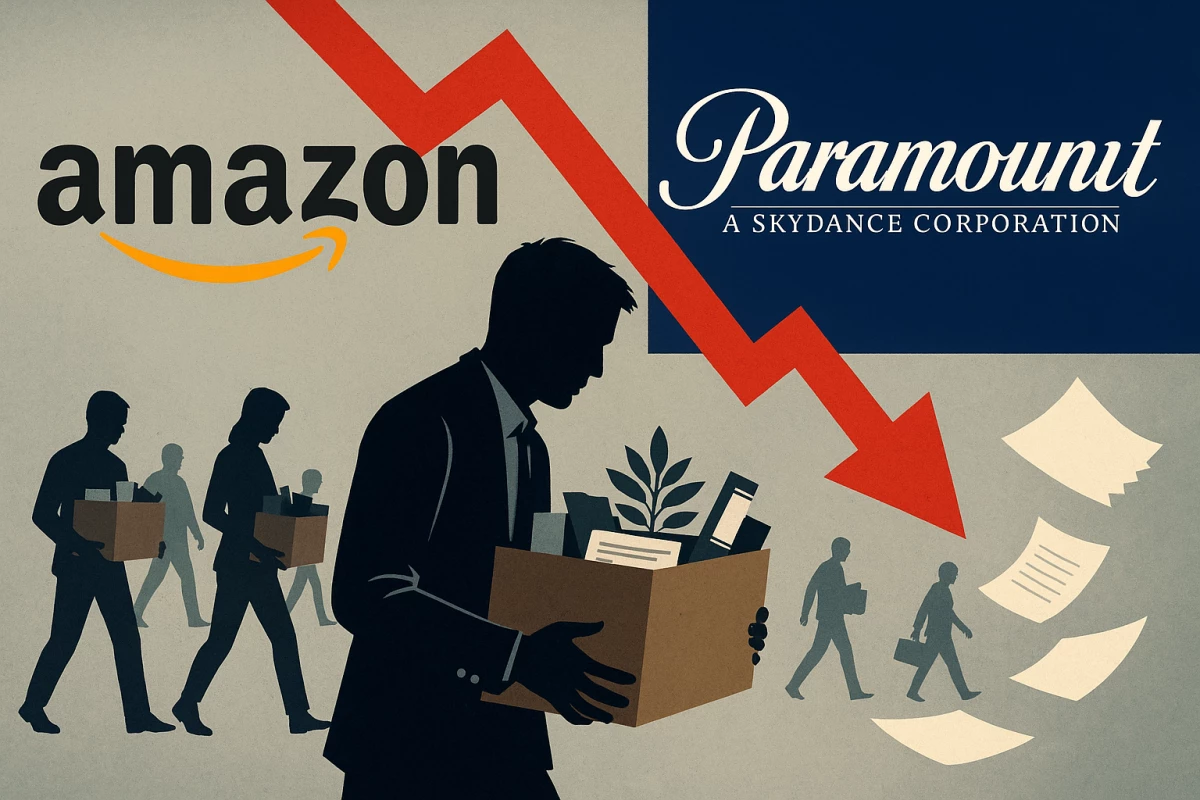

Amazon and Paramount Skydance Layoffs: Key Findings
- Amazon will cut up to 30,000 corporate jobs as AI-driven efficiency reshapes operations and reduces bureaucratic layers.
- Paramount Skydance begins its first major layoff since its $8.4 billion merger, cutting 1,000 jobs in a cost-saving restructure.
- Both companies highlight the reality that AI and consolidation are rewriting the rules of workforce planning.
The world’s largest tech and entertainment companies are slimming down, and fast.
Amazon is reportedly preparing to eliminate as many as 30,000 corporate roles.
Meanwhile, Paramount Skydance will lay off 1,000 employees in its first major post-merger move.
The cuts, which make up about 10% of Amazon's 350,000 corporate workforce, are the e-commerce giant's biggest round since 2022, when 27,000 roles were cut.
Notably, trusted insiders revealed that the divisions that will most likely take a hit are People Experience and Technology (PXT), operations, devices, and Amazon Web Services.
According to Reuters, managers were even asked to undergo training on how to communicate the news to affected teams before notifications began rolling out.
Amazon CEO Andy Jassy has framed the restructuring as part of his effort to cut red tape and flatten management.
Earlier this year, he revealed that an internal complaint system had prompted over 450 process changes to reduce inefficiency.
Jassy also hinted in June that AI tools would likely replace repetitive work, saying automation was already improving productivity across multiple teams.
“This latest move signals that Amazon is realizing enough AI-driven productivity gains within corporate teams to support a substantial reduction in force,” eMarketer analyst Sky Canaves told Reuters.
Post-Merger Shakeups at Paramount Skydance
Meanwhile, the newly merged Paramount Skydance is undergoing its own deep workforce reset.
A source familiar with the plans confirmed to Reuters that 1,000 layoffs will occur this week, affecting approximately 5% of its employees.
Variety added that a second, larger wave may follow, with total cuts expected to reach 2,000 jobs globally.
Paramount Skydance to Lay Off 1,000 Employees This Week, With Additional Cuts Expected
byu/darth_vader39 inentertainment
Executives have set an aggressive timeline for streamlining operations, with CEO David Ellison and President Jeff Shell targeting up to $2 billion in cost savings.
Ellison, who recently spent $7 billion to secure a seven-year UFC rights deal and poached the "Stranger Things" creators from Netflix, is betting big on long-term entertainment dominance even as he trims staff.
The company’s ambitions go beyond the $8.4 billion merger between Paramount Global and Skydance Media.
Analysts still view Paramount Skydance as a likely bidder for Warner Bros. Discovery, which rejected a $60 billion offer earlier this year.
What the Layoffs Reveal About Tech and Entertainment Giants
These mass layoffs are beyond just cost-cutting measures, as they signal a deeper recalibration of how large companies plan for the next decade:
- The scale and timing show both firms are prioritizing speed over stability, clearing payrolls ahead of holiday and earnings cycles to boost investor confidence.
- Amazon is moving towards a permanent shift toward automation-driven efficiency, where productivity gains are achieved by reducing human oversight.
- Paramount Skydance’s cuts reflect a high-risk, high-reward strategy: cut deeply now to fund long-term bets in entertainment IP and streaming dominance.
In 2024, tech giants like Meta made similar moves.
The Zuckerberg-owned company reduced about 5% of its workforce (roughly 3,600 employees) while expanding hiring in AI and machine learning to reinforce its long-term growth priorities.
And as we previously reported, Amazon also plans to replace up to 600,000 roles through robotics and AI within the next decade, aiming to double output without significantly expanding its U.S. workforce.
Ultimately, these sweeping changes highlight the scale of how the workforce might transform in the coming years, setting the stage for robot-led industries.
Our Take: Are We Watching Efficiency Replace Empathy?
Something is unsettling about watching entire workforces vanish in the name of optimization.
I get the business logic because every company wants to stay nimble. But when efficiency becomes the story itself, the human side starts to fade.
Amazon and Paramount are both rewriting what corporate success looks like: fewer people, faster results, and more automation.
Maybe that’s just where the world is heading.
But I can’t help wondering if, years from now, we’ll look back and realize we traded too much humanity for machine-perfect performance.
In other AI news, OpenAI launched its first AI-powered browser, "ChatGPT Atlas," signaling what could be the start of a browser war.


-preview-webp.webp)