
Google won a major antitrust lawsuit against news publishers in March, Reuters reported.
The case centered on claims that the company favored its own products, monopolizing how search platforms decide what gets seen first and what gets left further down the page.
According to Irina Shvaya, founder of website design company eSEOspace, that changes the job for every brand that depends on organic search.
“Pages now need to be structured so retrieval systems can extract meaning without inference, surface the right entities, and connect context across sections rather than relying on a single ranking signal,” she tells DesignRush.
eSEOspace focuses on building websites for both traditional search engines and AI-driven systems that interpret and summarize content.
The same systems behind search rankings now also determine how AI summaries are formed.
How AI Search Is Changing Visibility
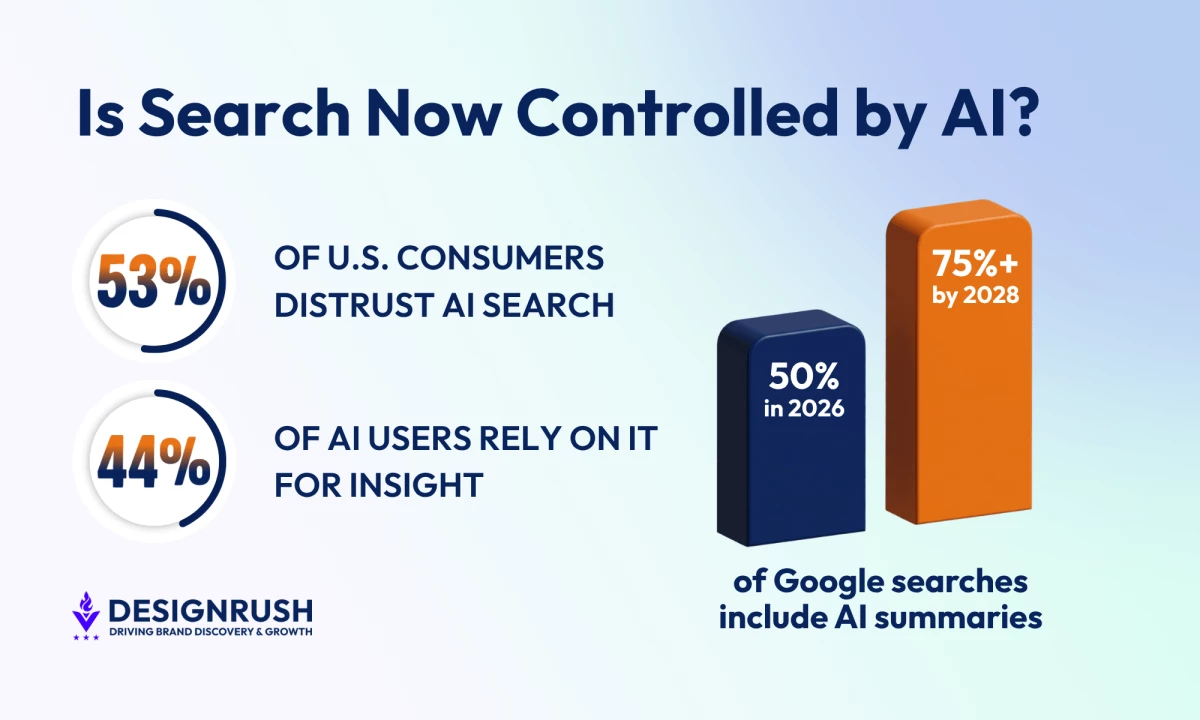
Half of Google searches now include AI summaries, and McKinsey expects this share to spike above 75% by 2028.
The strategy and management consulting firm also found that 44% of AI-powered search users see it as their primary source of insight, ahead of traditional search at 31% and retailer or brand websites at 9%.
This indicates that search rankings alone don’t determine visibility anymore because the same systems now decide how content is reused in AI-generated answers.
“Visibility now depends on two things at once: whether the page can rank, and whether it can be extracted cleanly into an AI summary,” Shvaya says.
That is where technical SEO starts earning its keep, with schema markup, internal linking, clear page hierarchy, and consistent entity signals that help search systems understand what a page covers and how its pieces connect.
eSEOspace has audited over 1,284 websites and found that the single highest-impact change for WordPress AI optimization is implementing comprehensive, accurate schema markup paired with extraction-friendly content structure.
Websites that make these two changes see an average 75-85% increase in AI citations within 90 days.
The key is understanding what each AI search engine is looking for and building the schema and content structure around that.
eSEOspace’s Director of Projects, Benjamin Gunther, explained this in detail during the previous GEO Conference.
By doing this, the agency’s GEO methodology consistently outperformed generic approaches by 40-60%.
It also says those same changes improved traditional Google rankings by 15% to 25% for target keywords.
This is because the old and new search layers are still connected.
“Most pages are written for humans and only later adapted for search,” Shvaya notes.
“Schema and structure determine how reliably content is interpreted at scale.”
Structuring Content for AI Answers
McKinsey recommends that brands write for answerability and not just keyword coverage, as AI search draws from sources that present information clearly and directly.
That makes headings, definitions, comparison sections, FAQs, and concise explanations more valuable than bloated copy that buries the point.
Shvaya says content is less likely to be selected for use in a generated answer if the page it’s located on forces a system to interpret or infer too much.
“Clear structure increases the chance that content is pulled and reused correctly.”
There’s also a trust issue.
Fifty-three percent of U.S. consumers distrust or lack confidence in the reliability and impartiality of AI-powered search results and summaries, a Gartner survey found.
A further 41% find generative AI overviews more frustrating than traditional search.
That means brands are dealing with a strange mix of dependence and skepticism. Users may start in AI search, but they still want proof once they arrive.
About 20% of Google searches linking to Penske Media sites now show AI Overviews, while affiliate revenue fell by more than a third from its peak, Reuters reported in September 2025.
That example shows how fast AI summaries can affect traffic and downstream revenue, even when rankings remain visible.
SEO for Search and AI Visibility
This is why SEO can’t be sold as rankings alone.
Agencies now have to account for schema, internal links, entity consistency, content clarity, and page structure that works for both traditional search and AI summaries.
Content planning also needs to focus on pages that directly answer specific user questions, rather than broad copy that tries to cover everything and ends up saying very little.
Shvaya says that’s where agencies can add value.
“The best work right now combines technical fixes with editorial discipline,” she says.
“If the content is clear, the structure is clean, and the signals are consistent, the page has a better chance of showing up in the places that matter.”
The recommendation is to build pages for readability, extraction, and authority.
“Search systems are increasingly evaluating pages at the section level,” Shvaya notes.
“If individual blocks of content can’t stand on their own when extracted, they’re far less likely to be used in AI-generated responses.”
Brands that keep publishing without adjusting structure are taking a gamble on visibility they don’t control.
The next question should be how content is built to be cited, surfaced, and trusted in both search results and AI summaries.