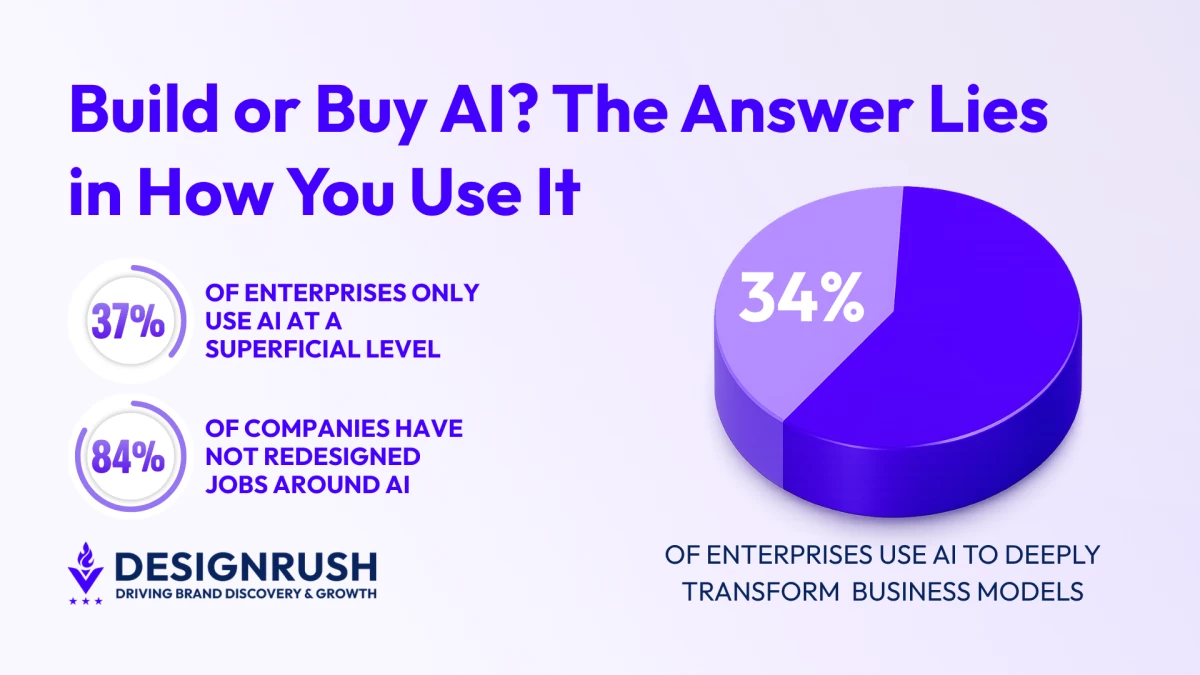

Deloitte’s 2026 State of AI in the Enterprise report surveyed 3,235 senior leaders across 24 countries and found that only 34% of organizations are using AI to fundamentally transform their business models.
Another 30% are redesigning key workflows around AI, while 37% are still using it primarily as a productivity layer with minimal operational change.
Most companies are seeing incremental efficiency gains. Far fewer are rethinking how the business itself operates.
That distinction is becoming increasingly important in the growing build vs. buy debate surrounding enterprise AI adoption.
AI Optimization vs. AI Transformation
AI optimization improves existing workflows. AI transformation changes the operational structure behind them.
A field experiment conducted by INSEAD and Harvard involving 515 startups helped quantify the difference.
Both groups had access to the same AI tools. The difference was that one group redesigned how work was done around those tools.
That group generated 90% higher revenue, completed 12% more internal tasks in the same timeframe, and required 40% less capital to hit milestones.
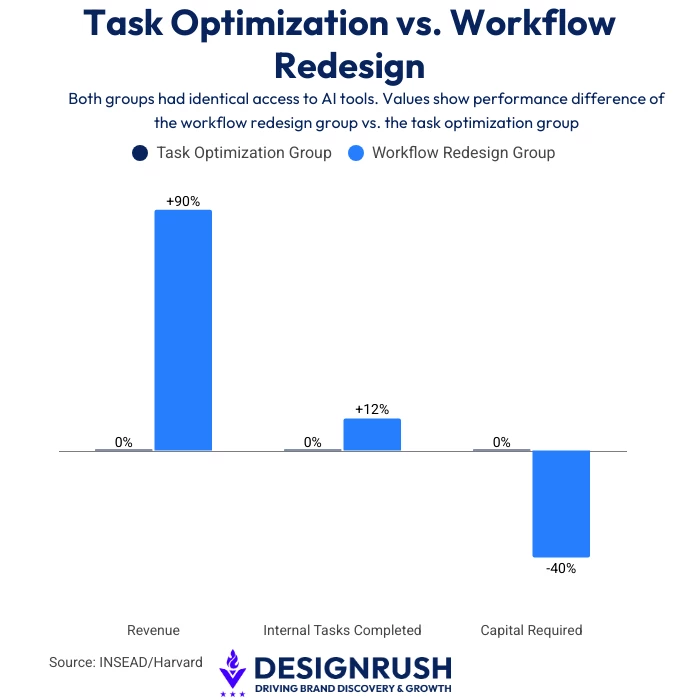 The control group had the same tools. They simply used them to move faster.
Essential Designs CEO and founder Scott Jackson sees this pattern frequently across enterprise software projects.
"A lot of companies are improving existing processes with AI and seeing short-term gains. True transformation is more difficult because it requires rebuilding systems that already function, even if they’re no longer optimal long term."
In a previous DesignRush interview, Jackson discussed how AI has accelerated development cycles while increasing the importance of strategic decision-making and operational architecture.
Why Off-the-Shelf AI Often Hits a Ceiling
The majority of companies not undergoing deep transformation are using the same platforms and tools available to everyone else.
That creates a predictable limitation.
Generic AI platforms are designed for mass adoption, meaning they are optimized for broad use cases across thousands of organizations.
The further a company’s operations move away from those average use cases, the more restrictive those tools become.
Where Custom AI Creates Separation
The differences between custom AI systems and off-the-shelf tools become especially clear across the areas enterprise leaders care about most:
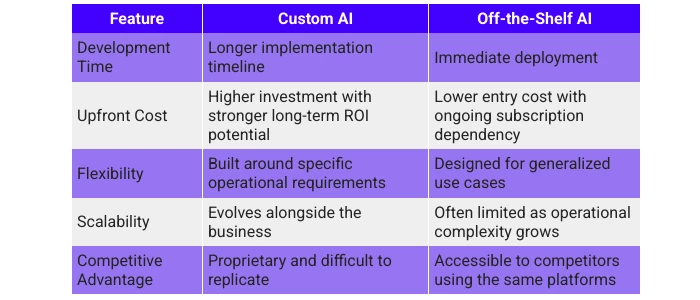 The trade-offs make the build vs. buy decision less about technology and more about long-term business strategy.
Short-term efficiency and long-term differentiation rarely point in the same direction.
"When every company in an industry is using the same tools, those tools stop being an advantage," Jackson says. "They become the baseline."
Proprietary Data Is Where the Advantage Lives
The organizations pursuing deeper AI transformation often share one common characteristic: they are building systems around operational knowledge and data competitors cannot replicate.
When Teck Resources needed to manage vendors across large-scale mining operations, paper-based workflows had already become unsustainable.
Generic vendor management platforms were evaluated but ultimately ruled out.
Essential Designs developed a custom platform with distinct vendor permissions, real-time access controls, and direct integration with Teck’s compliance requirements.
No off-the-shelf solution aligned with the operational complexity of the environment.
Similarly, when British Columbia Emergency Health Services partnered with Lifeguard to support emergency response workflows, triggering ambulance dispatch via GPS within 60 seconds required a highly specialized solution.
The operational specificity behind those systems is what makes custom AI fundamentally different from generic AI platforms.
When proprietary data, workflows, and institutional knowledge are integrated into purpose-built systems, the result becomes difficult for competitors to replicate.
What Deep Transformation Actually Requires
Deloitte’s findings point to something productivity metrics alone cannot measure: operational architecture.
The companies seeing the greatest impact from AI are making fundamentally different decisions early in the process, including:
- Designing AI systems around core business operations
- Building integrations around proprietary workflows and internal data
- Preserving human oversight and strategic judgment as automation scales
- Structuring systems to evolve alongside operational complexity
"Many companies adapt their operations around a platform instead of designing systems around how they actually work," Jackson says. "That's often where AI initiatives start losing momentum."
The Deloitte report also found that 84% of organizations have not redesigned jobs or workflows around AI adoption.
Many are training employees on tools that were never built around how the business actually operates.
The Build vs. Buy Debate Has Become a Strategic Decision
Buying a platform gives companies access to capabilities built for the average market.
Building custom systems allows organizations to leverage what competitors cannot replicate: proprietary workflows, institutional knowledge, operational complexity, and unique data.
That is where long-term competitive advantage is increasingly being created.
The companies seeing the greatest impact from AI are not simply adopting new tools faster.
They are redesigning how their businesses operate around systems tailored to their own operations, customers, and decision-making processes.
As AI adoption accelerates, the gap between optimization and transformation is likely to widen.