
AI is making it more convenient for anyone to build a website.
Clients are now able to see a polished prototype in a weekend and wonder why a production-ready website by professional developers takes weeks and costs more.
And that pressure is beginning to heat up a lot of seats.
In fact, 75.4% of web designers experienced AI-driven competition as an operational challenge over the past year, per a survey of 500 U.S. web designers by hosting company 20i.
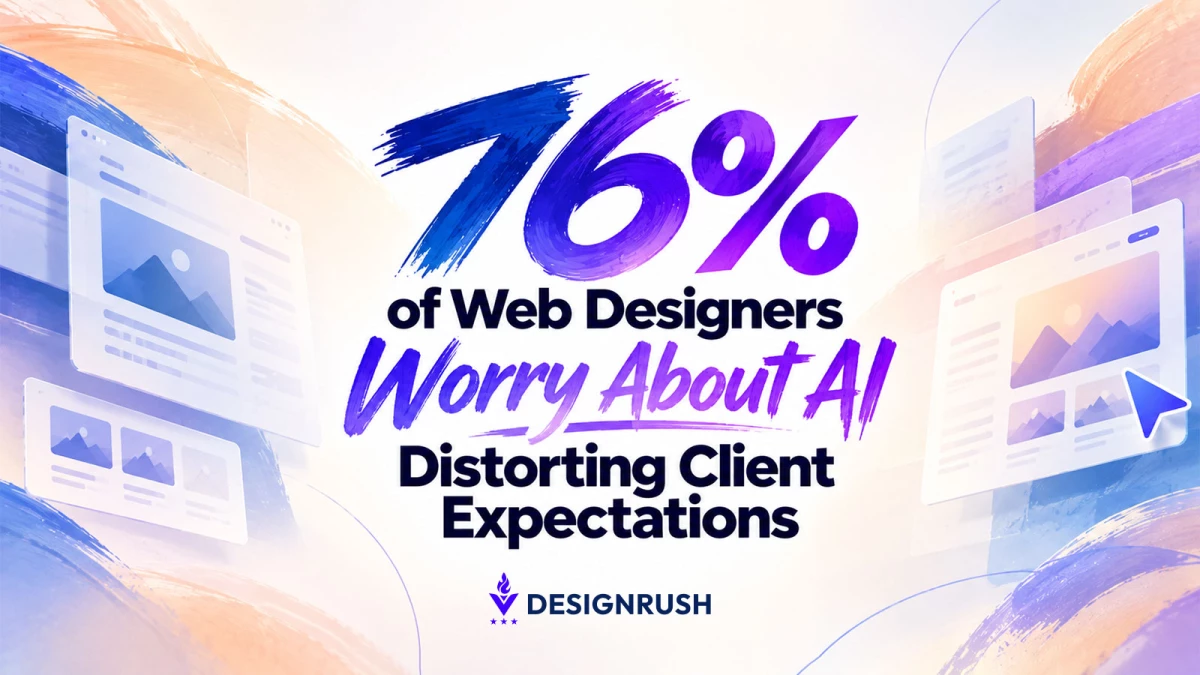
Furthermore, 76% of developers identified AI as their biggest concern about the industry's future, and 89% believe clients still underestimate the true cost of web design work.
These findings suggest that AI has moved beyond a new tool in the designer's workflow to a force changing how clients evaluate professional services.
For Adam Brazg, CEO of Bilberrry, the problem is partly one of perception.
"Clients now have a reference point, and it isn't always an accurate one,” he says.
"Someone builds something over a weekend that looks like a finished website, and that becomes the anchor for what a real project should cost."
That distinction matters because the website itself is only one part of the investment.
The systems behind it, the decisions made during development, and the ability to change it without breaking existing functionality often determine how much value the business gets.
AI Is Changing What Clients Think Web Design Should Cost
The first challenge for agencies is explaining why two websites that look similar can require very different levels of work.
AI website builders and code-generation tools have lowered the barrier to producing a functional starting point.
A small business that needs a basic brochure website can now explore inexpensive options that would have required more time and money a few years ago.
"Professional agencies should acknowledge that change rather than defend every traditional cost. Some projects genuinely have become cheaper to produce, and clients are right to expect technology to improve efficiency," Brazg says.
The difficulty lies in projects that look simple on the surface but rely on complex systems underneath. These often include:
- Websites with extensive content operations
- Integrations with third-party platforms
- Complex user permissions
- Accessibility requirements
- Workflows that connect the website to the rest of the business
So while a generated prototype is capable of showing how a product could look or behave under ideal conditions, it doesn't reveal how it can handle real users, changing requirements, and unexpected inputs.
Brazg sees that difference as a central issue in how clients evaluate web development.
"Those cases still require the engineering, integrations, and planning they always did. And that's where professional designers and developers can prove their value,” he says.
For agencies, the challenge is to make that hidden complexity visible before a project begins.
Clients need to understand what they are paying for, which requirements drive the cost, and what trade-offs they would accept by choosing a faster or less expensive approach.
That conversation is more productive than arguing over whether AI can build a website.
Sell The Value of a Website That Can Evolve
When basic production becomes easier, visual quality alone becomes a weaker differentiator.
After all, businesses can now generate layouts, draft copy, and assemble functional prototypes with tools that were unavailable just a few years ago.
However, the more consequential work often begins after the first version exists.
Whenever a company needs to introduce a change, such as a new product line or integrating a new CRM, it also introduces decisions about how the existing system is structured and what might break.
This means a website that works on launch day may become expensive to maintain if nobody understands how its components fit together.
In such a situation, the next feature can require significant reverse engineering before development can even begin.
Brazg argues that this is another instance where an experienced team creates lasting value for their clients.
“Building was never the expensive part. Changing things is. Most of what a website costs over its life happens after launch, when the business shifts and someone has to modify what exists without breaking it,” he says.
This is why Brazg and his team at Bilberrry evaluate proposals by asking four key questions:
- Can the website support future changes? The architecture should accommodate likely additions without requiring an extensive rebuild every time the business evolves.
- Can another developer understand the system? Clear documentation and maintainable code reduce the cost of transferring work or bringing in additional expertise.
- Will integrations remain manageable? Connections to marketing platforms, customer databases, and payment systems should be designed with future updates in mind.
- How will the team handle problems after launch? Testing, monitoring, maintenance, and a clear process for addressing issues help protect the investment over time.
"AI can help accelerate parts of this work, but speed alone does not establish that a product is ready for production," Brazg adds.
"The value of an experienced team lies partly in knowing which shortcuts are safe and which ones create problems that will be more expensive to fix later."
Protect The Work That Requires Judgment
The pressure from AI is unlikely to affect every part of web design equally.
Routine production tasks are becoming easier to automate, while projects involving complex integrations, substantial business risk, or difficult architectural decisions still require people who can understand the consequences of their choices.
Brazg believes it all boils down to the cost of being wrong.
“If being wrong costs nothing, AI will do that work, and it should. If being wrong costs six figures, creates a failed audit, or puts the brand at risk of being sued, someone has to be accountable for the decision,” he says.