
Wikipedia Traffic Drop: Key Findings
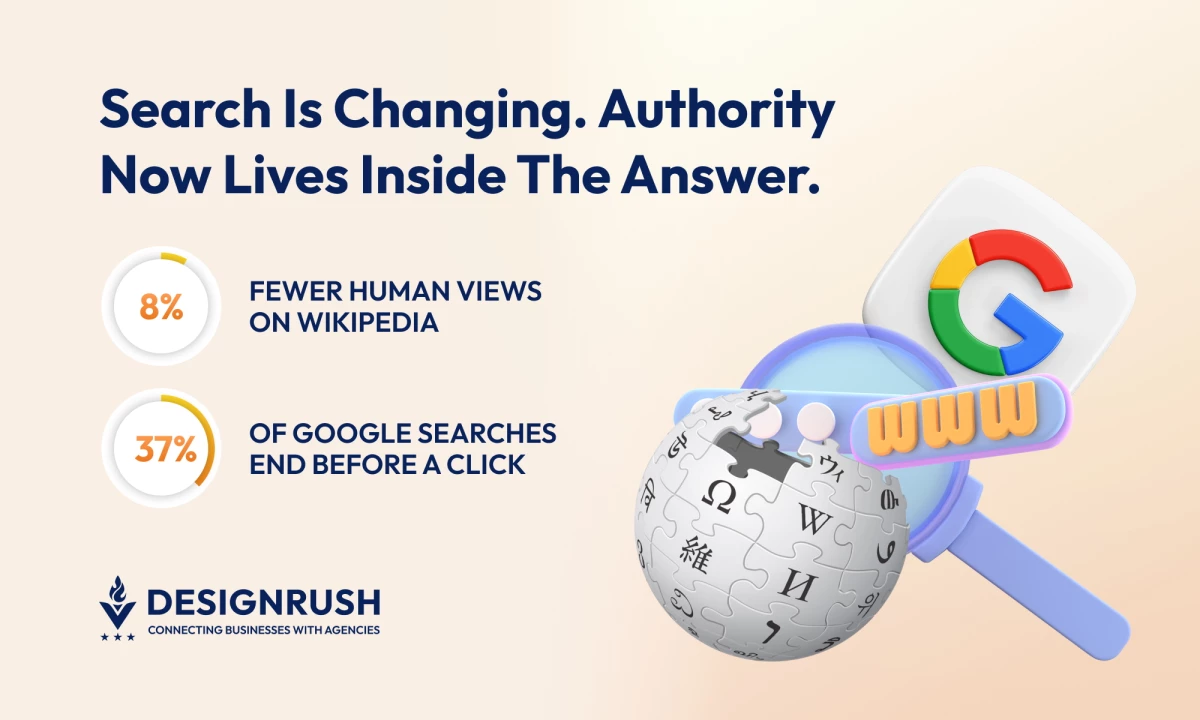
- Human pageviews fell by about 8% year-over-year, showing how brands must track where their content appears in AI search.
- Answer engines value credibility over ranking, so brands need clear authority signals and structured content that AI can easily cite.
- eSEOspace advises brands to connect SEO and GEO, creating data structures that help AI platforms recognize and reference them.
Search habits are changing faster than most brands realize.
Wikipedia, once a pillar of online discovery, has seen its human traffic decline as generative-AI search tools provide users with direct answers.
This is now reshaping how companies compete for attention online and how authority itself is measured.
The Wikimedia Foundation’s revised data shows an estimated 8% drop in human views from March through August 2025 compared to the same period in 2024.
Wikipedia says AI and social media are eating into its traffic
— Morning Brew ☕️ (@MorningBrew) October 18, 2025
Human pageviews are ⬇️ 8% compared to 2024 pic.twitter.com/YV0sGiPkfX
The organization attributes the decline to AI summaries and social platforms giving people information without needing to click through.
“This gradual shift is not unique to Wikipedia,” author Marshall Miller wrote in an article posted on Diff, a Wikimedia volunteer community blog.
“Many other publishers and content platforms are reporting similar shifts as users spend more time on search engines, AI chatbots, and social media to find information.
They are also experiencing the strain that these companies are putting on their infrastructure.”
AI relies heavily on Wikipedia for its training data, siphoning traffic away from Wiki & threatening its existence & future training data.
— Samuel Deats 🌕 (@SamuelDeats) October 17, 2025
Same for journalism, art, etc. AI will slam into a wall without new human data to steal. There's no future in this.https://t.co/zAujZzx4pv
It’s another sign that ranking first in search results no longer guarantees brands and businesses visibility.
And this change is exactly what full-service digital marketing firm eSEOspace has been tracking.
The company says the rise of AI-driven summaries demands a new kind of optimization, and it’s one that helps brands appear inside the answers themselves, not just on the page that follows.
“Search has never stood still. What’s happening now isn’t the death of SEO but its evolution,” Irina Gedarevich, founder of eSEOspace, told DesignRush.
“AI engines are rewriting how people find answers, so brands need to write for the machines that summarize and the humans who still verify. The goal now is to become the reference it relies on.”
AI Search Is Changing SEO Rules
AI-powered summaries now deliver answers on the spot, shifting SEO from ranking tactics to credibility building.
Being cited or referenced within AI responses is becoming more valuable than appearing at the top of a results page.
Gedarevich explains that this is driving brands to adapt their content architecture.
“Gen-AI engines look for clarity, accuracy, and verified location data,” she said.
“If your brand doesn’t provide these, it’s unlikely to appear in AI answers no matter how strong your traditional SEO is.”
Traditional SEO is dead and AI killed it 💀
— Alex Prompter (@alex_prompter) October 26, 2025
spent the last 3 months watching $1M+ in "optimized" content get zero distribution because nobody told these brands the game moved.
60% of Google searches end without a click now.
AI just gives the answer. your #1 ranking?… pic.twitter.com/oDteWvTUfx
2025 data from Similarweb shows how much AI Overviews (AIO) are changing search behavior.
When AIO appears, the median zero-click search rate jumps from about 60% to 80%, with an average of 83%.
This means fewer visits from traditional search results and a greater need to make content visible within AI summaries instead of relying on organic clicks.
How SEO and GEO Work Better Together
According to eSEOspace, visibility today depends on connecting where a brand operates with what it offers.
Generative Engine Optimization (GEO) focuses on location and intent, helping AI and search systems understand the relevance of a business to a specific area or audience.
SEO, on the other hand, focuses on keywords, content quality, and authority.
When used together, they tell a fuller story.
For instance, a restaurant that optimizes for both can show up in local AI recommendations for nearby diners, while a global brand can appear in regional summaries tied to user location.
To achieve this balance, eSEOspace recommends three steps:
- Maintain accuracy in local data. Keep addresses, hours, and contact information consistent across platforms so AI can verify trust.
- Connect local context with search relevance. Use content that reflects both regional identity and broader industry keywords.
- Adopt structured data. Schema markup and metadata help search systems associate brands with specific places and services.
As generative search expands, GEO ensures context while SEO ensures credibility.
Together, they help brands stay discoverable no matter how or where users search.
Keep Your Brand Seen in the AI Search Era
Generative AI is changing how authority spreads online.
Being visible in this new environment depends on clarity, credibility, and the ability to feed data to machines responsibly.
Wikipedia’s traffic drop is a visible symptom of this change: content remains valuable, but fewer humans are reading it directly.
The opportunity for brands and agencies lies in embracing these tools without surrendering control.
Teams that combine strategic data use with human-centered storytelling will stand out in a market ruled by instant answers.
The age of search as a list is ending, and the next wave of visibility will belong to the companies that prepare for discovery before the click.