
If you've ever kicked off a B2B website redesign, you've probably heard one of these questions almost immediately:
"Can you make us look more modern?"
"What will the homepage look like?"
"Can we make it feel more like our competitors?"
They're all fair questions. The only issue is that they're asked too early in the process.
After helping B2B companies plan and launch websites for more than 25 years at GoingClear, I've found that successful projects don't necessarily begin with different questions.
They simply ask them in a different order.
In fact, most B2B website projects don't underperform because of poor design. They underperform because design is asked to solve problems that strategy should have solved first.
Before discussing colors, layouts, or homepage concepts, every organization should answer one foundational question:
What does this website need to accomplish for the business?
That single shift changes the entire direction of a project.
Start with Strategy, Not Screens
A website is much more than a digital brochure.
For many organizations, it's the first salesperson, brand ambassador, recruiting tool, and customer-facing experience someone encounters.
That's why the strongest B2B websites are built from the inside out.
Before visual design begins, organizations should have clarity around:
- Business goals and success metrics
- Target audiences and buyer needs
- Core messaging and positioning
- Information architecture and user journeys
- Conversion opportunities across the customer lifecycle
Without that foundation, design conversations often become subjective.
Instead of asking whether everyone involved likes the website’s design, the better question to ask is "Will this help our customers accomplish what they came here to do?"
That subtle difference changes how teams make decisions throughout the entire project.
Great Design Amplifies Great Strategy
One of the most common misconceptions is that better design automatically produces better results.
Great design absolutely matters. But it performs best when it's reinforcing a well-defined strategy.
Consider a manufacturing company planning a website redesign.
Leadership may initially believe the biggest challenge is that the website "looks dated." But after stakeholder interviews, customer feedback, and analytics reviews, a different story often emerges.
Prospective customers can't quickly understand the company's capabilities. Key industries served aren't immediately obvious. Important differentiators are buried several clicks deep.
Clearly, these scenarios point to an issue with clarity rather than aesthetics.
It’s easy to fall into the trap of prioritizing visually pleasing designs. But the truth is that great designs are great because they allow clarity and strategy to inform decisions.
Once messaging, structure, and user experience are improved, the visual design has a much stronger foundation to build upon.
Discovery Creates Alignment
Some of the most valuable work in a B2B website project happens long before the first homepage concept is presented.
Discovery helps organizations step back and ask the right questions before solutions are proposed.
Stakeholder interviews uncover business priorities. Customer conversations reveal what buyers actually need to know before reaching out.
Meanwhile, analytics identify friction points, content audits expose messaging gaps, and information architecture organizes everything into a logical experience that feels intuitive rather than overwhelming.
Investing time in discovery often shortens the design process because major strategic decisions have already been made.
Teams spend less time debating personal preferences and more time evaluating whether each decision supports agreed business objectives.
Why We Built the G³ Framework™
After more than two decades of leading B2B website engagements, we noticed a consistent pattern.
The highest-performing websites weren't simply the ones with the most impressive visual design. They were the ones that connected website strategy directly to business growth.
That realization led us to formalize our G³ Framework™, a methodology that encourages organizations to think beyond pages and pixels and instead view their website as a long-term growth platform.
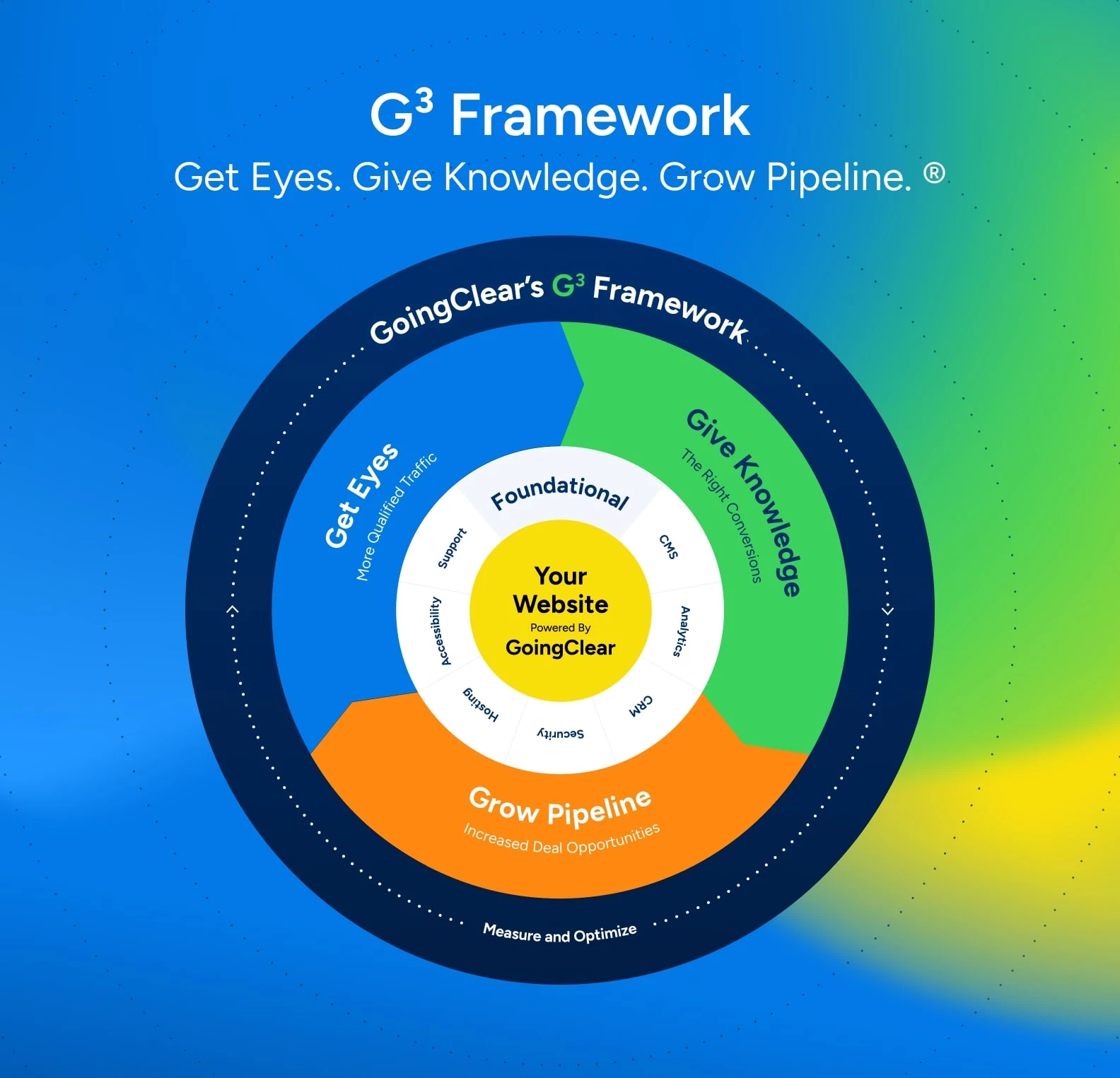
The framework is built around three connected principles:
- Get Eyes: Attract qualified visitors through search visibility, digital marketing, and strategic awareness so the right audience can actually find your business.
- Give Knowledge: Build trust with clear messaging, intuitive user experiences, and content that helps buyers understand your expertise and confidently evaluate their options.
- Grow Pipeline: Turn that trust into measurable business outcomes through thoughtful conversion paths, lead generation strategies, and stronger alignment between marketing and sales.
Design plays an essential role throughout every stage, but it's most effective when it's supporting strategy, not replacing it.
The Better First Question
So before asking what your new website should look like, consider asking "How should our website help our business grow?"
Answer that question first, and everything else, like messaging, information architecture, user experience, and visual design, becomes an easier and more purposeful decision.
Overall, the best B2B websites aren't built to win design awards. They’re built to help companies win from their websites.
Because when strategy comes first, design doesn't have to carry the entire weight of the project. It gets to do what great design does best: bring a smart strategy to life.