
AI systems can consume budget and staff time before a business knows whether the software can work reliably in daily operations.
Executives then face the costly decision of which AI investments deserve continued funding and which should end before committing more resources.
Meanwhile, 85% of functional leaders plan to increase AI spending, while only 22% of organizations have successfully scaled AI across multiple business units or adopted an AI-first approach, according to Gartner’s 2026 research.
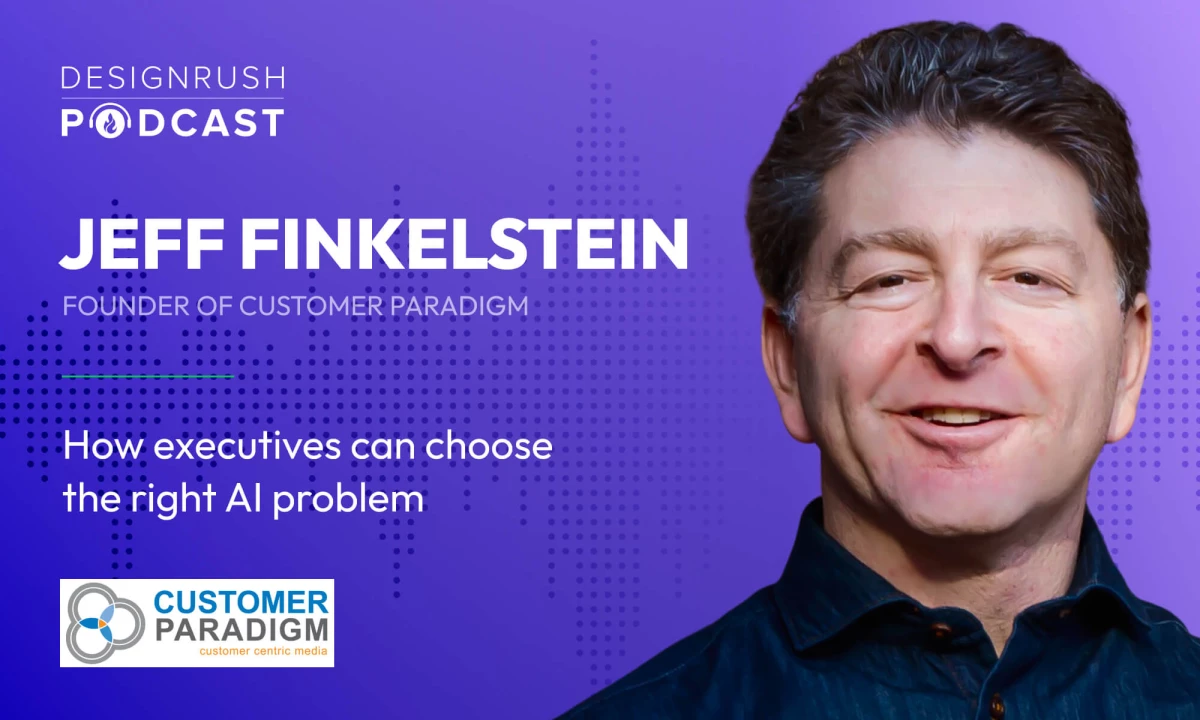
In the latest DesignRush Podcast, I spoke with Customer Paradigm Founder Jeff Finkelstein about how to test business value and reliability before putting AI into wider use.
Since founding Customer Paradigm in 2002, Finkelstein’s client work has included 3M, Xcel Energy, Level 3, and BP.
Customer Paradigm also worked directly with Amazon’s machine learning team on an Amazon Personalize integration.
“A lot of times people treat it as this bright, shiny object and they don't focus on what really matters to that end customer,” Customer Paradigm Founder Jeff Finkelstein tells DesignRush.
In other words, he believes that software should solve a problem the business already has and work reliably with real data, real users, and everyday business demands.
Watch the full episode now on YouTube or listen on Spotify.

Who is Jeff Finkelstein?
Jeff Finkelstein is the Founder of Customer Paradigm, a Boulder-based technology company he started in 2002. His background includes software engineering, eCommerce, automation, privacy, AI, and machine learning. He previously taught at Colorado State University and holds an MBA in Entrepreneurship & Technology Management from the University of Colorado Boulder.
Start with a Business Problem Worth Solving
Finkelstein says companies should begin with problems that customers, employees, and leadership already recognize.
“Are your customers happy? Are you finding key insights that are making your lives better, faster, easier?” Finkelstein says.
He also asks executives to identify the most important issues affecting the company before deciding where AI belongs.
“Tell me your top three issues right now that you're seeing,” Finkelstein adds.
For executives evaluating an AI investment, that process gives the first project a clear business reason.
A viable use case begins with a problem the business already considers important.
Finkelstein also looks at why customers may be leaving, where employees are losing time, and which operational problems are serious enough to justify investment.
Those questions help narrow the use case before money is committed to a larger system.
Plan for Failure Before Launch
Once a company has chosen a real problem to solve, the next question is whether the software can keep working when real operations get messy.
A controlled test can look convincing because the data is clean and users follow the expected steps.
Real operations introduce incorrect dates, failed API connections, weak warehouse Wi-Fi, and employees using the system in ways the test never accounted for.
“You want to plan for failure,” Finkelstein says.
For him, that means deciding what the system should do when one of those problems occurs.
It may need to retry a failed connection, alert an employee, stop an action, or leave enough information for someone to trace what went wrong.
Reliability becomes a business concern once employees start depending on the software. Executives need to know how it responds when data is wrong, a connection fails, or human intervention is needed.
DesignRush examined this further in its report on AI deployment strategy, where Finkelstein discusses privacy, cost, resilience, latency, and control when deciding where AI should run.
Privacy is one of his first concerns because the type of information involved, who can access it, and the consequences of exposure affect the decisions that follow.
Prove value before expanding the scope
When an AI system proves reliable in everyday use, the next question is whether it is creating enough value to justify further investment.
Finkelstein points to AI-assisted coding as one example of how quickly that value can appear.
“You know, it has allowed me to do things in an hour that would probably take two, three weeks traditionally to do.”
The same principle applies to smaller business processes. Finkelstein recommends looking for results that can be verified early, especially when a larger project could take 18 months or two years to judge.
“It could be something really small, something that takes back 30 minutes of somebody's time a week,” Finkelstein says.
A recurring 30-minute saving gives the business a concrete result from a real process and helps determine whether the project deserves the next stage of investment.
Early proof gives executives something concrete to base the next decision on.
In the full conversation, Finkelstein goes deeper on:
- Assessing whether company data is ready for AI
- Privacy and security factors that influence deployment
- System behavior when APIs or connections fail
- High-stakes decisions that still require human judgment
He also discusses how AI is changing software work, where companies often misjudge readiness, and what CEOs should ask before committing to a larger rollout.