
Visual Feedback Tools: Key Findings
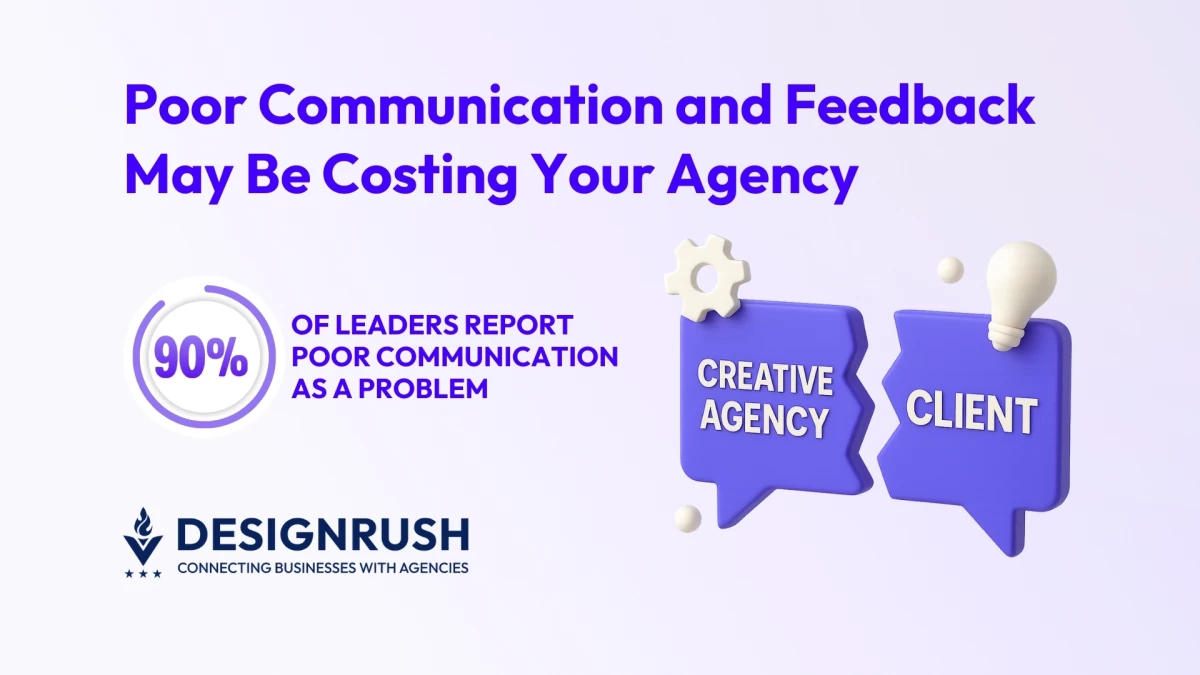
- 93% of business leaders say communication drives business performance, yet 90% report costly failures due to miscommunication.
- Revision cycles are accelerating as more stakeholders join reviews, forcing agencies to manage rising feedback volume with flat staffing and shrinking budgets.
- Scattered emails and screenshots make timelines unpredictable, pushing agencies to adopt visual-feedback systems that centralize comments.
Agencies across the world are juggling digital projects that now feel less like orderly production cycles and more like chaotic group chats with a deadline attached.
Every new website, campaign, or platform built gathers stakeholders the way a porch light gathers moths, and each one arrives with a fresh opinion about spacing, color tone, or “just one quick revision.”
The cost of this poor method of communication can be high.
According to a report from Grammarly, 93% of business leaders agree that “good communication is the backbone of business.”
Despite this, the same study showed that nine out of 10 business leaders have experienced the adverse effects of poor communication at work, including:
- Increased costs
- Missed deadlines or increased time to resolution
- Eroded brand credibility or reputation
- Decreased productivity
Miscommunication, scattered comments, and fractured sign-off processes aren’t just irritating. They are now among the largest contributors to project overruns and shrinking margins.
This is why agencies around the world have begun to move toward more structured visual feedback systems like BugHerd.
Why Agencies Are Standardizing Feedback to Protect Margins
The modern agency climate is defined by rising expectations and shrinking margins.
In many cases, clients bring more stakeholders into every review, each with their own interpretation of “make it pop.”
In other instances, vague instructions and different jargon can lead to multiple revisions that only end up frustrating both sides.
Such scenarios often lead to big issues for agencies:
1. Revision cycles are growing faster than staffing budgets
Agencies aren’t just working with more stakeholders. They’re working with more kinds of stakeholders: operational managers, regional leads, compliance reviewers, consultants, and more.
When timelines compress and teams stay the same size, every unclear piece of feedback creates friction that spreads across the project.
2. Scattered feedback makes timelines impossible to predict
When input arrives as a series of emails, Slack thread messages, annotated PDFs, and/or screenshots, even the most seasoned account manager can’t confidently say which version is current.
This often forces developers to spend hours deciphering vague instructions, which eats up time that could’ve otherwise been spent making the necessary client revisions. As a result, timelines crack under the weight of pure administrative inadequacy.
Every UX designer’s been there 😅 You’re deep in a project & suddenly you’re not designing anymore, you’re deciphering stakeholder feedback like a detective 🕵️♂️
— BugHerd (@bugherd) November 17, 2025
Richy shares how he uses BugHerd to capture feedback with context, so he can spend less time guessing & more designing. pic.twitter.com/lFinnQB7Y9
These two issues have surfaced the need to prioritize structure over improvisation.
“Instead of improvising through a stack of comments, agencies are discovering that standardized workflows and visual feedback tools give them a chance to hit deadlines without sacrificing sleep, revenue, or sanity,” said Stephen Neville, CEO of BugHerd.”
“Rigidity isn’t the goal here. The goal is clarity. And as it turns out, clarity is remarkably efficient from a workflow perspective and highly cost-effective from an operations perspective.”
In simpler terms, visual feedback tools function in the same way a traffic signal maintains order in a busy intersection: it gives everyone a single place to look.
Instead of guessing which comment belongs to which version, teams anchor feedback directly onto the element of the page or interface being built.
Show it. Don’t just say it. 🎥 With BugHerd’s video feedback tool, clients can record short screen captures (up to 1 min) right on your website - showing exactly what needs fixing. No more vague emails or lost context.
— BugHerd (@bugherd) November 3, 2025
👉 Try it now: https://t.co/aYaHzjOHLPpic.twitter.com/wgprnzklBJ
The advantages these tools bring to the table are numerous and significant:
- Comments are all in the same location, so everyone is guaranteed to look at the most current version.
- Revision requests are tied to the exact element that needs to be revised, eliminating guesswork.
- Less time is spent reconciling competing notes, freeing more hours for actual production instead of detective work.
How BugHerd Debugs Communication Errors
Agencies across multiple regions have already proven that when feedback stops scattering across inboxes through the use of visual feedback tools, timelines stabilize, and margins recover.
That pattern is the same whether the agency builds campaign sites, full platforms, or ongoing retainer work.
BugHerd’s long-term footprint across agencies is a good example of this shift at work. Its impact has been remarkably consistent: less guessing, fewer delays, and a lot more work actually getting out the door:
Faster delivery becomes possible
Pixelstorm in Melbourne, Australia, learned this the moment they centralized client feedback.
Before the shift, the agency relied on a combination of Google Sheets, Excel, emails, screenshots, and the like to collect website feedback.
Frustrated by this experience, the agency turned to BugHerd to simplify and professionalize its website feedback collection process.
Since then, Pixelstorm has seen incredible results:
- 80% reduction in project timelines
- Significant increase in client satisfaction
Cleaner workflow, less reconciliation
Longhouse, a Canadian full-service agency, works with over 850 organizations at the same time, which can make managing feedback a nightmare.
As such, the agency frequently encountered unclear revision requests and delayed approvals.
After determining feedback communication to be one of its biggest pain points, Longhouse decided to start using BugHerd, primarily because it integrated well with Slack and monday.com, two tools that the agency was already using.
Keep website feedback flowing where your team already works. ⚡️
— BugHerd (@bugherd) September 12, 2025
BugHerd integrates with @Jira, @Asana, @SlackHQ, @Trello, @ClickUp, @mondaydotcom, @GitHub & more.
👉 https://t.co/pGlGqPN40c#WebDevelopment#AgencyLife#ProjectManagement#WebDesignTools#ClientFeedbackpic.twitter.com/yAwIv7zifO
This seamless integration yielded some impressive results:
- 56% faster client feedback response time
- 88% reduction in time spent on reconciling client feedback
- 6 hours per week saved on managing client feedback
Predictable sign-off improves margins
KOTA, a creative agency with offices in London and New York, has used BugHerd for both internal QA reviews and external client feedback since 2016.
The improvements in sign-offs from internal approvers and external decision-makers have paid off in spades for the agency.
In fact, KOTA has seen a 15% increase in project profitability since making the transition to BugHerd.
Reliability that lasts
Big Sea, a U.S.-based marketing and web design agency focused on non-profits and the healthcare industry, was facing challenges stemming from an outdated CMS that made it tricky to manage feedback on tasks, images, and other design projects.
As part of their modernization efforts, Big Sea enlisted BugHerd to streamline their feedback and QA processes through the following features:
- A robust interface that allowed Big Sea to categorize and prioritize issues based on severity.
- A Kanban-style dashboard allowed for more efficient communication and smoother management.
- A slew of visual tools that allowed team members to quickly revisit discussions and screenshots, ensuring team members were aligned at all times.
Since using BugHerd, Big Sea has completed over 60 projects, including a key website redesign for the Mote Marine Laboratory & Aquarium, while reporting increases in stakeholder satisfaction and significant reductions in post-launch issues.
Reclaim Control Over Feedback Before It Becomes Noise
Agencies rarely lose margin because clients ask for changes. They lose it because those requests leave team members feeling like they’re stuck in a labyrinth.
The advantage now goes to teams that treat feedback not as a polite exchange or a checklist item, but as a core operational layer that preserves clarity and protects timelines.
After all, the quickest way to get lost is to have multiple navigators, each with their own set of directions.
Looking to simplify feedback and speed up projects?
BugHerd offers one-on-one demos with a product specialist or explore it with a free seven-day trial, no credit card required.