
Microsoft 2026 Outage: Key Findings
- Even routine maintenance can trigger major outages, as seen when Microsoft’s scheduled update collapsed under unexpected load and poor failover execution.
- Backend fragility is a critical and often underestimated risk, where tightly coupled systems, shared databases, and poor fault isolation allow minor stress to escalate into full platform failure.
- eCommerce brands cannot outsource resilience to cloud vendors, because third-party tools and APIs often become single points of failure without fallback systems in place.
On Jan. 22, 2026, Microsoft performed routine maintenance on its U.S. and Canadian data centers.
Normally, maintenance like this goes unnoticed. But this time, it didn’t.
During the process, Microsoft’s system experienced load and capacity complications, knocking out major Microsoft services.
For nearly eight hours, Outlook, Teams, Azure, and Microsoft 365 were out of commission.
What should have been routine turned into a full-day collapse that disrupted work across entire teams.
There was no breach. No external threat. Just internal architecture pushed beyond its limits.
Caleb Bradley, CEO of eCommerce development experts, Bighorn Web Solutions, says that for eCommerce brands, the lesson wasn’t about Microsoft. It was about what happens when a platform’s underlying systems aren’t built to fail safely.
“The outage wasn’t a fluke; it was a real-time stress test that exposed design decisions many companies still rely on.”
The video below was broadcast during the outage:
Editor's Note: This is a sponsored article created in partnership with Bighorn Web Solutions.
How Microsoft’s Infrastructure Failed Under Pressure
According to Microsoft’s postmortem reports, the failure wasn’t caused by malware or a network outage. It was the result of internal traffic rerouting that backfired.
When certain components started struggling under pressure, traffic was redirected. However, instead of relieving the load, those adjustments overwhelmed other parts of the system.
“That pattern is familiar to anyone who’s worked in systems engineering,” Bradley says.
“It’s the classic cascading failure, where one service starts to buckle and others begin to slow down, resulting in the system as a whole collapsing under the weight of its own interconnectedness.”
The Microsoft outage wasn’t an exception. It was a reminder that modern cloud infrastructure can fail at scale, and fast, if it isn’t built with stress in mind.
The following video describes the recent failures that lead to the outage:
Cloud Downtime by the Numbers
The scale of Microsoft’s January 2026 outage helps explain why backend resilience has become such a pressing concern.
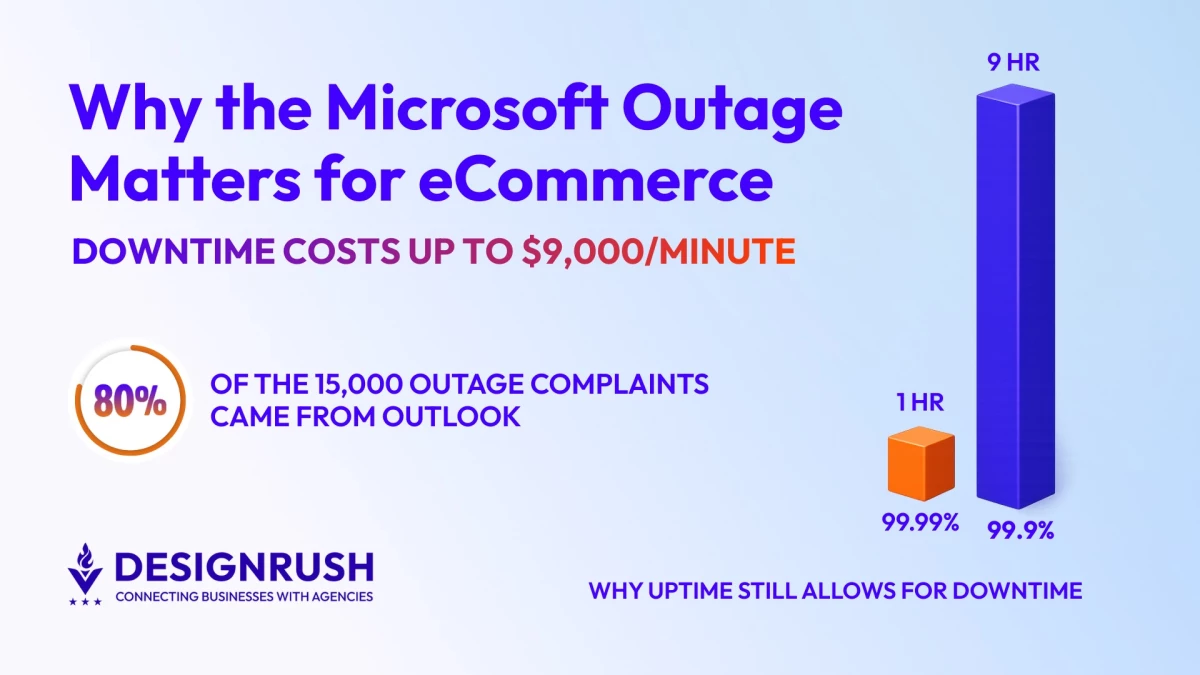
During the incident, Tom’s Guide reported that more than 15,000 users across Microsoft 365 services, with Outlook alone generating over 12,000 complaints at peak disruption.
The disruption nearly erased an entire workday for many North American businesses.
What’s more concerning is that this wasn’t an isolated failure.
Rest of World reports that over a recent 12‑month period, AWS, Azure, and Google Cloud collectively experienced more than 100 service outages, ranging from short blips to prolonged breakdowns affecting major customer segments.
Part of this disconnect comes from how uptime is commonly understood in the cloud hosting sector.
Bradley says that while the majority of cloud platforms advertise 99.9% to 99.99% availability in their service‑level agreements, those percentages still allow for meaningful downtime.
“A 99.9% uptime target still allows for nearly nine hours of downtime each year, and even 99.99% leaves close to an hour on the table,” Bradley says.
That gap carries real financial weight. Forbes estimates that downtime can cost large organizations up to $9,000 per minute once lost productivity and stalled transactions are factored in.
For eCommerce brands who intend to grow, and where availability is directly tied to revenue and customer confidence, those minutes add up quickly.
Why Many eCommerce Platforms Are Just as Fragile
A lot of eCommerce platforms are still carrying the weight of earlier architectural decisions; choices that made sense at the time but now leave them exposed.
Monolithic builds, for example, can help teams move fast in the beginning. But as complexity grows, those same systems become brittle.
“Shared databases often support multiple services with no boundaries, meaning a slowdown in one area ripples across the entire stack,” Bradley says.
“When systems are designed to scale vertically by adding power to a single server, they eventually hit a wall, particularly during promotions or seasonal peaks.”
There are also issues with synchronous service calls, where a delay in one component stalls everything downstream. And without proper caching at the edge or app layer, every request hits the core database, right when it’s most likely to fail.
These setups might run fine under typical load. But under pressure, they don’t just struggle, they break.
Reports on the 2024 Microsoft crash paints a picture of the extent these outages have on businesses; from halting flights to impacting television broadcasts:
How Resilient eCommerce Architecture Absorbs Failure
Resilient platforms are built on the assumption that things will go wrong. They’re engineered to contain failure, not to pretend it won’t happen.
One key approach is stateless services, which allow traffic to shift easily between nodes.
“Load balancers help distribute demand so no one server is overloaded,” Bradley says. “Circuit breakers and timeout mechanisms ensure that if one service begins to fail, others aren’t held hostage waiting for a response.”
Bradley says that queue-based systems provide a buffer that absorbs spikes in traffic, giving the backend time to catch up.
Caching also comes into play here, and when implemented well, it takes heat off core databases and helps platforms stay responsive, even as traffic spikes.
Moreover, when systems start to strain, the strongest architectures don’t try to do everything at once. They shed non‑essential features and protect what matters most, such as browsing, checkout, and payments, so that customers can still move through the experience.
The goal isn’t to eliminate failure. It’s to prevent a single problem from taking the entire business down with it.
How Third-Party APIs Can Break Your eCommerce Stack
One of the more invisible risks in modern eCommerce is over-reliance on third-party API providers.
Most platforms today depend on external services for payments, authentication, analytics, and more. But these services, while convenient, are rarely backed by true redundancy.
“Too often, teams assume that service-level agreements guarantee uptime,” Bradley says. “But in reality, if a third-party API slows down or fails, it can instantly disrupt entire user flows by locking out customers or stalling transactions.”
Without fallback logic or abstraction layers, platforms can find themselves powerless to respond.
What makes this even more dangerous is that these dependencies are usually hidden until they break. A login provider, for example, might be the only gateway to user sessions. If it goes down, even the most robust eCommerce backend can’t function.
Assuming these services will always work is a gamble. However, building around their potential failure is the safer bet.
Outage Readiness Starts Before the Breakdown
Brands that recover quickly from failure don’t rely on instinct or luck. They’ve already mapped out the process. Their teams know who’s responsible for what. They’ve run drills. They’ve tested failover systems and disaster recovery plans under real-world conditions.
Automated deployment and rollback pipelines help reduce the pressure to fix things on the fly.
Clear RTO (Recovery Time Objective) and RPO (Recovery Point Objective) targets keep everyone focused on what matters most to the business. And strong observability tools ensure that issues are caught early, not after customers start complaining.
“It’s far easier to recover from failure when you’ve planned for it. The worst time to figure things out is while the system is still crashing,” Bradley says.
eCommerce Takeaways From the Microsoft Outage
The lesson isn’t to ditch Microsoft or avoid cloud infrastructure. It’s to stop assuming that resilience comes built in.
Even the most sophisticated platforms can fail. And when they do, the damage depends entirely on how well the surrounding architecture is designed to contain it.
eCommerce brands that segment their workloads, test failure scenarios, and plan for partial outages will always be in a stronger position.
And the systems that survive them are the ones that treat resilience as a core function, not an afterthought.
Why Resilience Can’t Wait
The Microsoft outage didn’t just reveal a flaw in one company. It exposed the deeper fault lines running through modern digital infrastructure.
“As eCommerce platforms grow more complex and dependent on external APIs, resilience is no longer a backend concern but a board-level responsibility,” Bradley says.
Resilience is the new uptime.
And that means the eCommerce platforms that lead the pack will be engineered to fail fast, recover swiftly, and keep customers buying and coming back.