
Daily Online Shopping Drop: Key Findings
- The share of consumers shopping online daily has dropped YoY, showing habitual eCommerce use is weakening
- Consumers are becoming more intentional, as shoppers compare prices and spend more selectively across categories
- Brands must rethink engagement strategies by focusing on retention, timing, and experience to bring shoppers back more consistently
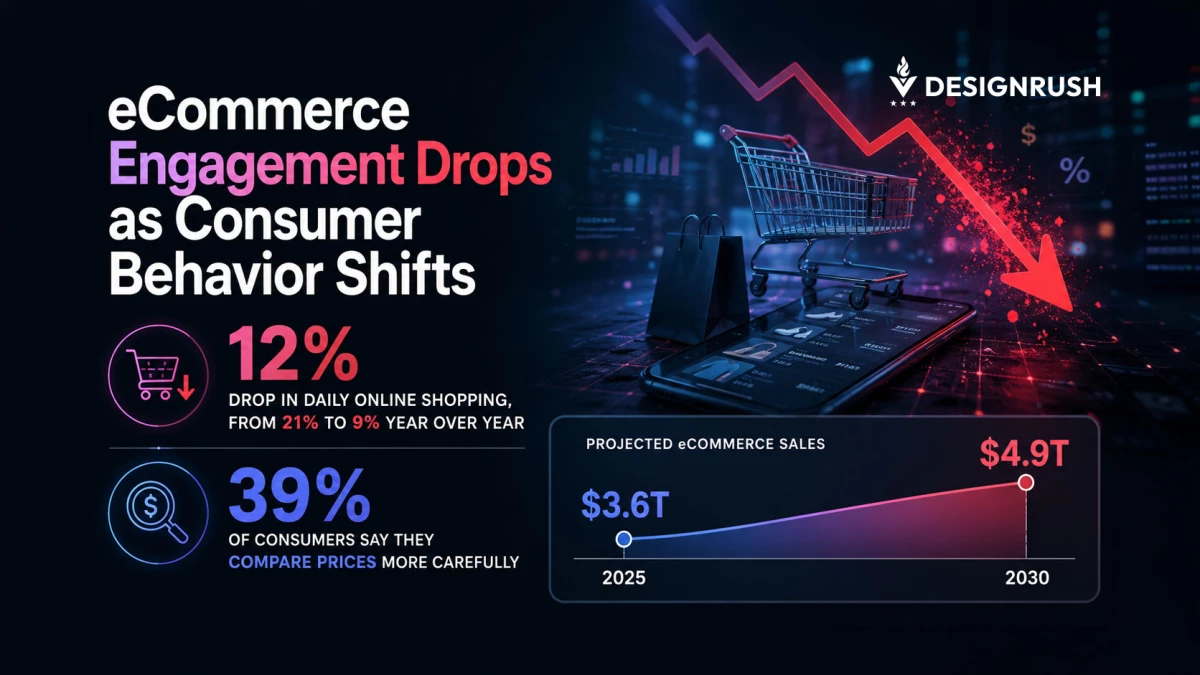
Daily online shopping has dropped 12 percentage points, falling from 21% of consumers to just 9% YoY, according to a 2026 report from Retail Dive.
This decline suggests many are moving away from routine, habit-driven shopping toward more intentional buying behavior.
Caleb Bradley is the CEO of Bighorn Web Solutions, an eCommerce agency specializing in Shopify Plus and Magento development.
He says that while overall engagement hasn’t disappeared, this drop is a big deal for brands since it directly impacts their chances to convert.
“The biggest change is consistency. People aren’t engaging with brands as frequently, which means you have fewer chances to convert and far less room for error,” Bradley tells DesignRush.
Once daily behavior starts to loosen, the downstream impact on acquisition, retention, and revenue compounds quickly.
For this reason, brands need to be hyperaware of consumer behavior online, both this year and beyond.
Bighorn Web Solutions outlines how to create a seamless eCommerce experience in the post below:
Editor's Note: This is a sponsored article created in partnership with Bighorn Web Solutions.
Why Shoppers Are Becoming More Intentional
What’s really changing here isn’t just how often people shop, but how they think about it.
Instead of engaging passively in online shopping, consumers are getting more intentional with their purchasing decisions.
And it makes sense.
With paid ads, search results, and constant content competing for consumer attention, it’s now harder than ever for brands to compete online.
To dodge some of the noise online, users are shopping more purposefully. More frequently, they’re setting out with a clear purpose, rather than just browsing.
And if nothing feels relevant right away, they leave.
“This shift toward more decisive shopping may not seem like a big deal, but it changes how brands actually compete day to day,” Bradley says.
“They’re not just up against other retailers anymore. They’re competing with everything else that fills someone’s time.”
And when attention gets stretched like that, habit is usually the first thing to slip.
The post below explains why shoppable video is becoming the next big thing in eCommerce:
Behind the 12% Drop in Daily Online Shopping
Fewer people are shopping online daily, reflecting the 12 percentage point YoY decrease reported by Retail Dive.
Economic pressure and changing consumer habits are the main reasons for the drop. And both are affecting how people spend.
How shoppers are changing, according to Retail Dive:
- 39% of consumers are comparing prices more carefully
- 38% are cutting back on spending in certain categories
- 37% are seeking more affordable alternatives
At the same time, in-store shopping has increased 11 percentage points, with 69% of consumers purchasing new products in physical stores. Social commerce has also declined, dropping 12 percentage points YoY.
“Routine visits are disappearing, and shoppers are becoming more selective about where they spend time. And when frequency drops, every interaction has to work harder to convert,” Bradley says.
This is especially true given how many are wary of new modes of shopping.
The same Retail Dive data shows that 22% of shoppers use AI to research products. But only 14% trust these tools enough to rely on them regularly, and a third don’t use them at all.
So even as new technology enters the space, trust hasn’t caught up yet. At the same time, the bigger opportunity hasn’t gone anywhere.
With global retail eCommerce sales expected to hit $3.6 trillion in 2025 and climb past $4.9 trillion by 2030, there’s still a lot of room to win online.
“Just because it’s harder to get users’ attention doesn’t mean brands can’t win. It just means every visit has to count,” Bradley says.
“The focus now is on relevance, speed, and making it easy for someone to take action the moment they land.”
Bighorn Web Solutions shows how using AI in eCommerce is driving brand growth:
Why Fewer Daily Shoppers Hurt Growth
At first, this kind of change is easy to underestimate. Then it starts showing up everywhere.
Fewer daily visits mean fewer chances to convert. But it also makes things less predictable.
When people stop showing up regularly, it’s harder to forecast, harder to plan, and campaigns don’t hit the same way.
“You start to feel it in acquisition, too. If people aren’t coming back on their own, you have to spend more to bring them in again,” Bradley says.
Research from Harvard Business Review shows that acquiring a new customer can cost five to 25 times more than retaining one, which makes losing that daily habit far more expensive over time.
And even when people do show up, conversion isn’t guaranteed.
Studies from Baymard Institute show that cart abandonment rates hover at over 70%. This means that fewer visits don’t just reduce traffic; they magnify the cost of every missed opportunity.
Bighorn Web Solutions’ post unveils why understanding your customer’s journey is the foundation of great eCommerce:
How Brands Can Improve Retention
Most brands respond the same way at first. They push harder with more emails, more ads, and more notifications. But that usually just adds to the noise.
What actually works is being more deliberate about when and how you show up.
And just as importantly, where you show up, particularly as email, paid, and social don’t all carry the same weight anymore.
Timing also matters more than it used to. Reaching someone when they’re already leaning in is far more effective than trying to pull them back later.
“The experience also has to deliver immediately,” Bradley says.
“If someone clicks through, it has to feel relevant right away. Not eventually, and not even after a few scrolls. Immediately. And that’s where expectations are rising fast.”
Take a look at Bighorn Web Solutions’ eCommerce CRO Blueprint that will help your brand drive traffic:
According to McKinsey, 71% of consumers now expect personalized interactions, which means generic experiences get ignored just as quickly as they’re opened.
And then there’s retention. Loyalty programs, subscriptions, and even simple follow-ups all play a role here.
“The goal isn’t just to bring people back once. It’s to rebuild a rhythm that keeps them coming back consistently,” Bradley says.
“Because while behavior is shifting, the bigger picture hasn’t changed.”
The post below tells why Bighorn Web Solutions considers a thorough understanding of customer behavior as a competitive advantage:
What This Means for eCommerce Brands
This isn’t just a short-term dip. It’s a shift in how people engage with online shopping, and it’s already forcing brands to adjust.
“The ones that depended on constant visibility are going to feel it first,” Bradley says. “When daily habits fade, showing up more often doesn’t really fix the problem. Showing up at the right moment does.”
You can already see the split starting to happen. Some brands will keep pushing volume, hoping things go back to how they were. Others will adapt, focusing more on timing, relevance, and user experience instead.
Moral of the story? As shopping becomes more intentional, every online interaction carries more weight. This means brands can’t rely on generic messaging or lazy tactics to get ahead.
“The brands that get this right early won’t just recover engagement. They’ll build something more stable, where people come back because they want to, not because it’s a habit,” Bradley says.
Want to know how your eCommerce brand can stand out from the rest?
Take a look at our Top eCommerce Companies of 2026.