
U.S. retail eCommerce sales were estimated at $340.2 billion in Q2 2026, up 12.2% from a year earlier.
Meanwhile, total retail sales rose 6.7%, per the Census Bureau’s Aug. 18 Q2 estimate cited by PracticalEcommerce.
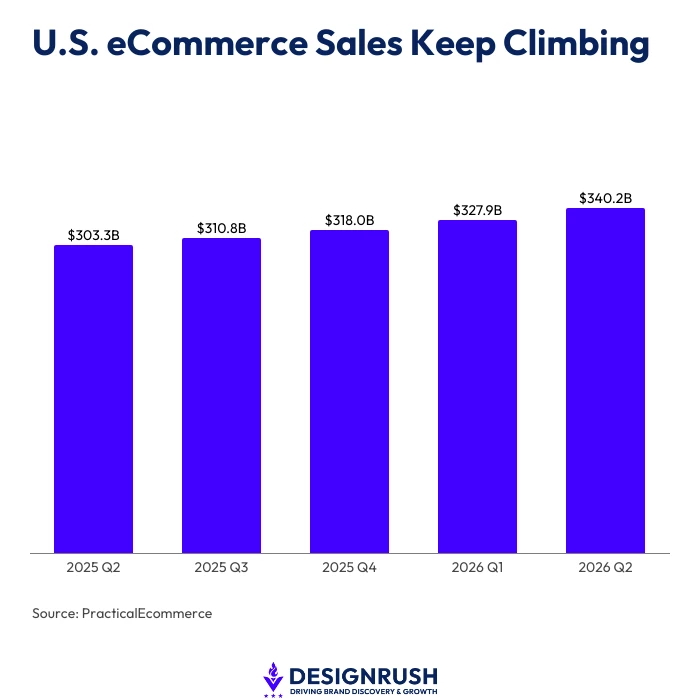
Online sales accounted for 17.1% of total retail sales during the quarter, a 3.8% increase from the first quarter after seasonal adjustment.
And while this growth sounds encouraging, a brand can still be left wondering where its next marketing dollar should go.
As a leading digital marketing agency, Intero Digital works across paid media, SEO, GEO, content, PR, and CRO, giving its teams a view of how budget decisions differ depending on where customers are lost.
The agency’s director of SEO and GEO communications, Cosima Compton, looks at how that journey now starts and develops across different channels.
"Users bounce between tools and platforms at different stages based on what they need at that moment," she says.
"Someone might first come across a brand through ChatGPT, then encounter it elsewhere before eventually reaching the company’s website."
eCommerce Growth Doesn’t Mean Brands Need More Traffic
Sometimes a brand just needs more people to reach the site. But even if people are already getting there and leaving without buying, more traffic won’t solve the problem.
"Paid media can bring more people to the site, while CRO deals with what happens once they get there," Compton says.
"In instances where sessions rise and conversions or revenue don’t follow, the extra traffic hasn’t solved anything."
Likewise, a store can also convert well and still have trouble being found. And if people rarely see it in traditional search or AI-generated results, fewer of them ever get the chance to buy.
SEO and GEO address that visibility problem.
For brands finding themselves in that position, spending more on acquisition without looking at how easily people can find it leaves an earlier part of the journey untouched.
AI Search Makes eCommerce Traffic Harder to Measure
Website traffic misses some of the places where people now discover brands.
AI Overviews and generative answers can put a company in front of someone without sending that person to its website.
"A brand can now be seen, cited, and even trusted by a user who never lands on the website at all," Compton adds.
"Someone can see a brand in an AI answer and reach the site later through search or a direct visit. Analytics sees the visit or sale, but the earlier AI mention may never appear."
Branded searches and direct visits can offer clues when that happens.
And while they won’t recreate the exact path, they can show whether people are seeking the brand out after encountering it somewhere else.
Conversions and revenue show what happened after people reached the site.
A drop in traffic matters less if sales are holding up, while more visits deserve a closer look if they aren’t producing more business.
Where Brands Should Spend the Next eCommerce Marketing Dollar
The next budget decision needs to be dependent on more than a traffic number.
To make that call, Compton says brands should look at three areas before deciding where the money goes:
1. Check what it costs to acquire a customer
Look at customer acquisition cost alongside revenue before putting more money into acquisition.
If the cost keeps rising without enough additional sales to justify it, more spend may not be the answer.
2. Look at what happens after the first purchase
New customers can keep coming in while too few return.
Retention belongs in the budget discussion when the business is repeatedly paying to replace customers instead of getting more value from the ones it already acquired.
3. Ask people how they found you
Some AI influence won’t always appear in analytics.
Compton recommends an open-ended “How did you hear about us?” field so that people can mention ChatGPT or another source without being pushed toward a predefined answer.
"Attribution matters because budgets follow it," Compton says. "But when AI-mediated influence can’t be traced to a revenue outcome, it’s systematically underfunded."
So before moving your budget, make sure you know where you're actually losing your next potential sale.