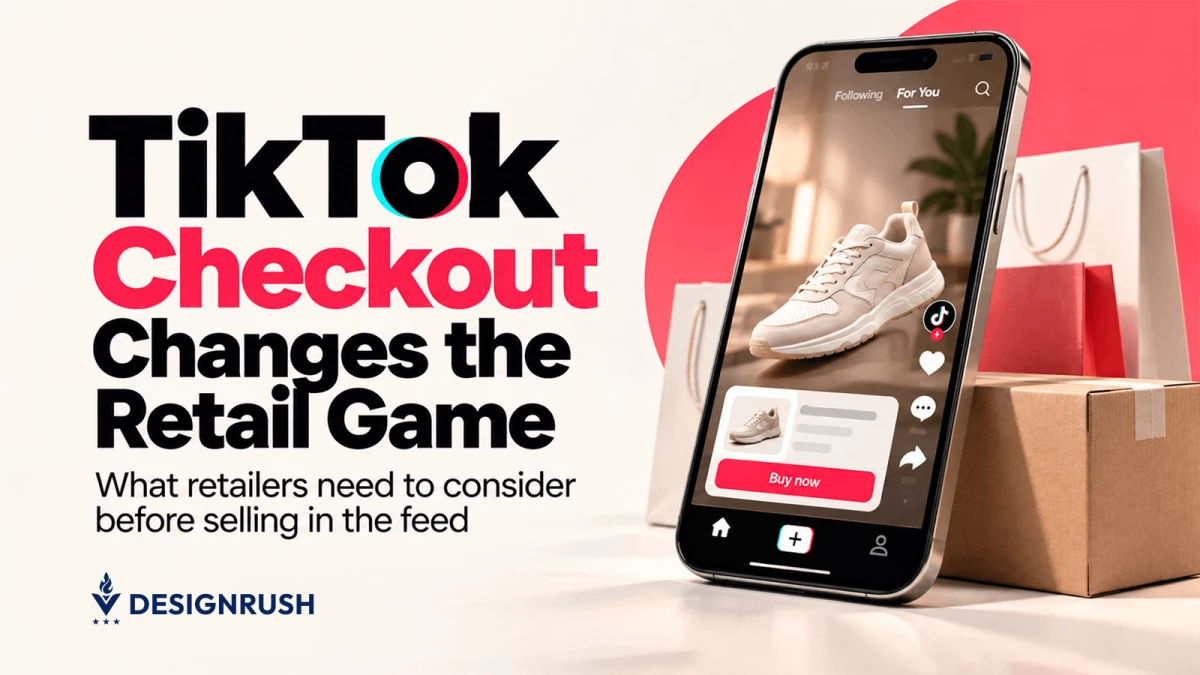

TikTok introduced a conversational AI shopping assistant and one-click feed checkout on October 5.
Shoppers can ask about product details, sizing, shopping, and availability, all while doom-scrolling.
Even partnerships with Shopify, Salesforce, and Stripe support the rollout.
So now, retailers need to decide which products they’ll offer through TikTok, and then what their own websites should handle once consumers can complete a purchase elsewhere.
Ken Braun, co-founder and chief brandtender of web design and digital marketing agency Lounge Lizard, points to the trade-off between a faster sale and control over the buying experience.
"TikTok is compressing the distance between seeing a product and buying it.
"That can remove friction, but it also means the brand has less room to answer questions on its own terms before the transaction happens."
How TikTok Checkout Affects Retail Websites
The website still has work to do, though.
Perhaps shoppers need to compare products, check specifications, or read return policies before spending money.
TikTok might be able to answer some of those questions, but retailers don’t have as much control over how much information appears in the feed.
That’s what makes the quality of a retailer’s own product pages so important, even if AI takes a larger role in online shopping.
Lounge Lizard’s Mind Games project takes a similar approach, making product discovery interactive while keeping the path to purchase simple:
Seventy-two percent of consumers expect retailers to offer AI-assisted shopping within the next year, according to Microsoft Advertising’s research.
And the same research found that visitors referred by AI convert 42% better than non-AI traffic.
So consumers expect more help from AI, and visitors arriving from AI sources convert at a higher rate.
But if product details are missing or stock information is incorrect, shoppers may leave without buying.
"The feed can introduce a product, but the website has to answer the questions that stop someone from buying it," Braun says.
The data available for follow-up depends on the platform’s policies and the merchant’s integration.
"That information can affect the value of a customer over time. Someone buying coffee or skin care may place several orders a year," he adds.
"A customer purchasing a sofa might not return for years. Customer acquisition costs need to account for those differences, particularly if a retailer has fewer ways to reach buyers after their first purchase."
How Retailers Should Allocate Holiday Budgets
AI is showing up at more points in the shopping process. The latest holiday figures give a sense of how consumers are using it:
- Adobe forecasts that AI-driven traffic to U.S. retail websites will increase 130% year-over-year this November and December.
- In Adobe’s July survey of 5,000 consumers, 77% of those who had used AI for online shopping said it made them more confident in their purchases.
- Deloitte’s 2026 Holiday Retail Survey found that 39% of respondents used generative AI as their primary tool for at least one holiday shopping task. Only 16% said they’d let AI complete a purchase.
Braun says retailers should check the numbers on each product before putting more money behind TikTok.
"I'd look at what the business keeps from each sale after fulfillment costs, discounts, and returns. A product can sell well in the feed and still leave very little margin. More orders won't fix that."
The same principle applies to B2B websites, where Lounge Lizard helped Durable Superior Casters organize an extensive product catalog so buyers could find specifications and request quotes more easily.
He recommends starting with a small selection of products rather than creating a whole new catalog all at once:
- Products with familiar uses and few sizing or compatibility concerns may suit a quick in-feed purchase.
- Configurable goods or items that require detailed comparisons may need more explanation on a retailer’s website.
"I’d start with products people can understand quickly and buy without needing a long comparison," Braun adds.
"If fit, customization, compatibility, or after-sale support plays a large part in the decision, the website may still be the better place to finish that purchase. The goal is to match the checkout experience to the buying decision."
In addition to this, retailers also need to separate new sales from purchases that have moved from one checkout to another.
And while an increase in TikTok orders may look promising in a channel report, it doesn't show whether the platform generated new sales or simply redirected purchases that would have happened on the brand's website.
"Look at how many sales are genuinely new," Braun says.
"Some customers would have bought from the website anyway. If TikTok records more orders but the overall business gains little additional revenue, the campaign may be moving sales between channels instead of generating growth."
Retailers also need to consider how much of their sales strategy should depend on a platform they don't control.
So if TikTok changes its reach or terms next season, would the brand still have enough direct customer relationships to sustain repeat sales?