
eCommerce discovery has always followed a straightforward pattern where a shopper:
- Searches for something
- Clicks through the SERPs
- Compares a few products
- Lands on a product page
But AI is starting to remove much of that journey.
In fact, Shopify's Q2 2026 results offer a glimpse of how quickly shopping habits are changing.
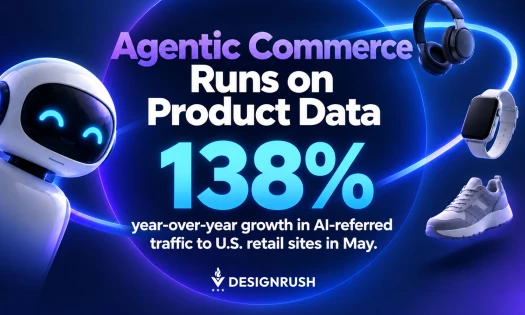
The company reported $3.6 billion in revenue, a 36% increase from the previous year, while AI-referred traffic and orders tripled over the same period.
All of these figures matter because it's a clear indication that AI is becoming an additional route to customers, especially for merchants selling specialized products.
According to Adam Brazg, CEO of Bilberrry, that additional route should have a major influence on the way enterprise brands build and manage their eCommerce experiences.
In this DesignRush interview, Brazg discusses what AI-driven growth means for eCommerce merchants, why product data is becoming critical to AI discovery, and how brands can prepare.

Who is Adam Brazg?
Adam Brazg's decade of work spans digital strategy, design, marketing, and product management. He has led digital innovation projects for companies including Deloitte, Business Wire, David’s Bridal, and Lockheed Martin.
Bilberrry grew out of that background. Custom applications, enterprise eCommerce, and long-term digital transformation work with CTOs and CIOs make up most of what the agency does today.
Make Product Data Useful to AI
Traditional product descriptions communicate benefits to human shoppers.
AI agents, however, need to identify specific attributes, compare products, and determine whether an item satisfies a shopper's requirements.
That requires merchants to rethink how they structure product information.
"The way I explain it to clients is your product data should look more like a spreadsheet than a brochure,” Brazg says.
“If your material, size, and care instructions are all in one paragraph of description text, you don't have product data. You have marketing copy that happens to contain facts, and you're hoping a machine can pull them back apart."
This difference is especially important since shoppers are known to ask AI assistants highly specific questions.
For example, someone looking for a waterproof jacket may have particular requirements for its water-resistance rating.
If those attributes are buried in descriptions or expressed inconsistently across a catalog, AI systems have a harder time identifying suitable products.
“Use the same word for the same thing every time, because 'waterproof,' ‘water resistant,’ and ‘IPX7’ scattered across a catalog read as three different products,” Brazg adds.
“The part that surprises people: consistency beats detail. Missing or inconsistent data is what gets skipped.”
But Brazg also says this doesn’t mean brands need to produce even more content.
In many cases, a review of what already exists and adjusting for consistency is equally effective.
In particular, Brazg says product-data reviews should focus on four areas:
- Attributes: Make materials, dimensions, specifications, and other product characteristics explicit.
- Terminology: Standardize how the same attributes are described across the catalog.
- Compatibility: Organize fit and compatibility information into identifiable fields.
- Completeness: Identify missing information that could prevent AI from recommending an otherwise suitable product.
Make the Product Page Keep the AI's Promise
Traditionally, product pages have been responsible for much of the persuasion involved in a purchase.
Today, however, an AI-referred shopper will likely have completed much of that evaluation before they land on a product page.
“Most product pages assume the shopper browsed their way there and understands the brand,” Brazg says.
“Someone arriving from a conversation has none of that and rarely goes looking. Everything needed to buy has to be right there: specs, fit, stock, real delivery date, returns, reviews.”
And because an AI assistant has already made a promise to a potential customer on a brand’s behalf, this changes how product pages should function and which information deserves priority.
More specifically, product pages and whatever data the AI reads have to say the same thing.
And if they don’t?
“When they disagree, you've put a credibility gap at the moment of purchase. And if customers can’t confirm what the AI has told them in about five seconds, you will likely lose the order,” Brazg says.
This is particularly significant given Shopify's finding that half of AI-referred sessions land directly on product pages.
Prevent AI From Flattening the Brand
Now, all of this seems like AI platforms hold a tremendous amount of control.
So how much control do merchants actually have over their brand voice when they’re cited by AI?
“Over the wording, almost none. Over what survives, quite a lot,” Brazg says.
Think of AI responses as a filter that strips adjectives and keeps claims.
"Crafted with passion by people who care" will likely not make it through, because there's nothing in it to carry over.
However, statements like "Sourced from three family farms in Oaxaca and roasted within 48 hours" usually survive mostly intact.
These two examples illustrate how the brands that get flattened into commodities are the ones whose whole difference lived in tone.
On the other hand, the ones that keep their identity keep their branding on-point, factual, and easily referenceable.
However, Brazg says the biggest risk in AI responses isn’t brand voice. Rather, it’s accuracy.
“When an assistant answers a warranty question for you and gets it wrong, that's a liability, not a tone problem,” he adds.
“It is also very important that you are careful in what you put in your data, because a soft marketing claim can often come across as a confident fact within an AI response.”
This makes accuracy a brand-management responsibility as much as a technical one.
Merchants need to consider how their product information will be interpreted and communicated outside their own websites, where they have considerably less control over its presentation.
The more AI participates in purchasing decisions, the more consequential those details become.
Make AI Readiness an eCommerce Priority
AI shopping is still developing, but the underlying requirement for merchants is already clear.
Merchants now need to start thinking about what happens when a customer asks a machine to make the first introduction.
That could make AI one of the strangest tests eCommerce has faced yet.
The companies that spent years perfecting how they speak to customers now have to be equally good at making themselves understood by something that doesn’t care how beautifully a brochure is written.