
When you ask ChatGPT for a project management tool, a skincare brand, or a B2B software vendor, you don’t get a list of 10 links. Instead, you usually get one (or a few) recommendations.
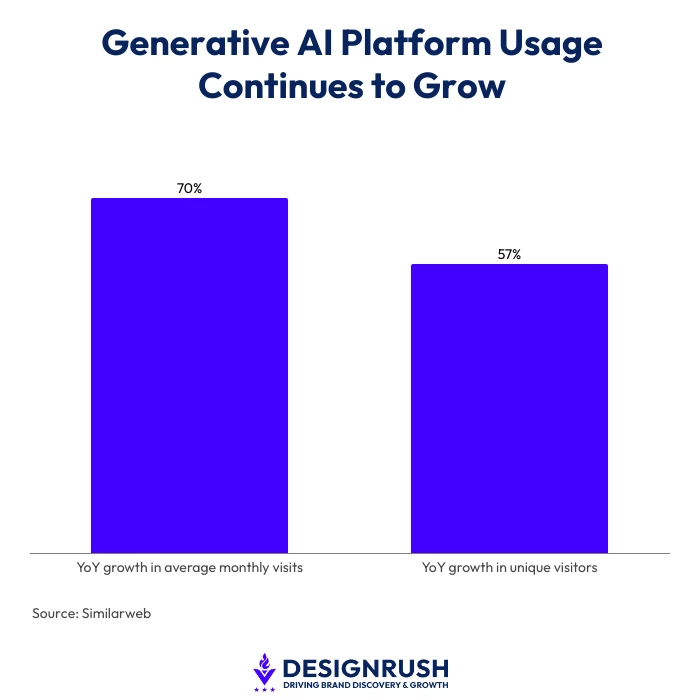
Similarweb’s 2026 Generative AI Landscape data shows that the average monthly visits to generative AI platforms grew 70% year over year to 9.5 billion between June 2025 and May 2026, while unique visitors increased 57% to 655 million.
More people are starting their research with ChatGPT, Gemini, Perplexity, and Google’s AI Mode. In many cases, users don’t even click on links, with AI just giving them an answer.
So being visible is no longer just about ranking on a search engine results page. Now, it’s about whether your brand is included, cited, or recommended in an AI response.
Intero Digital’s RASE framework for generative engine optimization addresses this change, and here’s what we’ve learned from using it with a variety of companies.
How AI Search Decides Which Brands to Recommend
Traditional SEO taught marketers to focus on rankings, which meant trying to get on the first page, in the top three spots, or in the featured snippet.
But AI systems work differently. They gather information from indexed content, structured data, and trusted third-party sources to build an answer and then decide which brands to mention.
Even if a brand’s website is technically strong, it can still be overlooked if its content isn’t set up for retrieval or if it doesn’t appear in the types of sources that AI trusts.
SEO is about helping people find your site in search results. GEO is about helping an AI system decide what to include in its answer, and the system’s choices can change each time.
Citation rates vary by category and platform, so your visibility strategy needs to focus on where your customers are asking their questions, not just on general presence.
5 Factors That Help Brands Get Cited in AI Search
Five signals consistently show up in our analysis of why one brand gets cited and a close competitor doesn't:
Entity clarity
AI systems need to know what a brand is, what it does, and how it fits with others in its category.
Structured data (like organization, product, and article schema) helps, as does consistent messaging across the brand’s website, listings, and third-party mentions.
Content built for extraction
Content should include clear headings, direct answers near the top of the page, and FAQ structures. This can be a quick fix to start with because it doesn’t require new content.
You’re just restructuring what’s already there.
Brand mentions in trusted sources
Being mentioned alongside relevant competitors and topics in trusted publications carries more weight than a standalone press release.
Technical accessibility
If AI crawlers can’t access a site, none of the above matters.
My team often finds sitemap errors, blocked resources, and crawl paths that prevent a brand from being included in the retrieval process before content quality is even considered.
This is one of the first things we check in an audit because it limits every other investment.
Community and forum presence
AI models don’t rely on brand-owned content alone. They also use sources like Reddit and Quora.
If a brand isn’t included in those conversations, it’s missing from a growing part of what shapes AI-generated answers, especially for questions where people want opinions instead of just facts.
Why Brands Get Left Out of AI Search Results
I see the same visibility gaps with many clients.
Some brands have strong on-site content but almost no third-party presence to back up who they are, so they’re well-documented but not well-supported in the eyes of a model that looks for agreement across sources.
Others have the opposite issue. A lot of press mentions but content that’s too unstructured for a model to extract easily.
Surprisingly, many well-optimized sites are blocking or slowing down the AI crawlers that need access to include them, often because of old bot-blocking rules that haven’t been updated since AI crawlers became common.
The common thread here is fragmentation. A brand’s authority signals are out there, but they’re scattered across formats and channels that weren’t necessarily built to work together.
7 Metrics for Measuring Brand Visibility in AI Search
Traditional tracking with GA4 or UTM parameters doesn’t capture the full impact of AI-generated answers.
That’s why brands need to track seven metrics to understand how visible they are in AI search:
Citations
These are references or links to a specific resource, page, or article in an AI search response.
Measurement involves tracking how often your brand is cited in AI search responses, which gives you insight into how your website’s content is being used by generative engines.
Share of voice
This is how often your brand is mentioned in AI-generated answers compared to your competitors. By tracking your share of voice, you’re able to measure how prominent your brand is compared to other brands in your space.
Share of voice is calculated by dividing the number of responses that mention your brand by the total number of all brand mentions across all responses.
Source tracking
This metric shows which sites AI engines use for a given topic.
It helps a brand focus on building the right relationships and mentions instead of trying to build authority everywhere.
Visibility score
This number tracks whether your brand appears in an AI search response. If you’re present, your score increases for that response. If you’re not, your score goes down.
Visibility score is calculated by dividing the number of responses that include your brand by the total number of responses that include at least one brand.
Sentiment
This evaluates how your brand is portrayed in AI search responses.
For example, answers including words like “expensive” might lower your sentiment score because they indicate a negative association, while phrases like “great ROI” might increase your sentiment score because they indicate a positive association.
Query-level, not keyword-level, tracking
The same brand might show up for one type of question but not another.
So visibility should be measured by the actual questions customers ask an AI system, not just the keywords they type into a search bar.
Directional indicators in existing tools
While increases in branded search or unexplained changes in direct traffic or homepage traffic are directional indicators, they can also potentially be early signs that AI-driven discovery is happening, even if it doesn’t show up as a referral source.
These metrics don’t guarantee that AI discovery is happening, but they are worth monitoring.
How SEO and GEO Work Together in AI Search
None of this replaces traditional SEO, but it does work alongside it.
SEO and GEO use the same technical foundation, but they target a different decision maker.
For GEO, that decision maker is a model that’s choosing what to say, not necessarily a person who’s choosing what to click.
Brands that see AI visibility as a part of their content and authority strategy, not a separate project, are the ones that will show up when and where it matters.
So ask yourself. When AI recommends a brand in your category, what reason have you given it to choose yours?