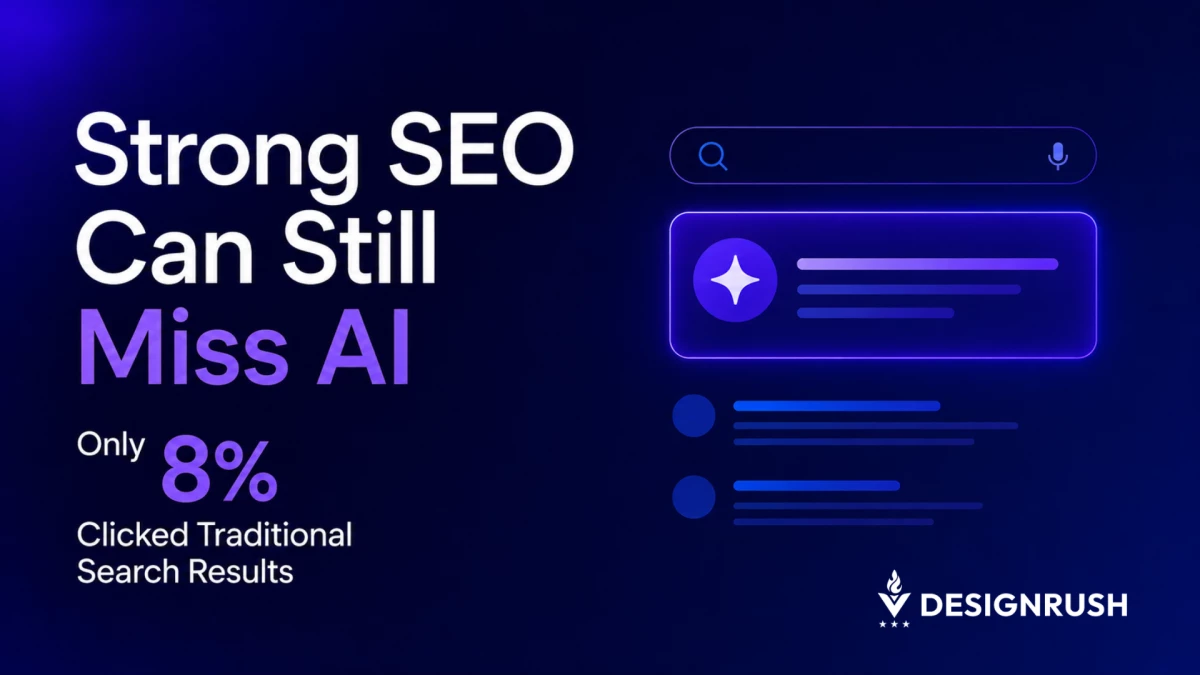

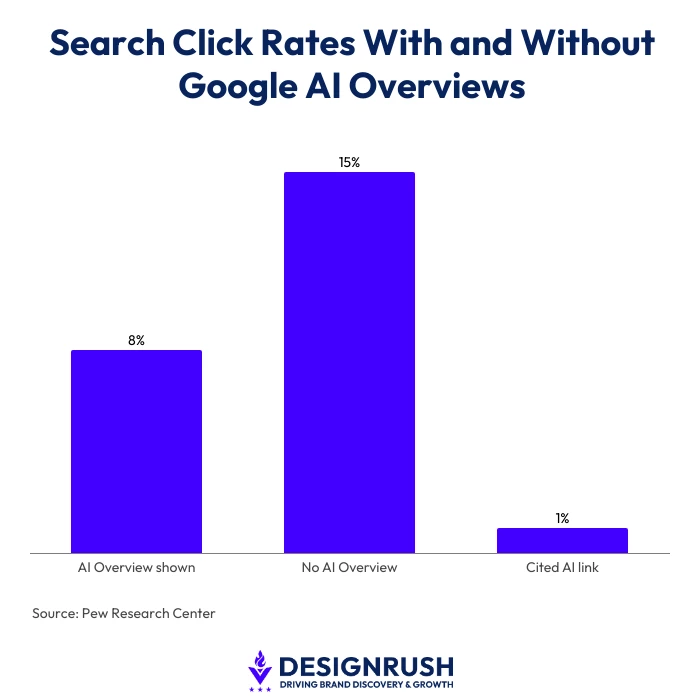
Google users clicked a traditional search result in just 8% of visits when an AI Overview appeared, compared to 15% when it didn't, Pew Research Center found.
Even the links cited inside those summaries drew clicks in only 1% of visits.
But by the time those visitors arrive, an AI answer may already have named some brands and left out others.
Intero Digital, a top-ranked digital marketing firm in the U.S., looks at that gap across its SEO and generative engine optimization work, comparing traditional search performance with how brands appear in AI-generated answers.
The agency’s Director of SEO and GEO Communications, Cosima Compton, explains that an established brand name doesn't always guarantee a citation.
"LLMs don't treat brand recognition as a shortcut to citation," Compton says.
"They're evaluating each individual piece of content on whether it's structured in a way they can actually lift and use as an answer."
Why Strong SEO Rankings Don't Guarantee AI Search Visibility
A page can rank well for a query and still go unnamed when someone asks an AI platform for a recommendation or comparison.
"A lot of the SEO foundation still matters, including keyword research, heading structure, site speed, crawlability, and schema," Compton adds. "Where it needs to change is format."
Google's own guidance supports that overlap.
Pages still need to be indexed and eligible to appear in Search to feature in AI Overviews or AI Mode, while crawlability, internal links, page experience, textual content, and structured data remain part of the foundation.
Google says there are no additional technical requirements for appearing in those features, and publishers don't need AI-specific markup or special schema.
How to Measure AI Search Visibility Without New Tools
Compton recommends checking whether the problem exists before investing in another platform.
Marketing teams can compile 20 to 30 questions customers might realistically ask about their industry, including queries that don't mention the brand, then run the same questions through ChatGPT, Gemini, and Claude.
Teams can then compare the brands appearing in those answers with their existing search rankings.
"You don't need new software or a platform account to do this first pass," Compton says.
"It'll show you pretty quickly whether you have a real gap and where that gap is concentrated, and it often looks nothing like your traditional search rankings."
How Freshpet’s Google AI Overview Visibility Rose 645% in 6 Months
Intero Digital found the same gap in its work with Freshpet. Despite years of content and an established audience, the brand was still missing from some AI-generated answers where the agency expected it to appear.
In a recent Search Engine Journal webinar, the agency walked through how it diagnosed and addressed those gaps.
Using its RASE framework, which looks at relevance, authority, structure, and engagement, the agency found issues with both content format and technical access.
"Freshpet had years of genuinely good, accurate content about pet nutrition, and it just wasn't built in a way an LLM could extract and cite," Compton says.
The agency also found that LLMs couldn't crawl some of Freshpet's review content because it was rendered in JavaScript.
Intero Digital then addressed indexation and redirect issues, added FAQs and content around higher-intent nutrition questions, aligned keywords with pages, and updated titles and meta descriptions.
Over six months, the agency reported a 645% increase in Freshpet's appearances in Google AI Overviews. Traffic from major AI search platforms rose 46%, while key events from AI referrals increased 44%, including use of the brand's store locator and delivery sign-ups.
Traditional search improved during the same engagement, with branded search visibility up 37% and the number of keywords ranking in Google's top 10 up 38.9%.
5 GEO Fixes to Improve AI Search Visibility
Based on what Intero Digital found with Freshpet, Compton recommends five areas for brands to review.
1. Write Self-Contained Answers for AI Search
Compton recommends writing key information in short, self-contained passages that answer specific questions directly.
The aim is to make an answer understandable on its own rather than requiring several surrounding paragraphs to establish what it means.
Compton describes the distinction as writing content that can be quoted as well as read, particularly for questions a customer is likely to ask an AI system.
2. Audit Robots.txt and JavaScript Content
Teams should check robots.txt to make sure relevant AI crawlers aren't being blocked and confirm that important information isn't inaccessible because of how it is rendered.
That includes checking content delivered through JavaScript, the same issue Intero Digital encountered with some of Freshpet's review material.
3. Expand Schema Markup
Compton also recommends using schema markup more extensively than teams might for traditional SEO.
The recommendation concerns how existing information is structured for machines to interpret.
Google separately says publishers don't need special AI-specific schema to appear in AI Overviews or AI Mode.
4. Target Niche and Trade Publications
For third-party coverage, Compton recommends considering how closely a publication relates to the subject rather than judging an opportunity by audience size or domain authority alone.
Intero Digital has found that a smaller niche or trade publication can carry more weight with an LLM when it provides stronger topical relevance and reinforcement than a larger general-interest outlet.
5. Track High-Intent Prompts and Conversion Gaps
Intero Digital tracked 475 individual prompts for Freshpet every day across major LLMs, grouped into more than a dozen categories.
That gave the agency a view of where the brand appears, where it doesn't, and which missing appearances sit closer to revenue.
Rather than treating every absent mention the same way, Compton recommends prioritizing the questions most closely tied to conversion.
How Marketing Leaders Should Judge AI Search Visibility
AI visibility on its own doesn't tell leaders much. A brand mention, citation, or appearance matters more when it connects to the questions customers ask and the actions that follow.
That also makes it harder to justify treating GEO as a separate reporting exercise.
For leaders, the more useful question is whether those measures are being looked at together rather than in separate dashboards.
So ask yourself this. Are you measuring AI visibility because it looks good in a report, or because you can see where it is influencing demand?