
A stock photo and a full brand shoot can produce the same problem. Both can result in a website that photographs well and still says nothing about the business behind it.
For Visuable, an award-winning Squarespace web design and SEO agency that includes photography sourcing in every website package, the stock-versus-custom debate is the wrong place to start.
For the agency’s Founder and Creative Director, Lidia Drzewiecka, with background as a professional brand photographer, every image decision should start with a more useful question.
What job is this photo doing?
That thinking is rooted in Visuable's own history.
The agency began as a personal brand photography venture before becoming a full digital brand agency, and its photography background still shapes how the team approaches visual storytelling and web design.
Custom photography is strongest when a website needs to sell a specific person, product, place, or real experience. Stock can work brilliantly when the job is to communicate mood, aspiration, positioning, or a more conceptual service.
The source matters less than whether the image is right for the job.
Start With What the Website Needs to Sell
What a website sells determines which photo works. Two beauty brands in Visuable's own portfolio show how differently that plays out.
Beautique Concierge sells premium in-home treatments built on an aspiration, so its site leans on curated stock imagery to set a clean, confident mood.
A studio in the same industry, Brow Canvas, sells something more literal, a specific team in a specific space.
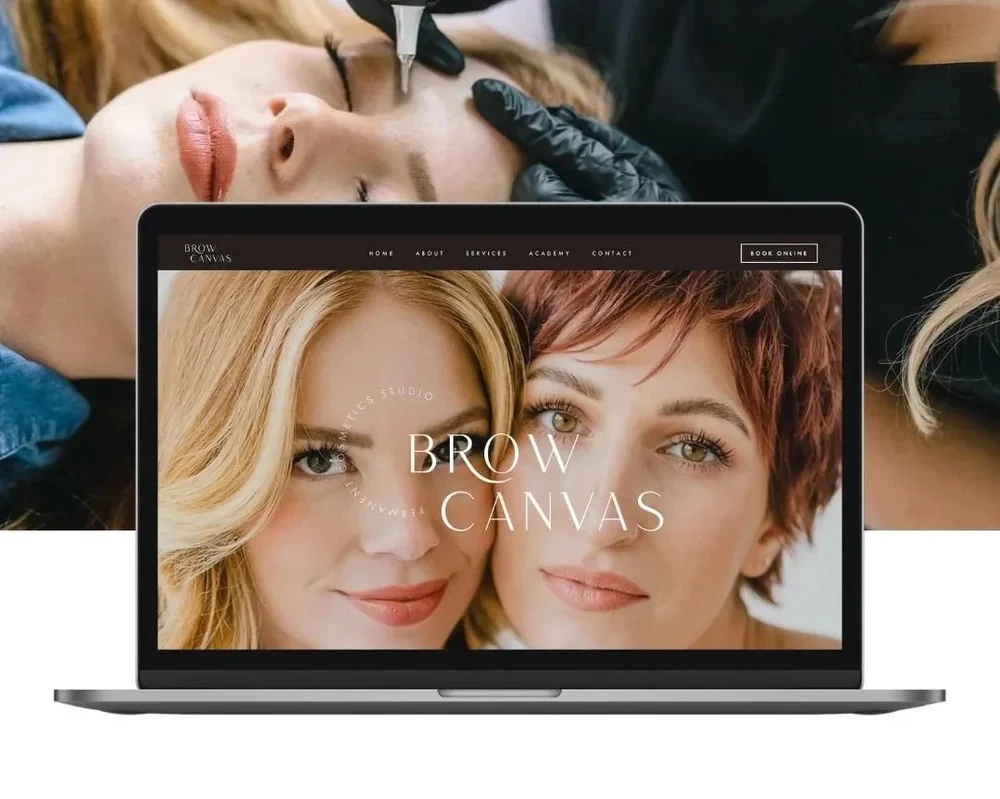
Real treatment photos, like this microblading session, sell what Brow Canvas clients book. Source: Visuable
Custom photography is fundamental there, since the website is effectively giving customers a preview of the experience before they book.
"The website uses real-client imagery and treatment photography to showcase the results and build confidence in what customers can expect," Drzewiecka says.
"In this instance, replacing those images with stock would remove some of the credibility and individuality of the experience."
Beautique needed its photography to create aspiration around the service, while Brow Canvas needed customers to see the actual people, treatments, and results they are considering booking.
That distinction is more useful than asking whether stock or custom photography performs better in general. The answer changes according to what a customer needs to see or feel before making a decision.
The Photo Is the Pitch for Personal Brands
For a personal brand, the person on camera is the product, and custom photography becomes essential. That thinking shaped sites for R&D leader Orestis Georgiou and stylist Anna Chabura.
"Their own photography became an important part of communicating personality, expertise and trust. Visitors aren't simply buying a service," Drzewiecka says.
"They're deciding whether they want to work with that particular person, so they need to see and connect with them."
Both projects use dedicated photography throughout.
The same question guided both sites, less about which photography performs better and more about what the customer needs to buy into.
Literal Imagery Is Often What Makes Stock Feel Generic
One reason stock photography can feel generic has less to do with where the image came from and more to do with how literally the business interprets what it does.
For example, growth is often depicted as an upward graph, while collaboration becomes a group gathered around a laptop. These images may describe the category, but they say little about the particular business using it.
That becomes especially limiting for B2B consulting companies selling ideas or outcomes that are difficult to photograph literally.
In those cases, imagery can communicate what the service represents instead, whether that is confidence, freedom, stability, ambition, or another idea tied to the brand's positioning.
Visuable applied that thinking to Wealth Builders, a financial services firm.
"Rather than filling the site with conventional financial imagery, the photography includes homes, lighthouses, and lifestyle settings," Drzewiecka says
"The imagery supports messaging around financial security, freedom of time, health, and peace of mind, focusing on what wealth can make possible rather than depicting financial planning itself."
The distinction is conceptual rather than literal. Stock imagery can feel highly specific to a business when the idea behind its selection is specific too.
Intentional Cropping Makes Stock Feel Considered
Intentional cropping is one of the simplest ways to turn a stock image into something considered.
A stock photo often shows an entire room or scene as supplied, but the team rarely uses it that way. Instead, it crops tightly into an architectural detail or a patch of negative space.
"You're no longer simply placing a stock photograph on a page. You're using the image as part of the design," Drzewiecka says.
The same instinct extends to the wider brand system.
For R&D Management, the visual identity took its cue from the client's own published book, so Visuable built the website, typography, color palette, and imagery as one connected system.
External Group took a different route. The business is tied to New York City, so the agency built the photography around the city's own visual signature.
It used stock images that carry the yellow and black of its cabs. That color became part of the brand palette itself, threading the imagery and the wider brand identity into one cohesive world.
"A strong stock image shouldn't feel interchangeable with the first similar photograph you find in a library," Drzewiecka explains.
"It should have been chosen, cropped and styled for a reason."
That discipline is what keeps a stock photo from feeling generic and makes it read as part of a brand's own visual language.
A Custom Shoot Without a Plan Still Falls Short
Custom photography tends to fall short in one specific way. The shoot gets the investment, but not enough thought is given to how the photos will work on the site.
A beautiful photograph isn't automatically a useful website photograph.
A portrait composed dead center leaves no room for a headline, and a vertical shot cannot fill a wide hero banner.
Strong lighting and editing can still undercut a shoot when they ignore the brand identity.
"Photography for a website needs to be planned as part of the design system, rather than created independently and handed to the designer afterwards," Drzewiecka says.
That means building a shot list around hero banners, About sections, testimonials, mobile crops, and other placements before the shoot begins.
A custom shoot may solve the question of where the photography comes from, but it still needs to answer the same question as stock. What job does each image need to do on the website?
Consistency Beats Quantity in a Stock Library
For a brand without a budget for a custom shoot, Drzewiecka prioritizes consistency over volume.
A smaller set of images that feels like one visual world beats twenty impressive but unrelated photographs.
Before adding any image, she checks it against six criteria:
- Lighting, whether the warmth and contrast match across the set.
- Composition, whether there's room for copy in landscape and mobile crops.
- Color, whether the tones complement the brand palette.
- Subject matter, whether it connects to the idea being communicated.
- Authenticity, whether it reads as natural rather than staged.
- Positioning, whether it reinforces how the business wants to be perceived.
Together, those checks keep the focus on what the photography contributes to the website rather than whether an individual image looks impressive on its own.
Visuable builds photography sourcing into every website package by default, treating image selection as part of the same creative decision as color, typography, and layout.
What This Means for Anyone Planning a Website Shoot
The "what job is this photo doing?" question also works as a practical filter when planning a website.
Establishing credibility, introducing a founder, demonstrating a product, or helping someone imagine an outcome all call for a different image.
Once that purpose is clear, deciding whether the image should be stock or custom becomes much easier.
"The mistake is starting with, 'Do I like this photograph?' A brand website isn't a personal Pinterest board," Drzewiecka says.
So, before approving a stock photo or booking a shoot, map out where each image lives on the page and what it has to accomplish there.
"A thoughtfully selected and beautifully art-directed stock image can add enormous value to a website," Drzewiecka says.
"A badly planned custom photograph can weaken one. What matters is whether every visual decision has a reason behind it."
The Visual Thinking Behind Better Web Design
That photography-first perspective still shapes how Drzewiecka thinks about visual storytelling on a website.
"I've always thought about imagery as storytelling, what happens inside the frame, what you leave outside it, where the eye travels," Drzewiecka says.
A website asks the same questions of a visitor moving down a page, deciding what to notice first and what to skip.
That's also why Drzewiecka pushes back on the instinct to avoid stock photography simply because it's stock.
"Good creative direction isn't about where an image came from. It's about what you do with it, why you've chosen it, and how successfully it tells the brand's story," she says.
That instinct carries into every project, regardless of budget or format. An image earns its place on a page when a real decision shaped it, whatever its source.