
The 34th episode of the DesignRush Podcast brings us a conversation with AJ Kohn, a marketing veteran with a 25-year-long record of managing both online and offline marketing programs.
Tune in to the full episode to find out:
- Why generative AI poses a threat to businesses, blogs, and expert sources that rely on website traffic
- How has the increase in spam and low-quality content affected SEO strategies
- How to prioritize SEO for large websites — AJ Kohn offers a three-tier schedule

Who Is AJ Kohn?
With decades of marketing experience and a successful track record of managing marketing programs, AJ specializes in performance marketing with an emphasis on search engine optimization (SEO), pay-per-click marketing (PPC), and emerging marketing channels. He combines a deep understanding of search marketing with a passion for product strategy and iterative product development, fusing design and user experience with quantitative analysis.
An extensive investigation into the statement, “Google is getting worse,” has proven to be true, with a study of SEO spam finding that higher-ranked pages tend to be better optimized for search engines, often using affiliate marketing to make money and usually having lower-quality content.
This begs the question, “What should small and new publishers prioritize to rank?”
Given this decline in the quality of SERPs, AJ believes that the challenge lies in the complexity of the problem and finding a balance that doesn't penalize genuine innovation or restrict new sites' ability to break through.
"No one's screaming at the rooftops about McDonald's being great. If you get the right voice, the right content, and the right originality, you're going to convert the right people into fans. They become your marketing army," he says.
He highlights that he believes in the long-term value of original, personality-driven content.
“This type of content has the potential to build a genuine brand and convert the right audience, ultimately improving ranking and visibility as these genuine voices gain traction,” he adds.
How Spam Content Disrupts Effective SEO Strategies
Spammy and low-quality content can negatively impact a website's ranking and overall SEO content strategy.
Yet, 47% of businesses use AI tools to generate content, prioritizing convenience and quantity over quality.
“The rise in spam has created a distraction for those committed to producing high-quality content. It presents a dilemma, especially when low-effort content appears to rank well, tempting businesses to deviate from ethical SEO practices,” AJ explains.
He says he has also observed clients experimenting with generative AI in content production, drawn by its potential for quick results at a lower cost.
“Executive teams, in particular, show a keen interest in leveraging AI for content generation to reduce expenses, which challenges the task of maintaining a focus on authentic content creation.
My approach remains centered on advocating for real, well-crafted content, although it demands more effort to dissuade the appeal of cheaper alternatives,” he adds.
Listen to the full podcast with AJ on Spotify:
AJ highlights that some businesses may see an opportunity to exploit this trend of using AI writing tools for quick gains, but it lacks long-term fulfillment and risks compromising a brand's integrity.
“Unless you want to be an internet pirate throughout 2024, then go for it. I mean, it's just like, hey, if you have a niche and you're like, OK, I'm just going to spin up some generative content, make money, and when it gets burned, it gets burned. I can't blame people for doing that,” he concludes.
If you’re looking for a reliable agency partner to help drive higher website rankings and traffic, our list of best SEO companies is the best place to start.
Maintaining Brand Identity in the Age of AI-Generated Content
It can’t be denied that AI tools revolutionize content research and creation.
But how can businesses leverage these tools without compromising their unique identity and values?
AJ believes that content created to embody a brand’s voice or personality shouldn’t rely on generative AI.
“Despite its efficiency, generative content often lacks the soul or uniqueness that brands strive to communicate.
There are practical applications for AI in content creation, like generating summaries, alt text for images, or improving titles on user-generated content platforms.
However, using AI to create in-depth articles or content central to a brand's identity can dilute its authenticity,” he says.
If it doesn't matter HOW the content is created as long as it's useful and valuable, then it shouldn't matter WHY the content is created as long as it is useful and valuable.
— AJ Kohn (@ajkohn) February 21, 2024
I think the message should be to create net NEW content instead of me too content. #seo#google#AI
According to him, AI can be effectively used to create content that might not otherwise be produced due to limited resources, such as meeting synopses, making this information accessible and useful to the community.
However, it shouldn’t be used for main content creation and definitely not as a primary tool in developing content marketing strategies.
“While AI can quickly produce content that might rank well temporarily, this strategy risks undermining long-term brand credibility and audience trust.
This makes it difficult for SEO professionals to toe the line with clients to say like, ‘No, don't do that,’” he adds.
Despite the potential short-term gains, AJ advises investing in genuine, expertly written content as the best approach for sustaining brand authenticity and achieving long-term SEO success.
QGP Founder and SEO Lead Kosta Hristov agrees that businesses should only leverage AI for developing the general structure of the article through outlines.
“AI content can be spotted, and no one knows when Google will start penalizing auto-generated content. Brands need to be extremely careful with AI,” he shares.
Prioritizing SEO Fixes for Large-Scale Websites
When handling SEO for a large website with so many areas needing attention, figuring out which tasks to tackle first is key to making meaningful progress
So, where do you start?
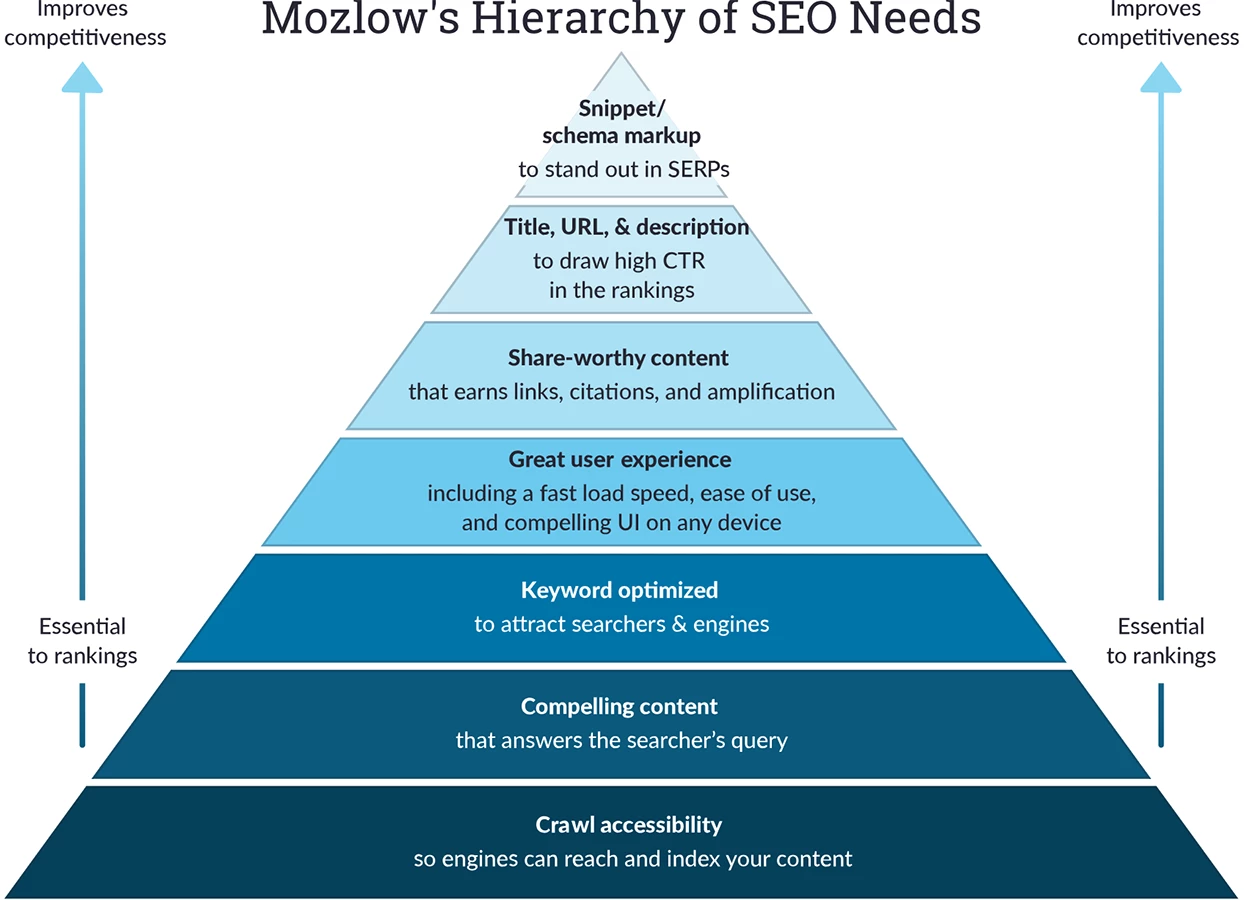
AJ says that he approaches SEO using a structured method similar to "Mozlow's hierarchy" but with technical SEO forming the foundation.
“It's crucial to ensure the site's technical elements are optimized first, as they lay the groundwork for all other SEO efforts.
Crawl efficiency, for instance, is paramount for large sites with millions or even billions of URLs. Google needs to efficiently crawl the site without encountering numerous errors or irrelevant pages,” he says.
According to AJ, the next priority typically involves on-page elements such as:
- Optimizing page types
- Ensuring cross-links are present for better navigation and user experience
- Refining title tags to accurately reflect user search queries
“Further down the list are creating and optimizing new page types to fill content gaps, which is often the most resource-intensive step.
This phase requires developing new pages, designing them appropriately, and establishing effective internal linking,” he adds.
How to Elevate SEO as a Priority in Large Organizations
Getting big companies to invest in SEO isn't always easy, especially when other strategies seem to offer quicker wins, with straightforward investments in paid search and programmatic advertising offering easy ROI measures.
In contrast, he says that SEO's benefits are less immediate and harder to quantify, which can be frustrating for those looking for clear in-and-out financial metrics.
“To tackle this, I emphasize that SEO requires ongoing effort and investment — it's not something you can pause and expect to maintain its benefits. SEO is a zero-sum game,” he adds.
In a previous podcast, we spoke to Lily Ray who shares why it's safer and more sustainable to play the long SEO game.
Watch the video below to learn more:
AJ also emphasizes that long-term success in SEO comes from consistently making small adjustments rather than just a few big changes, which collectively leads to significant results over time.
“A strategy that has proven effective with some organizations involves integrating SEO tasks into the agile framework engineering teams use.
Assigning point values to SEO tasks, similar to how engineering tasks are evaluated, helps quantify the effort needed for SEO and ensures that sufficient resources are dedicated to it each quarter,” AJ explains.
AJ's advice is a great reminder that even as technology changes, sticking to the basics — creating authentic, well-crafted content and having a solid SEO strategy — is still the best way to achieve lasting success.
AI-generated content can never beat original, high-quality content created by humans.