
OpenAI’s ChatGPT Atlas: Key Findings
- ChatGPT Atlas positions OpenAI as a direct challengerin the next browser era, turning AI from a chat tool into a full web companion.
- Its optional browser memories highlight features that are just part of the battle, and also involve user trust, privacy, and control.
- Atlas’ agent mode is a sign that search engines are moving to AI assistants, showing how action will drive the new web.
The next browser war may well be on its way, and it starts with OpenAI's groundbreaking move.
The leading AI company has launched "ChatGPT Atlas," a new web browser built around ChatGPT itself, marking another leap in how users interact with AI.
With Atlas, ChatGPT becomes a live assistant that travels with you across the internet.
It can read, respond, and take action directly within your browsing window.
"AI gives us a rare moment to rethink what it means to use the web," OpenAI said in its announcement.
"A browser built with ChatGPT takes us closer to a true super-assistant that understands your world and helps you achieve your goals."
This bold vision is already fueling speculation that OpenAI just fired the first shot in a new era of browser competition.
But what makes the new AI-powered browser so intriguing?
For starters, it combines browsing, search, and memory all in one space, turning ChatGPT into a contextual helper that remembers what you’re working on.
Instead of copying and pasting between tabs, users can stay on a single page while the model summarizes, searches, or completes tasks.
College student and early tester Yogya Kalra had good things to say about her experience with the new browser.
"Now ChatGPT instantly understands what I’m looking at, helping me improve my knowledge checks as I go," Kalra explained.
Notably, the system introduces optional browser memories, letting ChatGPT recall key information from previously visited sites to make future responses smarter.
Users can toggle these memories on or off, delete them at any time, or restrict visibility by page.
Privacy settings also ensure browsing data isn’t used for training unless explicitly opted in.
What Sets Atlas Apart
One of the most striking features about Atlas is its agent mode, which lets ChatGPT perform tasks within the browser.
This includes planning events, compiling data, or even shopping online.
For example, a user planning a dinner party can ask the assistant to find a recipe, locate a grocery store, and fill an online cart automatically.
Atlas also incorporates parental controls that extend from existing ChatGPT settings, giving families more oversight of how the model interacts with content.
Agent mode in Atlas completes tasks faster as you browse the web.
— OpenAI (@OpenAI) October 21, 2025
Available in preview for Plus, Pro, and Business users. pic.twitter.com/JvSKolLXib
When it comes to professional uses, the browser can also act as a productivity hub, handling tasks like document review or research compilation through the same interface.
In early previews, Plus, Pro, and Business users can test agent mode while OpenAI fine-tunes reliability and task completion.
To guard against risks from malicious prompts or unauthorized actions, the company also implemented strict safeguards like preventing code execution, file downloads, or access to external apps.
OpenAI said these features are part of its plans to work towards what it calls "agentic systems," where AI doesn’t just answer but acts.
Search for homes with @zillow in ChatGPT. pic.twitter.com/ZzHEWSKIdi
— OpenAI (@OpenAI) October 6, 2025
Tying into this is OpenAI's launch of "Apps SDK," integrating Canva, Zillow, and Spotify into ChatGPT.
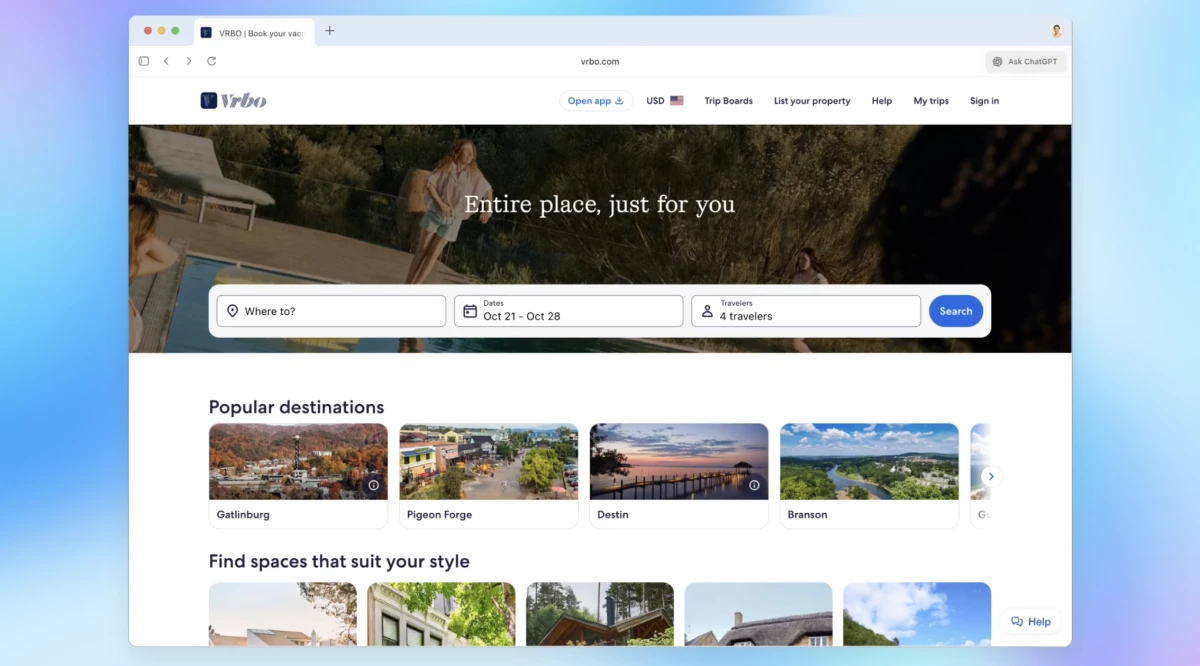
ChatGPT Atlas is now available worldwide on macOS for all ChatGPT tiers, with Windows, iOS, and Android versions coming soon.
Are We Entering the New Browser Wars?
With OpenAI’s Atlas and Perplexity’s Comet on the scene, it’s starting to feel like a new generation of browser wars.
But right now, this shouldn't be a worry for Google, claimed some users.
Google lost $100B because of OpenAI's New Browser coming out.
— Dimi (@ufodimi) October 21, 2025
Then people figured out that it would use the Chromium engine.
C-L-O-W-N-S pic.twitter.com/iHZpqZmBC4
Most of these custom browsers are still built on Chromium, which is Google’s open-source foundation.
This means the company still benefits from the data that flows through them.
While others rush to make AI-first browsers, Google already has Chrome, and everyone’s just waiting to see when Gemini will be baked in.
What looks like fragmentation might actually be strengthening Google’s position even more.
Furthermore, the latest launch lies an interesting twist that people haven’t really talked about yet.
Since AI models can’t handle every bit of JavaScript online, browsers like Atlas could be leaning on users’ devices to do the heavy lifting, trading free AI features for your processing power.
What OpenAI’s Browser Signals for the Next Web Race
OpenAI’s Atlas is on its way to challenging the very foundation of how we access the internet. What once felt like a settled market is suddenly alive again.
Here, we learn that:
- Integrating AI directly into browsers could redefine how users discover, search, and act online.
- Control over memory, privacy, and context is quickly becoming the new battleground for user trust.
- The line between platform, assistant, and search engine is blurring, and whoever wins that space may shape the next decade of the web.
With ChatGPT Atlas, every coding app is now a vibe coding app 😄 pic.twitter.com/AZqGGqZTIp
— dominik kundel (@dkundel) October 21, 2025
If ChatGPT Atlas succeeds, it won’t just change how people browse but also decide who owns the experience of the internet itself.
Discovery, automation, and power are converging inside a single interface, and every tech company wants a piece of it.
Our Take: Is This A New Era of Browser?
I’ve used browsers that felt fast, private, and smart, but Atlas feels like something else entirely.
Every company racing into this new space is promising convenience, but the real competition might be for control over our attention, data, and even our devices.
For marketers, this is critical.
If AI browsers become the default gateway to the internet, brand visibility and awareness will depend on how well your content is understood and surfaced by these systems.
Google might still hold the cards through Chromium, but OpenAI is redefining the rules of engagement.
We could be witnessing the start of a world where users and machines trade power in real time, and our actions feed the very systems meant to serve us.
It’s clever, inevitable, and a reminder that in this new browser era, participation comes with a price.
Recently, the AI company launched its first-ever brand campaign for ChatGPT, showing the AI woven into everyday moments; a move that backs its most recent developments.
The browser is becoming the next frontier for AI.
These top AI companies build technology that integrates discovery, automation, and user control into one seamless experience.