
OpenAI's First Brand Campaign: Key Points
- OpenAI worked with Isle of Any and director Miles Jay on its first major brand campaign, showing everyday ChatGPT use.
- Human-first creative emphasizes emotion, supported by music, film craft, and AI used as a creative partner.
- The campaign runs across broadcast, outdoor, and social media, debuting during NFL Primetime and expanding globally.
OpenAI is shining the spotlight on everyday moments in its first major brand campaign for ChatGPT.
Made with indie agency Isle of Any and directed by Miles Jay, the campaign highlights real user prompts woven into cinematic 30-second spots.
Instead of futuristic visuals, the work shows quiet, tactile slices of life like cooking for someone new, training for fitness, or planning travel.
All before ChatGPT’s text responses scroll like movie credits.
“We loved the idea of the viewer feeling like they had just been dropped into the final scene of a movie
using the prompt and the answer from ChatGPT as a nod to movie credits,” Isle of Any Founders Laurie Howell and Toby Treyer-Evans shared.
"We wanted these small moments to feel elevated, and give scale to how Chat helps co-create these small moments in our lives.”
Meanwhile, OpenAI’s CMO Kate Rouch described the campaign as a way to make AI more relatable.
“The primary strategy is to lift up how people are using [ChatGPT] in their daily lives and what we’re hearing from them," she explained.
The campaign launched in the U.S. and U.K. during NFL Primetime and will expand across broadcast, streaming, and outdoor placements in locations such as Piccadilly Lights in London.
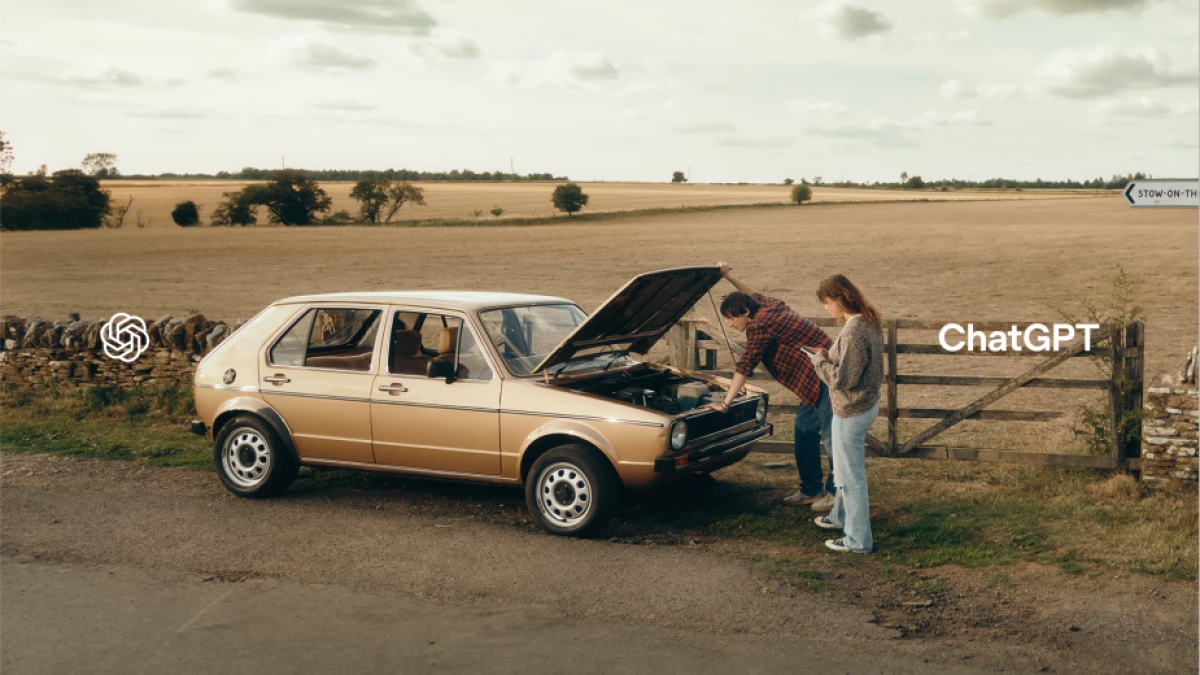
Notably, OOH ads shot by Samuel Bradley and styled by Heidi Bivens give the ads a stripped-down, human look.
The work includes pared-back outdoor ads that feature people with their phones, framed by ChatGPT’s logo and wordmark.
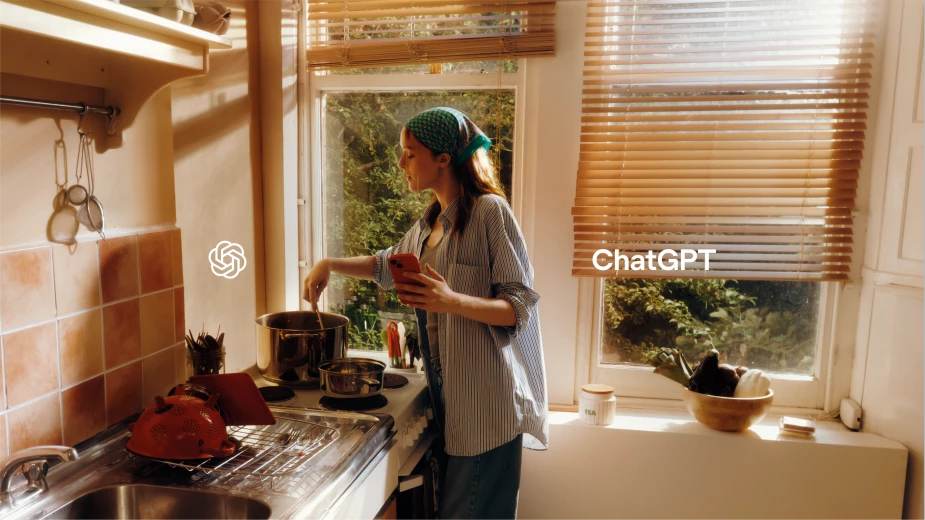
These executions invite viewers to project their own potential uses of the tool.
Michael Tabtabai, VP of creative at OpenAI, said the goal was to create “quiet confidence” in how the brand shows up to consumers.
Turning Prompts Into Closing Scenes
Shot on 35mm, the films play out like single-take sequences that resemble final scenes from feature films.
Music drives much of the emotion, with tracks by Perfume Genius, Simple Minds, and Neil Diamond used to create different moods across spots.
In "Road Trip," a young man takes his sister out on a trip, but doesn't tell her where they're headed.
The prompt then rolls on the screen like credits, showing the man asking ChatGPT where he could take his sister, to which the AI tool suggests the Blue Ridge Mountains.
"Pull-Up," like its title suggests, shows a man working out in an open park, attempting to do his first-ever pull-up and succeeding.
"I want to feel stronger. Help me do some pull-ups by fall," his prompt to ChatGPT reads.
"Dishes," the last of the bunch, shows a woman visibly impressed by the dish her partner cooked for her.
However, the man wouldn't have been able to make it without the help of ChatGPT's recipe suggestions.
Stubenvoll noted that ChatGPT itself played a role in concepting characters and brainstorming directions, acting as a creative partner alongside the human teams.
That detail helps OpenAI show its technology’s power while emphasizing human-led craft.
This campaign follows other efforts to promote its tool, including its first Super Bowl spot and activations with U.S. sports teams and student programs.
OpenAI is in a unique spot: it’s promoting a product already adopted by hundreds of millions.
Apart from that, it's also competing against new entrants like Anthropic’s Claude, which launched its own campaign this month with agency Mother.
Last year, OpenAI was ranked among the Top 50 most innovative companies in the world by Fast Company, highlighting its growing influence across both tech and marketing spaces.
How to Sell AI 101 with OpenAI
For agencies, OpenAI’s ChatGPT launch offers a clear example of the importance of adding a human touch to technology-heavy campaigns.
Key takeaways include:
- Product-led stories can resonate more when shown through relatable, cinematic storytelling instead of abstract futuristic tropes.
- Using AI in the creative process works best when paired with skilled filmmaking, music, and design choices.
- Running cohesive campaigns across TV, outdoor, and social media builds brand consistency in a crowded and fast-changing market.
Other brands have faced similar balancing acts.
The New York Times, for example, worked with Isle of Any this year on a campaign that allowed it to ground its brand identity in emotional storytelling rather than pure information.
Our Take: Can Ads Make AI Human?
What strikes me about this campaign is the active decision to avoid the obvious futuristic angle.
Instead of chrome robots or sterile tech visuals, we get cooking, planning, and running.
And these are human stories that anyone can relate to.
For me, that’s where the work succeeds: it reminds us that we can overcome the intimidation that comes with AI and new tech.
The challenge, however, is consistency.
Human-first creative like this can win trust, but it has to keep evolving as AI becomes part of more complex decisions in people’s lives.
I think OpenAI’s choice to lean on cinematic storytelling is smart, but the real test will be how long it can sustain that before audiences demand something new.
In other news, Arts & Letters and Titos Vodka similarly leaned into relatable imagery and cinematic cues for the brand's summer campaign.