
Most brands that place a mention in a third-party source see their AI search visibility tick up. Most also watch it slide back within weeks.
Noble, an offsite platform that places brand mentions in the sources AI cites, recently published a new study that analyzed 599 mentions placed for 79 brands across 18 weeks to find out what separates the two.
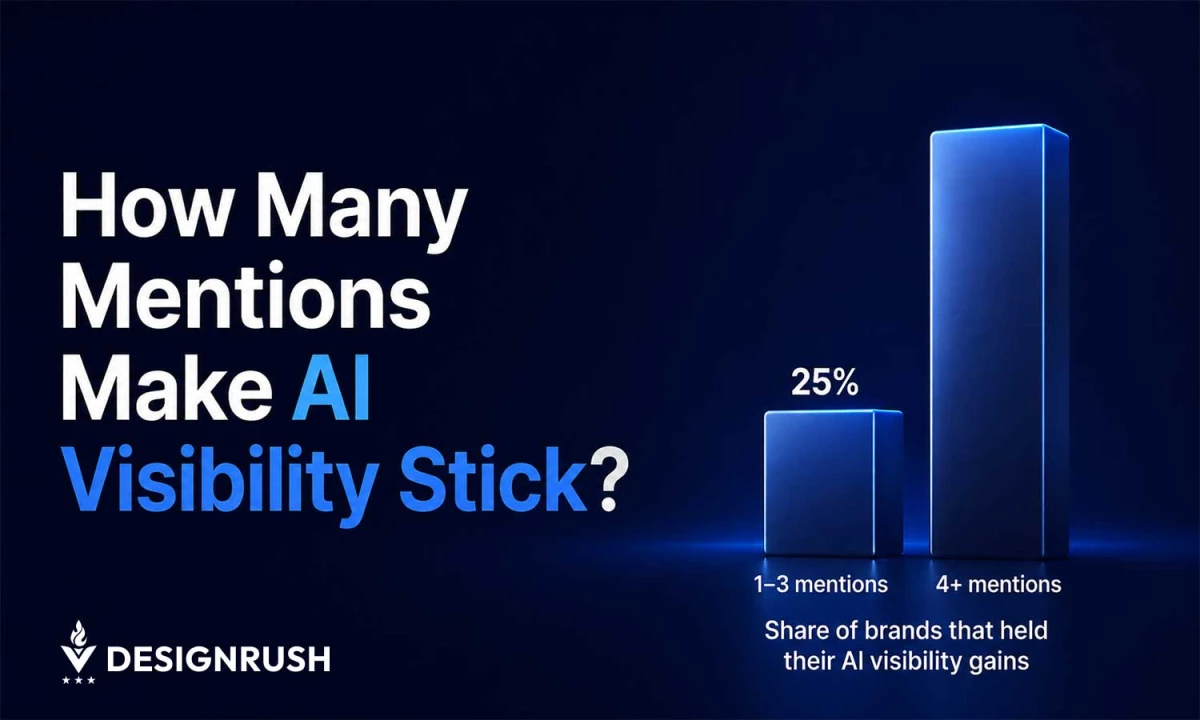
Brands with one to three live mentions held their gains about a quarter of the time. At four or more, that rate more than doubled.
Four is where lifts start holding, but it is not where the work ends. Noble's data shows the brands that kept placing mentions were the ones that stayed visible.
Two of the platform’s case studies also demonstrate what the work of placing brand mentions looks like in action from opposite starting points.
The ABM Agency started invisible in one of its categories.
Zip, on the other hand, started in fourth place, already a $2.2 billion procurement platform.
Why Distribution Beats Reputation
Onsite content still works when someone searches for a brand by name, since LLMs lean on well-structured website content to answer those branded questions.
Unbranded prompts work differently. When asked something like "what's the best social media scheduling tool for a 5-person team," the model doesn't just pull from any brand's website.
It builds the answer mostly from third-party sources instead.
That's the gap most brands miss, according to Delia Rowland, Head of Content at Noble.
"The biggest misconception brands have is thinking that focusing on their onsite content is enough to get cited in the AI answer," she says.
"But prioritizing offsite is the biggest lever that most brands are missing.”
The scale of that gap is measurable.
Across 75,000 brands, brand mentions across the web correlate more strongly with AI visibility than domain authority or backlinks, according to Ahrefs.
For a brand banking on its own website to win unbranded queries, that means the deck is stacked against it before the campaign even starts.
How The ABM Agency and Zip Gained Ground
The ABM Agency moved into a new category in 2026, helping brands get found and cited by AI. But when it came to the questions that mattered, the agency was invisible.
That invisibility mirrors a categorical problem. Some competitors tried ranking themselves first in self-published "best of" listicles instead of earning outside coverage.
But that tactic is backfiring.
In fact, sites relying on it saw visibility drops of 29% to 49% after a January 2026 Google update, according to SEO researcher Lily Ray.
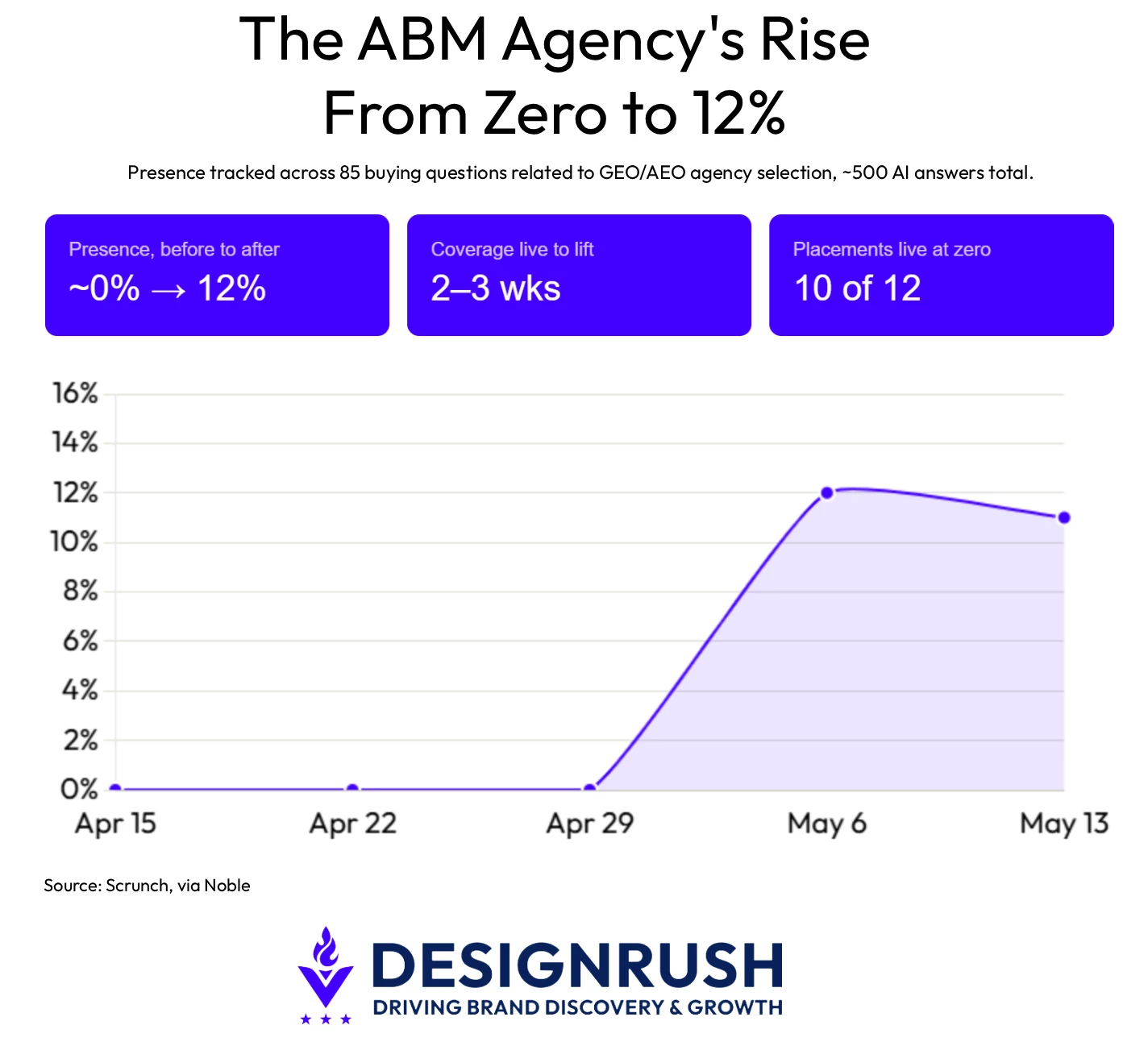
Noble secured 12 third-party placements for The ABM Agency instead. Presence held at zero for most of four months, even with most placements live.
Then, within a single week in May, it jumped to about 12%, roughly one in eight tracked answers, and held there.
Another client, Zip, faced a different disadvantage. The procurement platform, valued at $2.2 billion, held fourth place in its category, trailing Coupa, SAP Ariba, and Procurify.
Over four months, Noble placed it in 14 third-party articles alongside its own onsite work. Their presence climbed from 29% to 52%. In turn, Zip passed Procurify into third place.
Third-party brand mentions contributed to both gains, alongside each brand's own onsite content and authority work.
Both delays, weeks of nothing before a sudden jump, match a pattern the offsite platform found across its broader client base.
"As I was hunting for customer case studies I could write for Noble, I started to notice a pattern in the number of mentions that it took to see a sustained lift rather than just a spike," Rowland says.
Where Visibility Starts to Hold
Noble measured how often each of 79 brands appeared in AI answers for the prompts it cared about, week by week, between January and May 2026.
Then compared where each brand finished against where it started.
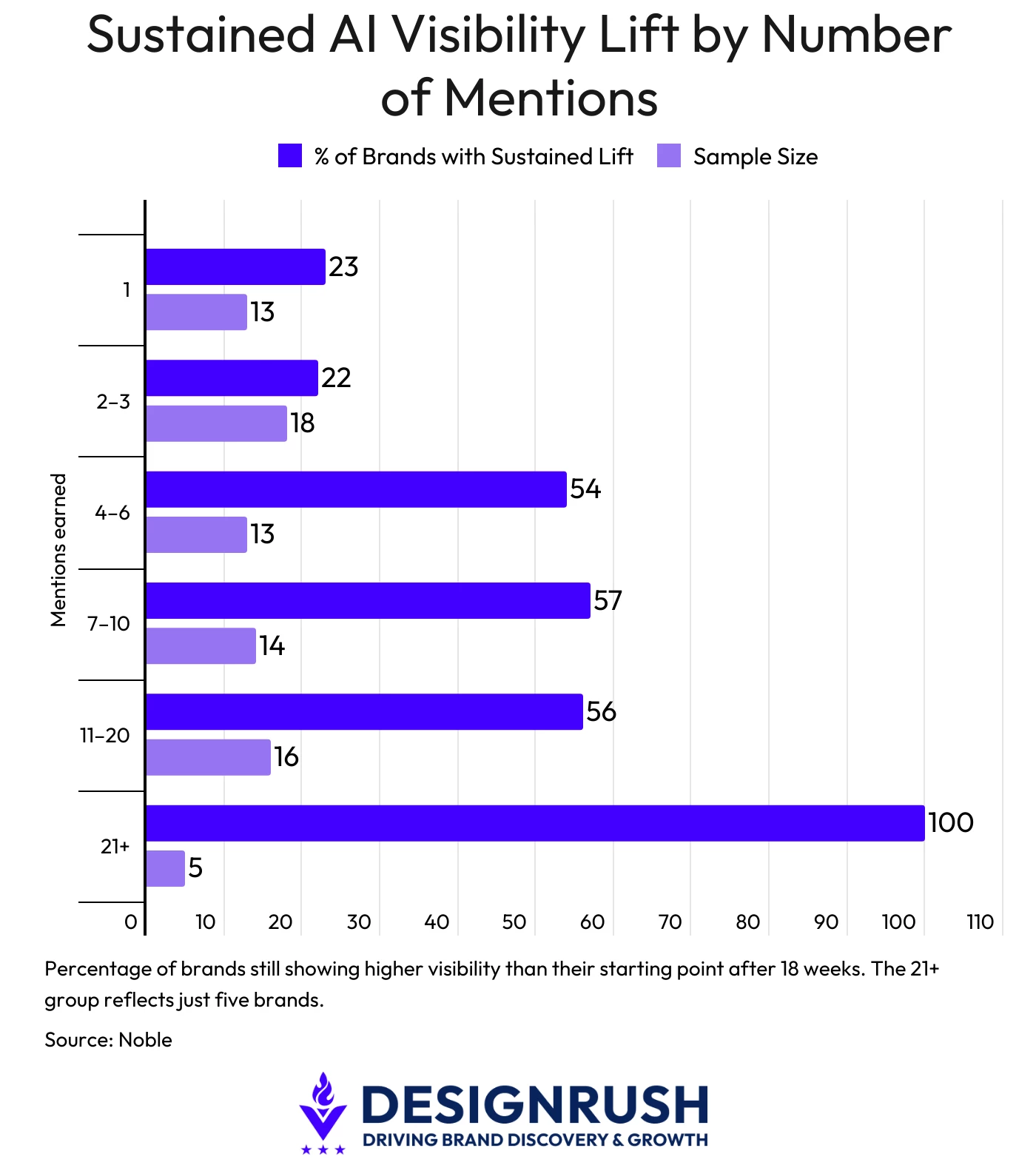
The pattern broke at four.
Noble also compared the group against 41 brands in its dataset with no mentions at all.
Brands with four or more mentions sustained a lift at more than double the control group's rate, a gap that would show up by chance about three times in 1,000.
What the table does not show is a climb. From four mentions through 20, the rate holds steady in the mid-50s rather than rising.
Four is where the odds change, not a slope a brand can ride upward.
Both campaigns in this piece sat well above that line. The ABM Agency earned 12 mentions and Zip 14, putting both in a band where 56% of brands held their gains.
Neither is a test of the four-mention minimum, but rather examples of what success looks like once a brand is past it.
Four is the entry point, not the destination.
“The speed is what stood out to me," Rowland says.
"For brands starting from nothing, we saw visibility move within about four weeks of the first mention going live, as long as they went on to reach four."
The volume argument is also different from what the table first suggests. The fifteenth mention isn't necessarily more powerful than the fifth. The difference is cushion.
"Four gets you in, but it doesn't keep you there," Rowland says.
"Sources can sometimes drop out of an engine's rotation and LLMs also tend to favor fresh sources. So, it’s important to continue placing relevant, authentic brand mentions to sustain and continue growth."
Noble's dataset skews heavily toward B2B software, and the analysis observed what happened rather than testing it experimentally.
The threshold is well-evidenced for B2B SaaS and a working hypothesis elsewhere.
What It Takes to Repeat the Results
Achieving visibility gains similar to The ABM Agency and Zip starts with having a great set of prompts.
If a brand doesn't know what its prospects are asking, it'll always be pointing the target at the wrong place.
"Once you have a solid list, you can reverse-engineer by looking at what sources the engines are already citing for the questions on your prompt list," Rowland says.
Then, as a brand's product or positioning evolves, so do the prompts buyers use to find it, which opens up an entirely new set of sources to target.
Earning more visibility from there comes down to continuing to chase those shifting sources, according to Rowland, not repeating the placements that worked at launch.
Consistency matters too. A brand calling itself an "AI orchestration platform" in one source and an "ABM expert" in another leaves the model unsure which to believe, so it moves on.
That's why keeping existing mentions updated matters as much as landing new ones, to keep the pool of corroborating evidence clean.
Rowland doesn't see this as a fluke tied to a few lucky brands. In her view, the strategy stated above holds up consistently, no matter your starting point or the size of your brand.
What This Means for Your Brand
Three things follow from the data.
- One or two mentions isn't enough. If you're deciding whether offsite mentions work for your category, you haven't found out until four authentic brand mentions in high-quality sources are live.
- Give it at least a month. AI engines need time to ingest new information. Judging results the week a placement publishes tells you nothing.
- Four is the floor. It’s a useful threshold to start tracking the success of your strategy, but ultimately, the brands that held their gains kept placing mentions.
The pattern in Noble's data is that AI visibility rewards ongoing work over a single launch. For brands still watching from the sidelines, this should be encouraging.
The window to catch up - when done properly - is smaller than you think.
Noble is an offsite platform that places brand mentions in the third-party sources AI cites. The full research, including methodology and limitations, is available at https://thatsnoble.com/resources/.