
Mobile Self-Service Customer Experience: Key Findings
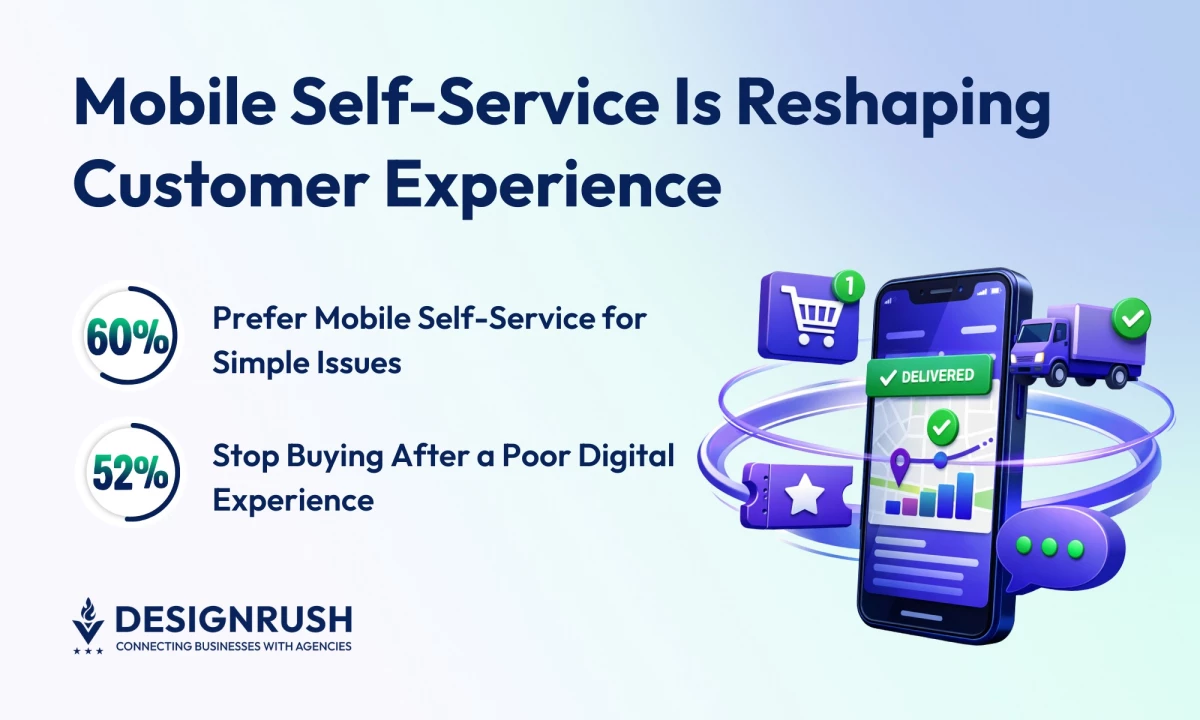
- 60% of users prefer mobile self-service for simple issues, making it a clear driver of lower support costs and reduced customer churn.
- Mobile self-service now underpins the entire customer experience, as frictionless control directly influences loyalty and repeat usage.
- Well-designed mobile self-service improves trust and efficiency simultaneously, reducing call center load while increasing customer confidence.
Customers didn’t lose patience. They ran out of tolerance for broken service moments.
Tolerance for waiting, for explaining the same issue twice, for being told to hold while the system “checks something.”
What once passed as service now feels like friction.
Now, mobile self-service is gaining popularity because expectations around control have changed.
According to Miquido, a full-service software development company working with global consumer apps, the “Mission: Self-Possible” report examines how users approach everyday service tasks.
It found that 60% of users prefer handling simple issues themselves rather than talking to an agent, while 46% feel frustrated when self-service options are missing.
That frustration rarely sparks fireworks, but it nags like a tiny alarm that never stops.
It pops up when a delivery status disappears into the void, when a return suddenly needs a call, or when a small tweak somehow turns into an epic quest.
Meanwhile, customers expect experiences that actually get them, what they are doing, where they are, and how they want it handled right now.
Editor's Note: This is a sponsored article created in partnership with Miquido.
60% of users prefer to solve simple issues on their own. When self-service is missing, frustration grows fast.
— Miquido (@miquido) December 23, 2025
Are your digital products built for that expectation?
Download the report to find out: https://t.co/7OholjpDOvpic.twitter.com/waJcNnQzyb
The same report shows that 71% expect personalized interactions, and 76% feel frustrated when personalization is missing.
Users want relevance without dependency. Guidance without pressure. Control without asking for permission.
This mix of speed, control, and context is what the report calls the “Autonomy Economy.”
It’s a world where customers expect to get things done here and now, without waiting in line and without human help unless it actually adds value.
Ignoring Self-Service Slowly Erodes Loyalty
Mobile self-service is at the heart of this change. It serves as a core response to how people live, make decisions, and spend their time today.
Over time, a lack of self-service creates friction that pushes customers away.
Because when users can’t handle simple issues on their own, frustration spreads fast.
That frustration rarely turns into a complaint. More often, it shows up as abandonment, reduced usage, or the decision to try a different app next time.
This is where traditional CX models start to crack.
Call centers and live chat queues are built to react, not to prevent friction.
Each handoff adds time. Each explanation adds effort.
And every unnecessary interaction reminds customers that the system is designed around internal processes, not their time.
The commercial impact is already visible.
52% of U.S. consumers stopped buying from a brand after a poor digital experience, PwC’s 2025 Customer Experience Survey found.
And not after a major failure either, but rather after an experience that simply didn’t work as expected.
Self-Service Builds Trust and Speeds Resolution
And automation alone doesn’t solve this.
When self-service lacks clarity, customers feel pushed into a maze rather than supported.
85% of consumers are open to or prefer automated service only if it resolves their issue, according to Verint’s 2025 State of Customer Experience report.
What breaks, in the end, is trust.
And once customers stop trusting that a brand will let them solve things quickly and clearly, they stop coming back.
Fast resolution and trust come first, and self-service is how an organization makes that happen.
Customers want the shortest path from issue to closure: one status view. One next-step screen. Clear outcomes. Fast resolution without escalation unless truly necessary.
Brands that design around this principle reward users with control, clarity, and confidence.
Trust is the other lever. Self-service is now a trust-building mechanism.
Customers appreciate being able to see what’s happening, make their own choices, and take action without asking.
Without that, a simple task can quickly turn into a frustrating experience.
The myTUI app offers a practical example.
With over one million downloads and ratings of 4.6 on Google Play and 4.9 on the App Store, the app emphasizes self-service across purchase, booking management, and post-purchase flows.
The result is a shorter purchase path and reduced reliance on call centers.
Martyna Czajka, TUI Project Manager at Miquido, explains:
“Users value informed but independently made decisions over seller-guided choices. Younger generations often avoid in-person contact and prefer to make their own choices.
When releasing the newest app version, we focused on self-service functionalities, especially trip configuration, purchase process, and reservation management.
The more the user can do themselves and customize along the way, the happier they feel with the outcome.”
Leaders need to think in two dimensions:
- The product itself must anticipate, simplify, and resolve.
- Teams must support autonomy with clear communication, context-aware guidance, and predictable outcomes.
This approach builds loyalty, smooths the experience, and frees people to focus on meaningful work instead of repetitive tasks.
Dominika Będkowska, Market Researcher at Miquido and author of the Mission: Self-Possible report, sums it up:
“Customer expectations are rising, where users want things faster, simpler, without waiting, without explaining ourselves to a consultant,” she says.
We want control. That’s why self-service is becoming the natural answer to modern life.
While working on this report, I wanted to connect concrete examples with the bigger picture and the trends that make the autonomous consumer the new standard.”
Brands that embrace autonomy today follow how customers live, decide, and spend their time.
-content-large-webp.webp "From Agent-Led to App-Led Travel Experience")
Ignoring this approach can slow resolution, hurt trust, and make the CX gap grow.
Here’s what works in practice:
- Give product teams the tools to catch and fix issues before they become problems.
- Build flows that let users see what’s happening, know their options, and act easily.
- Focus on how quickly and clearly users complete tasks, not on adding more features.
Autonomy in action is simple: shorten the path from problem to solution, cut extra steps, and make self-service something users can rely on.
Brands that get this right keep customers happy, ease the load on support teams, and deliver CX that actually fits how people live today.