
UX and Architecture Define Mobile App Success: Key Findings
- Mobile is now core brand infrastructure, where perception, trust, and loyalty are built in real time.
- Retention matters more than downloads because sustainable revenue in a $626B market depends on long-term engagement, not short-term spikes.
- Scalable architecture determines survival, since without a flexible foundation growth leads to breakdowns, rebuilds, and lost competitive advantage.
Nearly 85% of Americans reach for their phone within 10 minutes of waking, according to a 2025 Reviews.org study.
A few taps later, money has been sent, social feeds have been scrolled through, food is on the way, and the day’s news is already half-read. None of it feels dramatic. It just feels normal.
That routine is where brands now live. The competition isn’t only on billboards or TV spots anymore, but inside the apps people open without even thinking.
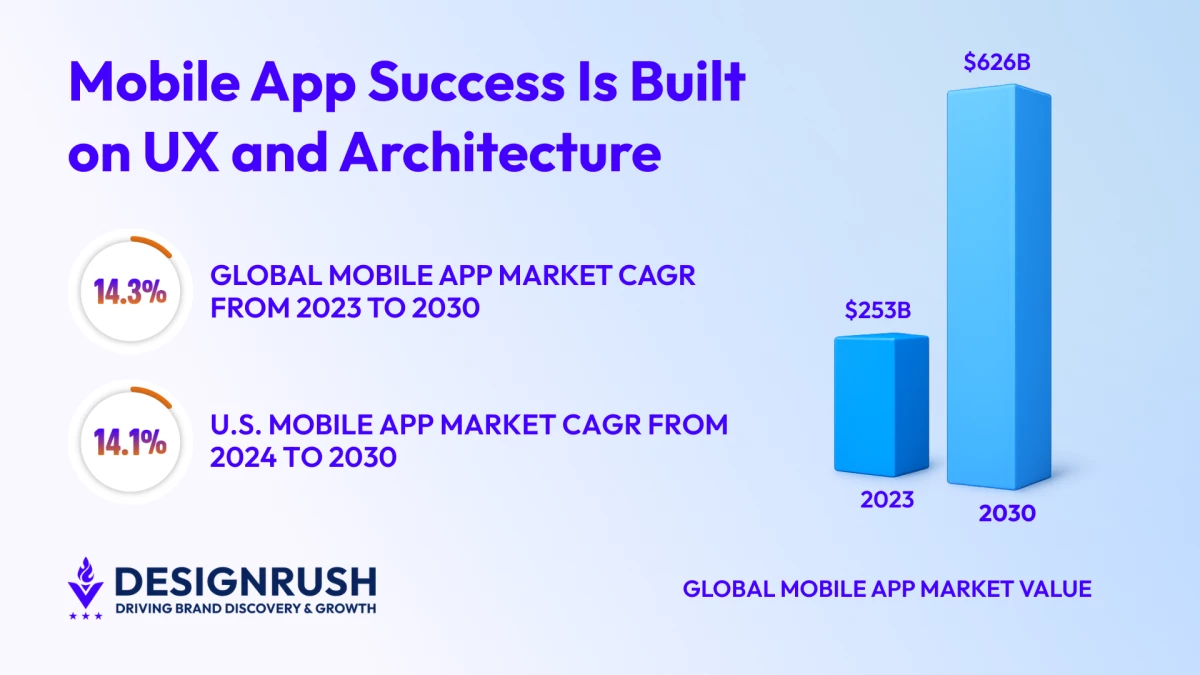
Insights from Grand View Research highlight the growth of mobile apps, noting that the global mobile app market was valued at nearly $253 billion in 2023 and is expected to reach more than $626 billion by 2030.
This represents a compound annual growth rate of around 14%.
Teams building these products feel that pressure daily.
For agencies like Bolder Apps, a leader in mobile app development, the acceleration reflects what product leaders are already seeing on the ground.
Andrew Abbey, CMO at Bolder Apps, says that mobile now carries the core customer experience. It’s where brands earn trust, lose patience, and define how they’re remembered.
“What were once treated as functional utilities are now strategic experience platforms that shape brand perception in real time. And given that apps directly correlate with revenue, the margin for poor execution is slim.”
Editor's Note: This is a sponsored article created in partnership with Bolder Apps.
Global Mobile App Growth Is Accelerating Competition
While the expansion is global, its intensity varies by region.
The Asia Pacific region dominates the market, accounting for over 32% of the global revenue share. China in particular is projected to grow at 15.8% from 2024 to 2030, driven largely by short-form video offered by platforms such as TikTok.
In Europe, the UK’s app market accounts for 26% regional share on the back of the growing use of apps to access essential services such as healthcare.
Here, Germany makes its regional presence known and is anticipated to grow at a compound annual rate of 14.5% through 2030.
North America isn’t far behind, with the U.S. market expected to grow at a rate of 14.1% from 2024 to 2030, owing to the presence of mobile app companies and the reliance of businesses engaging with customers through mobile apps.
And while this growth bodes well for the future of the industry, it also leads to increased competition where users compare performance, clarity, and responsiveness instantly.
“The real competitive advantage isn't features; it's whether your app feels like a natural part of someone's day. That's an architecture decision, not a design one,” Abbey says.
UX Now Drives Revenue in the Mobile App Market
Downloads may generate headlines, but retention defines revenue stability.
“In saturated app ecosystems, retention is the true growth metric,” Abbey says. “Every interaction inside an application either reinforces trust or weakens it.”
By contrast, intuitive flows and purposeful interaction design accelerate time to value. User experience is no longer aesthetic polish and directly influences lifecycle value.
“Organizations that commit to research-driven design and continuous refinement build platforms that evolve alongside their customers,” Abbey says. ”That consistency transforms engagement into loyalty.”
Scalable Architecture Determines Who Survives App Growth
Rapid user growth exposes architectural weaknesses.
Applications engineered without scalability in mind often struggle when adoption accelerates. Here, performance issues, integration limitations, and costly rebuilds can stall progress at precisely the wrong moment.
“This means that flexible frameworks and architecture must be prioritized," Abbey says.
“This allows brands to expand features, integrate emerging technologies, and enter new markets without destabilizing their core systems. Planning for scale early reduces technical debt and protects user confidence.”
These future-ready systems prevent growth from becoming a liability. And for brands, these architectural decisions will influence speed to innovation and long-term operational resilience.
Mobile Apps Are Now Core Brand Infrastructure
Mobile apps now handle key customer interactions, from payments to support and loyalty programs
Applications now function as immersive brand spaces where customers transact, engage with services, consume content, and form perceptions.
The design language, performance reliability, and logical structure of the mobile app reflect the organization’s identity.
When experience and brand positioning align, credibility strengthens.
However, when they diverge, differentiation fades.
The smartest agencies aren't building apps anymore; they're building platforms. The ones still treating mobile as a one-off project are already behind.
“The conversation is moving from app development to experience architecture,” Abbey says.
“UX strategy and technical architecture are becoming inseparable from broader brand planning.”
How Brands Win in the Mobile App Market
As the market advances toward $626.39B, Abbey breaks it down to three non-negotiables for brands building in this market:
- Retention economics outweigh acquisition spikes. Sustained engagement drives stronger lifetime value.
- Scalability must be embedded at the beginning. Retrofitting infrastructure after rapid growth introduces unnecessary cost and risk.
- Mobile strategy should integrate directly with brand architecture. Disconnected experiences dilute equity in an increasingly crowded landscape.
Sticking to these will determine which brands convert growth into a durable advantage.
The Mobile App Market Will Separate Leaders From Laggards
By 2030, feature parity across industries will be common. Distinction will then depend on how well applications anticipate user needs and sustain performance under pressure.
“Brands that invest in deliberate UX and durable technical frameworks will convert growth into long-term advantage,” Abbey says.
”Those that prioritize speed without structure may find expansion magnifies their weaknesses.”
In the next era of mobile competition, the strength of the foundation will determine the durability of the brand.
And the brands that understand this shift today will define what mobile app leadership looks like tomorrow.
Want to know more about mobile app development?
Check out our list of Top App Development Companies of 2026.