
Apps in an AI-First World: Key Findings
- App usage is expected to decline by 25% by 2027, as users shift from tapping apps to interacting with AI assistants that handle tasks directly.
- AI-enabled smartphones are rapidly becoming the new standard, with shipments forecast to grow from 234.2 million in 2024 to over 912 million by 2028, signaling that AI-first interactions will soon dominate mobile behavior.
- The AI interface is replacing the app interface, meaning brands must optimize for visibility within assistant-led ecosystems or risk losing customer engagement and first-party data.
For years, mobile apps sat comfortably on users' home screens, just a swipe or a tap away.
But everything about mobile is changing in 2026.
Apple has now brought Google’s Gemini into Siri, while Samsung is rolling out devices built from the ground up to support AI.
The operating system is no longer just a background framework, and is fast becoming the front line of how users interact with the digital world.
Andrew Abbey is Director of Product Strategy at Bolder Apps, a leading mobile development agency.
His take on what's happening in the mobile space? It presents both a challenge and a choice for app developers.
“If your app still depends on users launching it manually and clicking through menus, it is already behind,” Abbey says.
Reuters explains Apple’s recent Gemini shift:
Editor's Note: This is a sponsored article created in partnership with Bolder Apps.
How AI-Powered Operating Systems Are Replacing Apps
Apple’s move to power Siri with Gemini is not just a clever tech upgrade. It reflects a deeper shift in how people engage with their devices.
“Mobile experiences are moving from touch to intent,” Abbey says. “Users now speak to assistants that can complete tasks for them in seconds, skipping the traditional app interface entirely.”
This trend has massive backing.
According to The Guardian, Google’s parent company, Alphabet, surged past $4tn in market value at the start of 2026, with its stock rising by 65% in 2025.
Those gains were driven in large part by investor confidence in the future of Gemini and on-device AI.
Instead of launching an app to book a ride or schedule a meeting, users now ask their phones to handle it for them, with the OS doing the work in the background.
“The app now becomes part of the process, and no longer the first point of contact,” Abbey says. “And that shift is changing everything about how mobile products need to be designed.”
This shift is happening fast on the hardware side too.
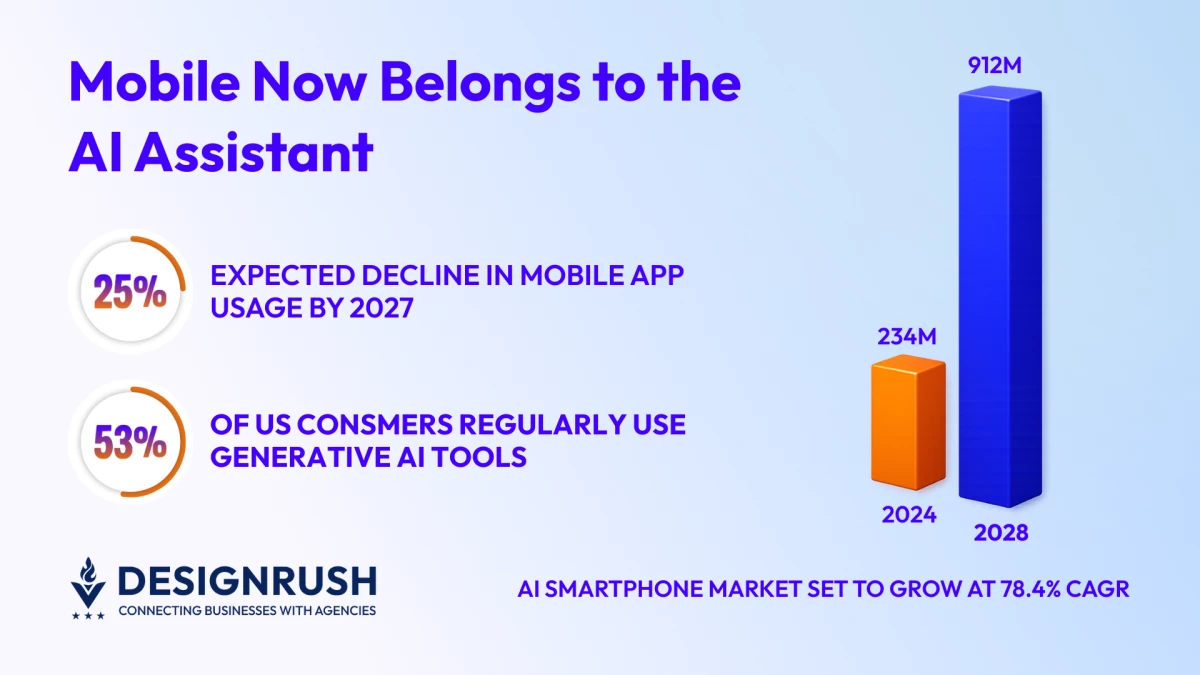
IDC reports that shipments of generative AI smartphones are set to increase from just over 234 million devices globally in 2024 to over 912 million units by 2028, driven by demand for phones that support voice-first, assistant-led experiences.
This explosive growth represents a 78.4% compound annual growth rate, signaling that AI capability is becoming standard, and not just a premium feature.
Why AI Assistants Are Driving the Decline of Mobile Apps
Gartner's latest research makes it clear that this isn’t just a trend among early adopters, with app usage expected to decline by 25% by 2027.
That drop comes on the back of users relying on AI assistants to complete tasks they once did manually
Apps with low engagement are especially vulnerable. Tools that only serve one purpose or are rarely used will be the first to be replaced by assistants.
“For many brands, this means losing both visibility and control over the user experience,” Abbey says. “It also means giving up valuable first-party data, since assistants will sit between the brand and the customer.”
This behavioral shift is already well underway.
According to Deloitte’s 2025 Connected Consumer Survey, 53% of US consumers are either experimenting with or regularly using generative AI tools. Of those, 42% say AI has already had a very positive impact on their lives.
Among the top uses of AI on smartphones are content summarization, generating text or images, and using assistants to learn new things.
All of these were once features found inside standalone apps.
“The user interface is no longer your app. It is the AI that decides when and how to surface your service. That is a major shift in power and one developers must respond to quickly,” Abbey says.
Designing Mobile Apps for AI-First User Experiences
Designing for AI-first experiences starts with understanding user intent over the interface.
Mobile tools now need to deliver value through assistants instead of relying on screens.
And in many cases, they’re becoming background services, triggered by voice, context, or user intent.
As a result, they must be treated as intelligent infrastructure; summoned only when needed, as opposed to being opened and explored.
This means that mobile app developers need to think in modules, not screens.
“Features must be available to other systems through clean APIs and smart logic,” Abbey says.
“If your app cannot respond to a natural language request or integrate with an assistant, it may not appear at all.”
What AI-First Mobile Experiences Mean for Brands
This is not just a technical challenge. It is a brand challenge.
If users no longer open your app, how do you stay present in their digital lives?
With this in mind, how do you then build an app that drives business growth and contributes to measurable ROI?
“That role now belongs to the AI interface,” Abbey says. “Brands must ensure that their services are accessible, their language is clear, and their positioning is strong enough to be surfaced by an assistant, and not just a search.”
Weldon adds that this means not only investing in content design that works in an AI-led flow, but building backend structures that support predictive service, fast responses, and personalized logic.
The Future of Mobile Apps in an AI-First World
The mobile app model that defined the last decade is being rewritten.
AI is doing a whole lot more than just enhancing the experience. It’s replacing the app as the starting point for user interaction.
The speed of this transition leaves little room for passive iteration.
“Brands must be prepared to meet the user where the OS decides to place you,” Abbey says.
“And if your brand still expects to be the destination, you may already be too late. The future belongs to apps that can work without being seen.”
Fail to recalibrate for AI-first discovery, and you run the risk of becoming invisible (and possibly irrelevant) in future stages of mobile.