
Mobile phones contribute 73% of worldwide retail site traffic but only 71% of orders, according to Statista's Q1 2026 numbers.
This two-point difference has long indicated that, once a shopper lands on a desktop, more sales are closed per visit.
On the other hand is Dynamic Yield, which tracks a different signal and tells a different story.
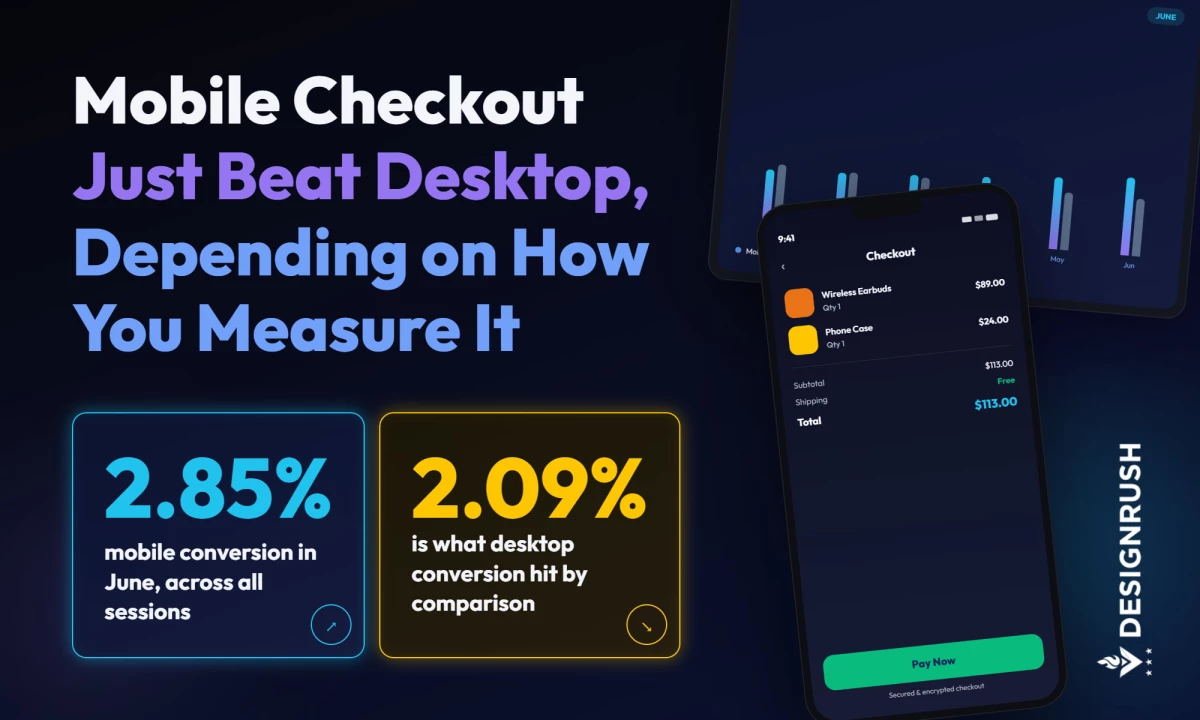
Per their report, mobile conversion beat desktop through most of the past year, hitting 2.85% in June 2026 against desktop's 2.09%.
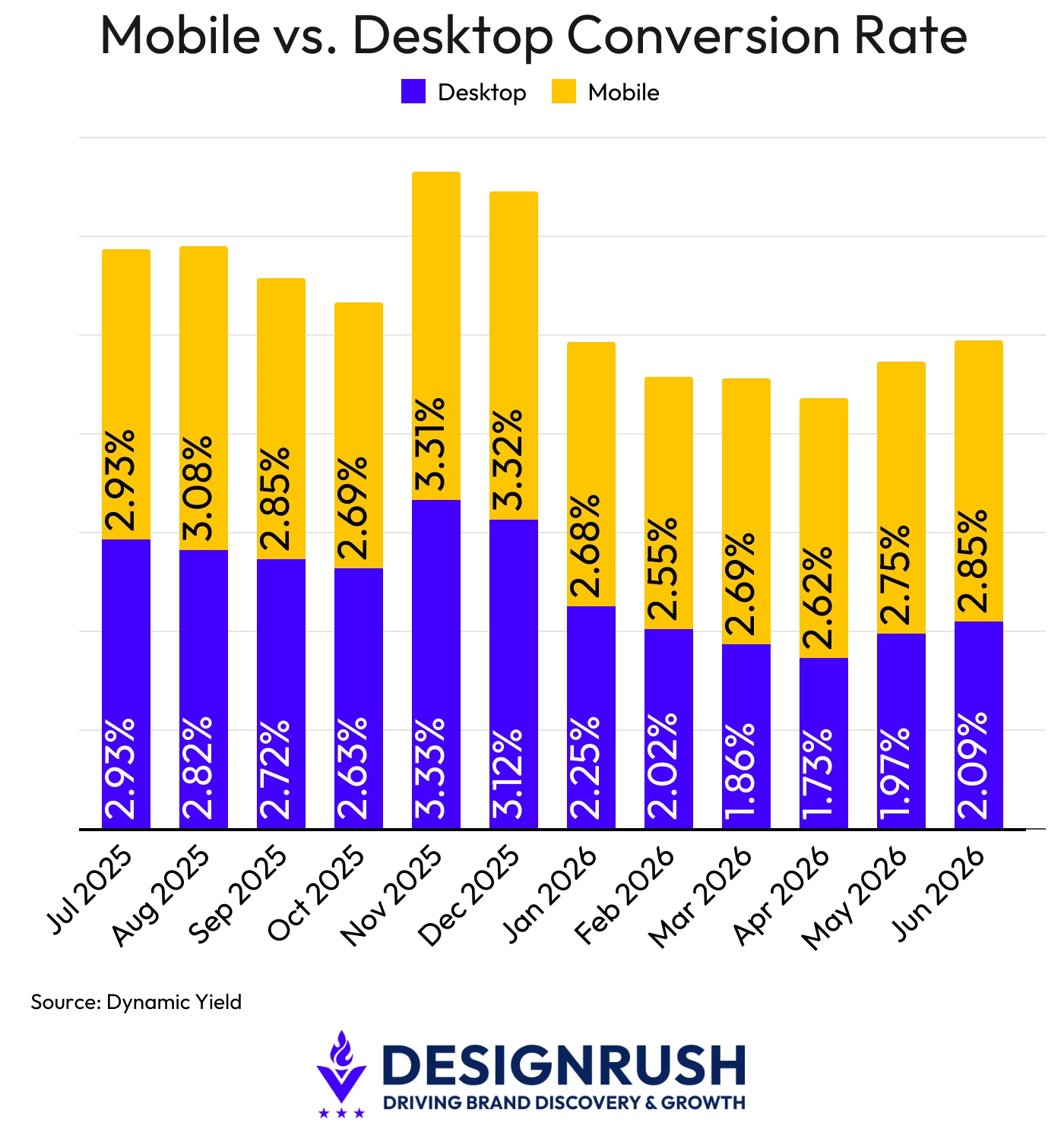 The sample behind it spans over 200 million monthly users across 400+ brands.
Whether desktop still wins the checkout depends entirely on what gets measured. Share of total orders points one way. Raw conversion rate by session points the other.
For a brand deciding where to put its next round of UX budget, that ambiguity is the actual signal worth acting on, not the specific number either report lands on.
Why the Gap Held for a Decade
Cart abandonment explains most of the historical gap. The rate reaches 70.22% worldwide across all devices, according to the Baymard Institute.
Mobile carries the larger share of that number, mainly because checkout asks more of a smaller screen.
 A desktop checkout form fits on one view. A mobile version splits the same fields across multiple screens, and each additional screen is another chance to stop.
Autofill closes that gap, but only on forms built to support it.
Payment friction compounds the problem. Typing a 16-digit card number on a phone keyboard produces more errors than typing it on a full keyboard.
A typo mid-checkout on mobile more often ends in abandonment than a retry.
That checkout was built for a different screen, then ported over with the same steps and the same form design.
Where Mobile Checkout Caught Up
Digital wallets did more of that work than any single UX fix. They now carry roughly half of global eCommerce transaction value, replacing a typed card number with a tap or a fingerprint.
That shift set a new bar. Retailers that wired in one-tap payment and biometric authentication early captured the carts that used to be abandoned at the card-entry field.
Smaller merchants running an unchanged checkout flow are now measured against a standard set just recently, one far higher than mobile checkout had five years ago.
That gap is exactly why we at Design In DC treat wallet integration and biometric authentication as part of the same launch checklist as load time rather than a later add-on.
That checklist is about to get longer. AI shopping agents complete some purchases without a mobile interface at all.
No screen means no friction to fix, because a purchase an agent completes never reaches a checkout page a person could abandon. But the agent still has to read the product to buy it.
That's why merchants whose product data isn't structured for an agent to read stay capped at the old conversion ceiling, regardless of how good their human-facing checkout becomes.
What This Means for the Next Checkout Rebuild
Wallet integration and biometric authentication are the fastest fixes with the clearest payoff, since both address the exact steps that push mobile shoppers to abandon.
A merchant still asking for a typed card number should treat that as the first thing to fix.
Product data readiness matters just as much, even though it has nothing to do with the checkout screen itself.
An AI agent shopping on a customer's behalf skips the interface entirely and reads structured data instead (pricing, availability, specifications) in a format it can parse.
A product page built only for a human eye is invisible to that agent, regardless of how fast or how well-designed the mobile checkout behind it is.
Design In DC now scopes both into the same rebuild. A project that fixes checkout friction but skips product data structuring solves last year's problem, not the one already arriving.
What AI Agents Change About the Funnel
The funnel mobile UX spent a decade optimizing assumes a human eye somewhere in the process.
Agent-led purchases remove that assumption entirely, which changes what "conversion rate" even measures.
A merchant tracking mobile conversion by session will not see agent purchases in that number at all, since most agent traffic does not register as a typical browsing session.
Google and Mastercard's AP2 and Verifiable Intent standards, submitted to FIDO Alliance this year, define how those transactions get authorized.
None of that activity shows up in a UX dashboard built around clicks, scrolls, and cart events.
That gap in measurement matters more than the checkout screen it replaces.
The same business could be improving every visible metric while still losing share to agents its analytics cannot see.
The solution is to track that share by adding agent traffic as its own category, separate from human sessions, and auditing product data for whether an agent can actually parse it.
Measuring only what a person clicks now means measuring half the funnel that exists.