
Edge Computing & AI: Key Findings
- 75% of enterprise data will be processed at the edge by 2025, enabling faster, privacy-first computing without relying on the cloud.
- Lenovo improved production scheduling by 98% and cut supply chain decision time by 60% using its own AI PCs.
- Employees saved two hours per week by using Copilot on AI-enabled devices to automate meeting notes and task tracking.
By 2025, 75% of enterprise-generated data is expected to be created and processed at the edge, not in centralized data centers, according to 2023 Gartner projections.
This move to edge computing is more than a stat.
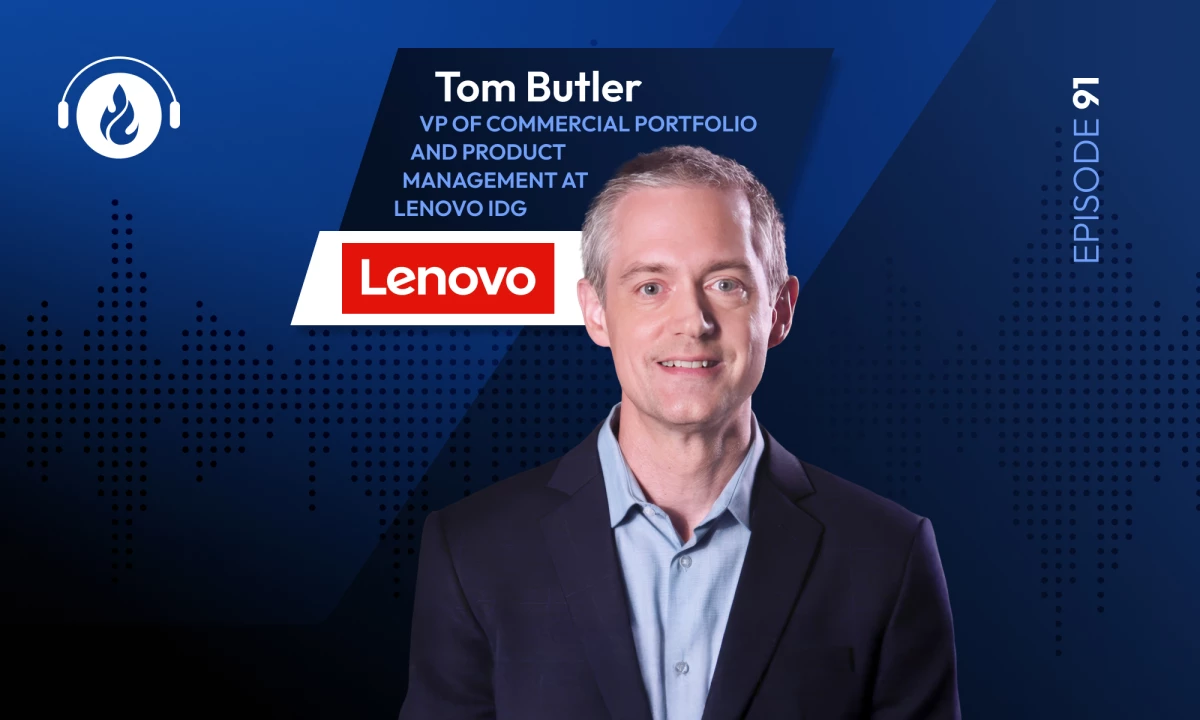
Tom Butler, Vice President of Commercial Portfolio and Product Management at Lenovo Intelligent Devices Group (IDG), says this shift is already changing the role of workplace hardware.
How? Through a shift in where and how work gets done — starting with the device itself.
In episode 91 of the DesignRush Podcast, Tom explains why enterprise productivity isn’t happening in cloud software or chatbot interfaces. Instead, the biggest changes are to the hardware you use every day.
He outlines why the future of work will be shaped bysmarter PCs that adjust to how people work — without the drag of outdated systems.
He’s not referring to voice assistants or chat prompts, either. He’s describing devices that quietly handle repetitive tasks and remove common workplace friction.
Listen to the full episode now on Spotify, Apple Podcasts, or YouTube.
Episode Chapter Summary (TO FOLLOW)
- 03:24 – What AI PCs Can Really Do for Business Users
- 06:02 – Personalization, Protection & Productivity with AI
- 08:45 – Real Use Cases: From Finance to Enterprise Impact
- 18:23 – The AI Challenges No One Talks About
- 25:36 – Advice for Leaders: Start Small, Scale Fast
Changes Driving the AI PC Era
As edge computing takes hold, these five shifts show how workplace tech is changing, and where businesses are already benefiting.
1. The Adaptive Edge
According to Tom, a major shift in workplace technology is happening at the device level.
Rather than relying solely on cloud-based platforms to run AI, new machines are being designed with built-in capabilities that allow them to process information locally and respond in real time.
These devices include a neural processing unit (NPU), a third processor alongside the CPU and GPU, that enables the system to run AI models continuously without offloading everything to the cloud.
This opens up new possibilities for automation, privacy, and performance at the edge.
“AI-powered personalization is not just a convenience on the device. It's going to be a multiplier for us.”
Tom emphasizes that these systems aren’t just faster, they’re adaptive. They observe how each user works, identify repetitive tasks, and begin to personalize the experience accordingly.
No two setups will function exactly the same, even in the same team.
"Your system, your PC will operate and be personalized to you and the counter to that mind would operate or be personalized to me. So we're going to have different experiences even sitting side by side."
For business leaders, this signals a shift away from one-size-fits-all tech environments. Devices that adapt to the individual not only reduce friction, they also give teams back valuable time and attention.
The result is a more focused, responsive, and efficient workplace.
Want to brush up on edge computing and how it works? Check out this informative video from Accenture:
2. Powering Productivity at the Edge
IT teams face growing pressure to deliver AI capabilities without compromising data governance.
Tom says the answer is hybrid AI: offload the heavy lifting to local devices and reduce dependency on cloud-based processing.
"Our devices are becoming more contextual aware. We have sensors and cameras, so we can determine attention if you're focused on the device at hand, if you're even present in front of the system as well."
This enables AI to run silently in the background, keeping you safe, focused, and productive without requiring constant user input.
3. Edge AI, Clean Gains
The shift to large language models and always-on AI is raising serious energy and infrastructure costs, both financial and environmental.
Tom is clear: AI must be sustainable, and that means pushing computation to the edge.
"Power is a major concern if you think about sustainable use. What I'm excited about is as we move into more of a hybrid stance, we're able to leverage the power of the devices. The AI PCs that are now coming into the market, draw power at a much lower power state. And so you can accomplish a lot at the edge."
For companies with net-zero goals, AI PCs offer a rare win: higher performance with lower power usage, and no compromise on security.
4. AI That Pays Off
While many organizations are stuck in pilot purgatory, Lenovo rolled out AI tools internally and saw immediate impact.
"We've used AI to accelerate our supply chain decision making by over 60% and dramatically improve our production scheduling by 98%. And so that allows us to use our manufacturing facilities more efficiently, which allows us to deliver products in a faster manner to our customers globally."
Internally, their teams use Microsoft Copilot to automate meeting notes and task tracking, saving almost two hours per week per employee.
"We've reduced our handling times by 20%, which allows us to, again, boost output because now we've got more time with customers and more customers that we can see with quick wins."
This isn’t a 5-year roadmap. It’s happening now, and Tom encourages execs to stop waiting for perfect conditions.
5. The Window Is Closing
The pace of AI adoption is accelerating and according to Tom, we’ve already passed the point of no return.
“We're on a rocket ship right now as we move into this AI PC era.”
His advice to leaders is simple and direct:
“Don't wait to start."
The businesses that act now, even with small, low-risk implementations, will build trust, gather data, and train teams faster than those that sit back and observe.

About Tom Butler
Tom Butler is the Vice President of Commercial Portfolio and Product Management at Lenovo Intelligent Devices Group. He leads the global rollout of Lenovo’s AI PC strategy, working with clients and internal teams to engineer personalized, privacy-first, and performance-driven devices for the future of work.
AI Isn’t Replacing People — It’s Replacing Friction
The real story isn’t about AI taking jobs. It’s about AI freeing people to do the work that matters most.
The future isn’t coming. It’s already built into your device.
If you're responsible for strategy, productivity, or tech innovation, and you’re still treating your PC like a tool instead of a teammate, you’re behind.
What Leaders Should Do Now
- Rethink Devices as Team Members: Evaluate where hardware can augment human workflows, not just support them.
- Start Small, Scale Fast: Look for quick AI wins in meetings, IT, or customer service.
- Prioritize Privacy & Power Efficiency: Shift to on-device AI to reduce cloud dependence and protect sensitive data.
- Measure Impact, Not Headlines: Focus on time saved, risks reduced, and employee productivity, not just AI adoption stats.
This is more than transformation. It’s operational reinvention.
🎧 Watch or listen to the full episode with Tom Butler on Spotify, Apple, or YouTube.